

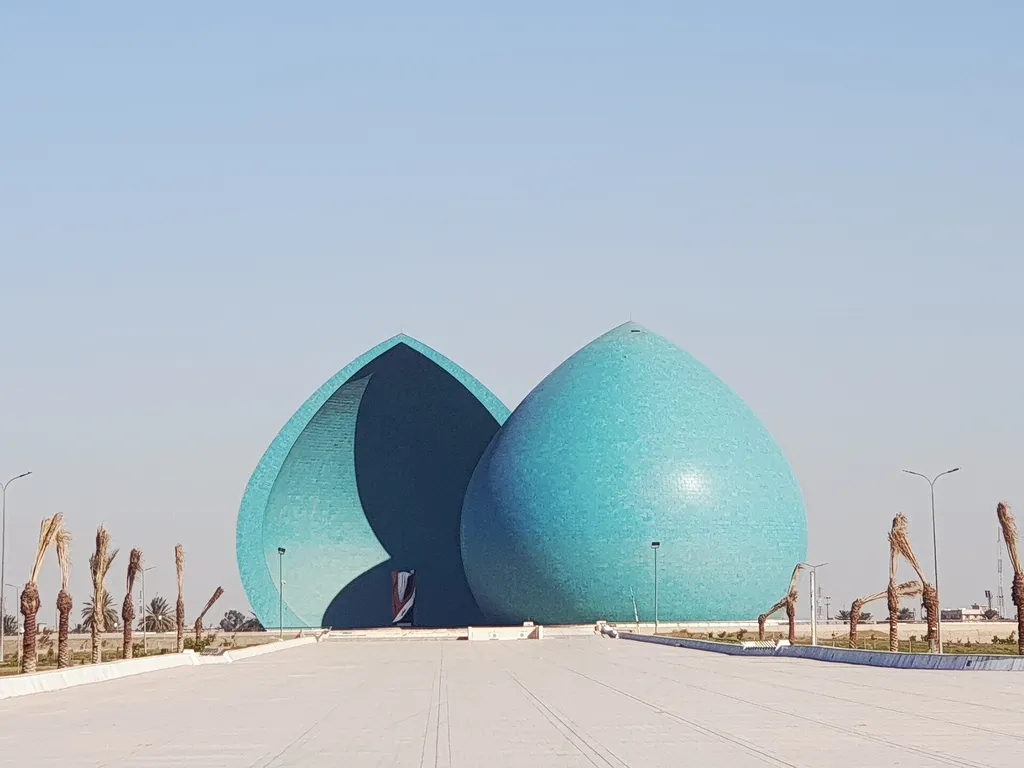
Al-Shaheed Monument — Baghdad's Eternal Tribute
Location & First Impressions
On the eastern bank of the Tigris River, roughly 4.5 kilometres north of Tahrir Square, the Al-Shaheed Monument emerges from the Baghdad skyline like a crown of turquoise set against the vast Iraqi sky. Situated near the Army Canal that separates Sadr City from the rest of the capital, the monument occupies a circular platform 190 metres in diameter at the centre of an artificial lake, its twin turquoise domes reflected in the still water below as if mirroring eternity itself. From the moment it comes into view, this landmark commands awe — a quality of silence mingled with grandeur that few memorials in the world can match.
The surrounding complex extends the experience far beyond the monument itself. Landscaped parks, pedestrian walkways, small bridges, and a playground encircle the lake, creating a peaceful urban oasis where locals and visitors alike can walk, reflect, and breathe. At dusk, when the fading sun saturates the glazed tiles in deep gold and copper tones, the monument becomes something close to otherworldly.
The Birth of a Vision — History & Creation
Commissioned in the early 1980s during the grinding years of the Iran-Iraq War, the Al-Shaheed Monument was designed by celebrated Iraqi sculptor Ismail Fatah al-Turk (1934–2004) in collaboration with architect Saman Kamal and the Baghdad Architecture Group. Construction spanned from 1981 to 1983, with the official inauguration taking place in 1983. The project was part of a broader government initiative to beautify Baghdad and erect public works that would instil national pride — but what Al-Turk created transcended the political moment entirely.
The sculptor himself described his creative journey: he began with the idea of a martyr bursting from the centre but found it too theatrical. Instead, the concept of life versus death began to take shape — two forms moving together toward martyrdom and fertility, toward the lifestream. The completed monument cost half a million dollars and, upon its unveiling, was rated by Art in America magazine as the most beautiful design in the Middle East. That reputation has only deepened with time.
The Architecture — A Study in Symbolism
The monument's most dramatic feature is its 40-metre tall split turquoise dome — two identical curved halves, offset from one another, clad entirely in glazed ceramic tiles chosen for their extraordinary durability in Baghdad's intense heat. The separation between the halves is deliberate and deeply symbolic: a soul ascending, a flower blooming, the moment of sacrifice frozen in architectural form. The visual illusion is equally remarkable: viewed from a distance, the monument appears as a single unified dome; step closer and the full drama of the split is revealed.
Between the two halves burns an eternal flame, honouring the fallen day and night without pause. Nearby, a spring of water flows quietly — symbolising the blood of those who gave their lives for their country. Below the Iraqi flag suspended at the monument's apex, an oculus opens downward, allowing natural light to cascade into the underground levels in a breathtaking play of architecture and illumination. A marble slab bearing Quranic verses rendered in ancient Kufic script anchors the monument to Iraq's rich Islamic heritage, while the surrounding wall is engraved with the names of thousands of Iraqi martyrs, turning every step around the perimeter into an act of remembrance.
Beneath the Surface — The Museum & Cultural Facilities
The Al-Shaheed Monument is far more than a striking silhouette against the Baghdad skyline. Spread across two levels beneath the circular platform lies a rich cultural complex: a museum, a library, a lecture hall, and an exhibition gallery. The museum documents the monument's creation and contextualises its significance, offering visitors a deeper understanding of the human cost that shaped this memorial. Artefacts, photographs, and narratives from the era of its construction fill the galleries, transforming a visual experience into a historical and emotional journey. This underground world makes Al-Shaheed one of the most layered memorial sites in the Arab world — a place where beauty and history are inseparable.
Baghdad's Trilogy of Monuments
To fully appreciate Al-Shaheed, it helps to understand its place in Baghdad's broader commemorative landscape. The monument forms one point in a powerful architectural trilogy alongside the Monument to the Unknown Soldier (1982) and the Victory Arch (1989). Together, the three structures form a visual and metaphorical unit — a conversation in stone, steel, and fire about sacrifice, endurance, and national identity in modern Iraq. Visiting all three in a single day offers a profound and moving portrait of a city that has borne extraordinary weight and endured.
Visitor Tips
The ideal time to visit is between October and April, when Baghdad's temperatures are mild enough to fully enjoy the outdoor spaces, gardens, and lakeside walkways. Dress modestly out of respect for local customs and the memorial's solemnity. Access to the site typically requires arranging transport from central Baghdad — a local driver or guided tour is the most reliable option. Photography is generally welcomed in the exterior areas, and the view at sunset, when the turquoise tiles glow amber and the eternal flame brightens against the darkening sky, is among the most memorable images any traveller can carry home from Iraq.
The Split Turquoise Dome
The monument's twin domes, rising 40 metres above an artificial lake and clad in brilliant turquoise ceramic tiles, are among the most recognisable silhouettes in the Arab world. Designed by sculptor Ismail Fatah al-Turk, the dramatic split form symbolises life and death in eternal dialogue, earning a rating from Art in America as the most beautiful design in the Middle East.
The Eternal Flame
At the heart of the opening between the two dome halves burns a flame that has never been extinguished since the monument's inauguration in 1983. Day and night, it honours Iraq's fallen heroes, accompanied by a flowing spring of water that symbolises the blood of those who gave their lives for their nation.
The Underground Museum
Beneath the circular platform lie two levels of cultural facilities: a museum, exhibition gallery, library, and lecture hall. The museum immerses visitors in the history of the monument's creation and the human stories behind it, making Al-Shaheed one of the most layered and emotionally resonant memorial sites in the entire region.
The Wall of Names & Kufic Inscriptions
A perimeter wall engraved with the names of thousands of Iraqi martyrs transforms the act of walking around the monument into a profound pilgrimage. At the base of the dome, a marble slab bearing Quranic verses in ancient Kufic script connects the memorial to the deep roots of Iraq's Islamic and Mesopotamian civilisation.
The Artificial Lake & Gardens
The monument rises from the centre of a man-made lake whose still surface mirrors the turquoise domes in breathtaking double vision. Surrounding gardens, walkways, and bridges extend the experience into a peaceful urban park, offering visitors both contemplative silence and the living warmth of everyday Baghdad.