

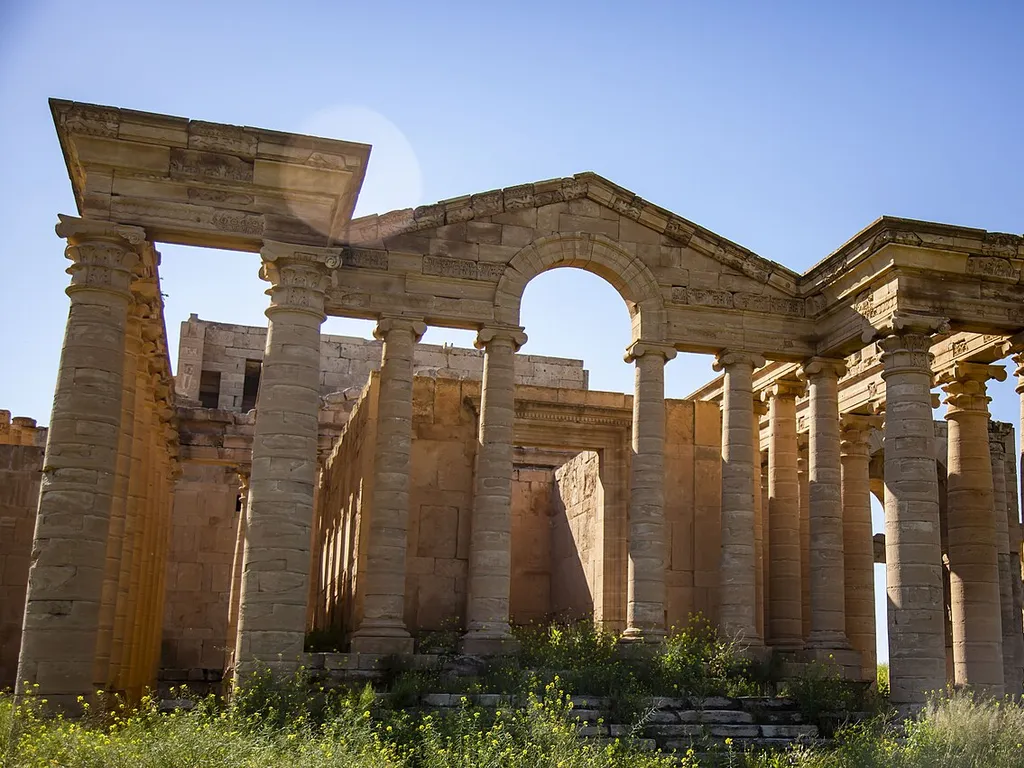
Hatra: Capital of the First Arab Kingdom
Where the Desert Meets Eternity
Rising from the semi-arid plains of northern Iraq, the ancient city of Hatra is one of the most extraordinary archaeological sites in the world. Located 290 kilometres northwest of Baghdad and 110 kilometres southwest of Mosul in the Nineveh Governorate, Hatra sits at the crossroads of ancient trade routes that once linked the Roman Empire in the west to the mighty Parthian Empire in the east. In the open desert, its towering circular walls and soaring temple arches emerge like a stone mirage — a ghost city that once commanded the attention of empires and gathered the gods of many nations beneath its skies.
Founded between the 3rd and 2nd centuries BC, Hatra grew from a modest Assyrian settlement into the proud capital of the Kingdom of Hatra, the first Arab kingdom in recorded history. At its height, the city covered nearly 300 hectares and was home to a thriving community of merchants, priests, soldiers, and scholars. In recognition of its extraordinary historical value, UNESCO inscribed Hatra on its World Heritage List in 1985.
A Kingdom Between Two Empires
Hatra's story is one of extraordinary resilience and political genius. Positioned strategically between the Roman and Parthian empires, it was no mere waypoint — it was a powerful semi-autonomous state renowned for its formidable defenses and cultural sophistication. Its name likely derives from the Aramaic or Arabic word for enclosure or hedge, and a fortress it certainly was: encircled by double walls nearly 6.4 kilometres in circumference and reinforced by more than 160 towers, Hatra was virtually impregnable.
This strength was tested — and spectacularly proven — against Rome's mightiest emperors. In AD 116, Emperor Trajan besieged Hatra and failed to take it. In AD 198, Emperor Septimius Severus tried again and was repelled a second time. These victories were not only military triumphs — they were a testament to the genius of Hatra's circular fortification design, a plan so effective that military historians still study it today. The city finally fell not to Rome, but to the Sassanid Empire around AD 241, ending over four centuries of proud independence.
Temples of the Gods: Where Many Faiths Converged
At the heart of Hatra lay its sacred precinct — a vast temenos covering approximately 1.2 hectares, home to some of the most breathtaking religious architecture of the ancient world. The city earned the name Beit ʾElāhāʾ, meaning House of God, not because it worshipped a single deity, but because it welcomed them all. Gods of Mesopotamian, Greek, Roman, Aramean, and Arabian origin were venerated side by side in Hatra's temples, making it one of antiquity's great centers of religious syncretism and spiritual tolerance.
The Great Iwans Complex is the crown jewel of the site — a monumental structure of two enormous vaulted halls, each flanked by two smaller chambers, with soaring domed arches that once rose 30 metres into the sky. The Hellenistic-inspired Temple of Maran, with its elegant columns and ceremonial staircase, and the Temple of Allat, dedicated to the Arabian goddess, complete a sacred landscape unlike anything else on earth. The seamless blend of Hellenistic, Roman, and Eastern architectural elements at Hatra is unparalleled — a visual language of civilizational fusion carved permanently in stone.
Art, Sculpture, and the Hatrene Legacy
Beyond its extraordinary architecture, Hatra yielded one of the richest troves of ancient sculpture in the Middle East. Hundreds of stone statues, statuettes, and reliefs have been excavated from the site — portraits of gods, rulers, soldiers, and priests rendered in a distinctive post-Hellenistic style unique to Hatra. Many of these works bear inscriptions in Hatran Aramaic, offering scholars an invaluable window into the city's language, beliefs, and social structure. Selected masterpieces are displayed in Hatra's on-site museum, while others grace the Iraqi National Museum in Baghdad and collections around the world.
This remarkable artistic heritage reflects a civilization that absorbed the best of every culture it encountered — synthesizing Greek elegance, Roman grandeur, and the spiritual depth of the ancient Near East into something wholly original: the Hatrene identity.
Hatra Today: A City Reawakening
After decades of conflict — including deliberate destruction by ISIS in 2015, when militants smashed statues and fired upon ancient reliefs — Hatra is once again opening its arms to visitors. Iraqi and international archaeologists have been working tirelessly to restore the damage, and since 2022 organized tours have resumed, bringing travelers back to these extraordinary ruins. Approximately 15% of the city suffered damage during the ISIS period, but the great walls, the iwans, and much of the temple complex remain standing, as awe-inspiring as ever.
The best time to visit is between October and April, when the desert climate is mild and golden light plays beautifully across the ancient stone. The site is roughly a two-hour drive from Mosul and is easily accessible as a day trip. Come to Hatra not merely to see ancient stones, but to stand at the place where East met West, where empires clashed and gods gathered — and where human civilization reached one of its most magnificent and enduring peaks.
Great Iwans Complex
The colossal vaulted halls of the Great Iwans Complex are Hatra's most iconic sight. Two enormous arched chambers, each flanked by smaller halls, soar skyward in magnificent Parthian architectural tradition. Dating to the early 2nd century AD, the complex represents the apex of ancient Iraqi monumental construction and has left visitors speechless for centuries.
The Circular Walls
Hatra's double ring of fortifications — nearly 6.4 kilometres in circumference and supported by over 160 towers — is one of antiquity's most effective defensive systems. These walls repelled Emperor Trajan in AD 116 and Emperor Septimius Severus in AD 198, making Hatra one of very few cities in history to defeat Rome twice and live to tell the tale.
Temple of Maran
The Temple of Maran, also known as the Hellenistic Temple, is a masterwork of cultural fusion. Its long cella, elegant columns, and ornamental staircase blend Greek design principles with the sensibilities of the ancient East. It stands as a symbol of Hatra's unique genius for absorbing and transforming the artistic traditions of multiple civilizations into something entirely its own.
House of Many Gods
Known in antiquity as Beit ʾElāhāʾ, the House of God, Hatra's sacred precinct honored deities from Mesopotamian, Greek, Roman, Arabian, and Aramean traditions side by side. This extraordinary religious openness made the city a pilgrimage destination for traders and believers from across the ancient world, and a symbol of civilizational tolerance rare in any era.
Hatrene Sculpture
Hundreds of stone statues and reliefs excavated at Hatra represent one of the richest collections of ancient sculpture in the Middle East. Rendered in a distinctive post-Hellenistic style unique to this city, many bearing Hatran Aramaic inscriptions, these works offer an unparalleled glimpse into the life, beliefs, and extraordinary artistic sophistication of the Hatrene civilization.