

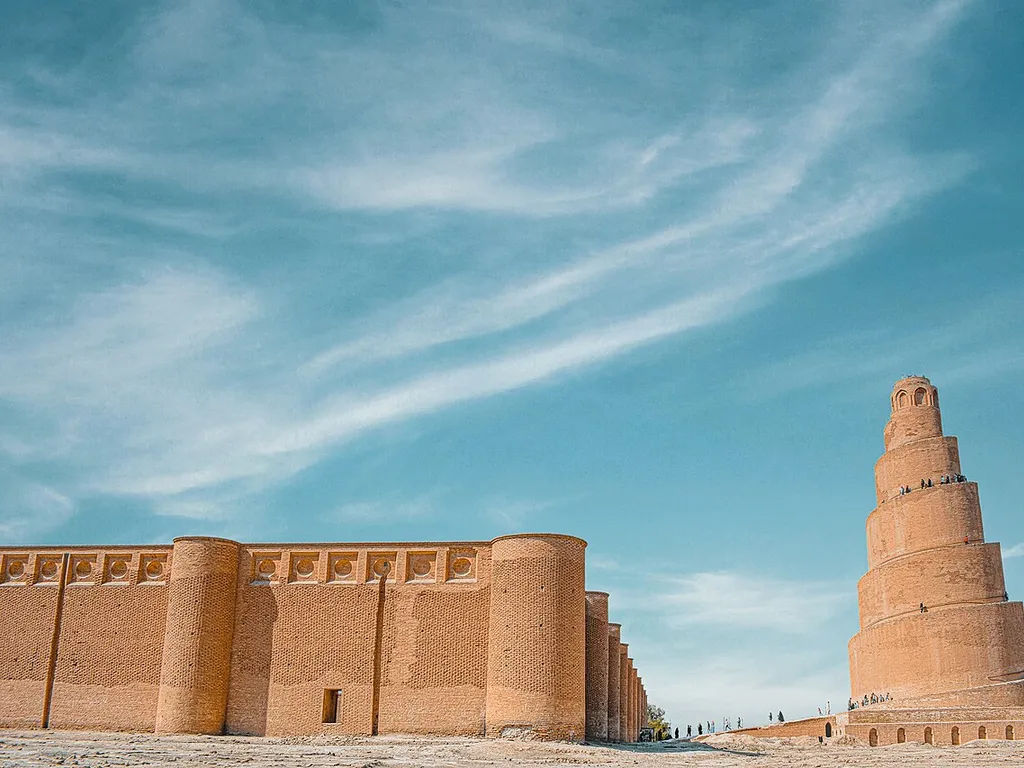
Al-Malwiya Mosque – The Great Mosque of Samarra
Location & Overview
On the western bank of the Tigris River, roughly 125 kilometres north of Baghdad, the Malwiya Minaret pierces the sky above the ancient city of Samarra with an unmistakable silhouette. This spiralling tower belongs to the monumental complex of the Great Mosque of Al-Mutawakkil — known as Al-Malwiya Mosque after its legendary minaret — set within the Saladin Governorate of Iraq. In the ninth century, Samarra served as the second capital of the Abbasid Caliphate, an empire that stretched from Tunisia in the west to Central Asia in the east.
The very name "Samarra" carries its meaning in Arabic: Surra man ra'a — "A joy for all those who see it." When your eyes first settle on the corkscrew silhouette of the Malwiya rising against the wide Iraqi sky, those words feel less like a historical footnote and more like a personal greeting from twelve centuries ago.
History of the Great Mosque
Commissioned in 848 CE by the Abbasid Caliph Al-Mutawakkil and completed in 851 CE, the Great Mosque of Samarra was at its inception the largest mosque in the world. It could accommodate over 80,000 worshippers across its seventeen aisles, its walls panelled with deep blue glass mosaics and its corners adorned with marble columns imported from distant quarries. Al-Mutawakkil, an avid patron of architecture who had relocated his court from Baghdad to Samarra, assembled the finest craftsmen and architects from across his empire to build a house of prayer worthy of Abbasid ambition.
The mosque held its record as the world's largest place of Islamic worship for over four centuries — until it was razed in 1258 CE by the Mongol army of Hulagu Khan, grandson of Genghis Khan, during his devastating sweep across the Islamic heartlands. Of the vast 38,000-square-metre complex, only the outer perimeter wall and the Malwiya Minaret survived. The minaret's singular beauty apparently spared it from destruction — a testament to the power of extraordinary design.
The Spiral Minaret – An Engineering Marvel
The Malwiya Minaret stands 52 metres tall, with a base measuring 33 metres across. A broad exterior ramp winds counter-clockwise around the structure in five ascending tiers, culminating in a round vestibule at the summit adorned with eight pointed-arch niches. Originally connected to the mosque by a dedicated bridge, the minaret was the stage from which the muezzin broadcast the call to prayer five times daily, his voice carrying across the rooftops of Samarra and into the surrounding plains — a sound that once anchored the rhythms of an entire capital city.
Architectural historians note striking echoes of the ancient Mesopotamian ziggurat in the minaret's stepped, ascending form — as if the builders consciously wove the region's pre-Islamic heritage into a new Islamic monument. The mosque at Samarra went on to inspire later Islamic architecture, most notably the Mosque of Ibn Tulun in Cairo, which mirrors its open courtyard and spiralling minaret concept. Legend holds that Caliph Al-Mutawakkil himself would ride a white donkey to the summit to enjoy the panoramic view — a detail that speaks both to the ramp's generous width and to the caliph's obvious pride in what he had built.
Cultural Significance & UNESCO Recognition
In 2007, UNESCO inscribed the Samarra Archaeological City as a World Heritage Site, recognising the outstanding universal value of the Malwiya and Abu Dulaf mosques and the broader Abbasid cityscape. Samarra holds a unique position in the history of urban civilisation: it is the only surviving Islamic capital that retains its original plan, architecture, and decorative arts — stucco carvings, mosaics, geometric friezes — largely intact. Remarkably, an estimated 80% of the archaeological site has yet to be excavated, meaning Samarra's full story is still buried beneath the soil, waiting.
The mosque complex also contributed to the development of early Islamic decorative vocabulary. The floral and geometric stucco carvings found within the ruins represent some of the earliest known examples of Islamic ornamental design, later spreading across the breadth of the Muslim world.
Visiting the Malwiya Today
Visitors today can climb the Malwiya Minaret via the exterior ramp all the way to the top, where sweeping views of Samarra and the Tigris valley stretch in every direction. A word of caution: the ramp has a rail only on its inner side, leaving the outer edge open — thrilling for the adventurous, but requiring careful footwork. The best seasons to visit are spring (March–May) and autumn (October–November), when temperatures are mild and the light over the plains is golden and soft.
Samarra lies approximately two hours north of Baghdad by road, making it a manageable day trip from the capital. The city also houses important Shia pilgrimage sites in its modern district, meaning a single visit can blend archaeological wonder with living religious tradition in a way few places in the world can offer.
A Monument That Endures
The Malwiya Minaret has survived Mongol invasion, centuries of neglect, and the violence of modern warfare — including a partial explosion in 2005 — yet it still stands, still spirals, still calls to those who approach across the Mesopotamian plain. To stand at its base and look upward is to feel the full weight and ambition of the Abbasid civilisation pressing down through the centuries. This is Iraq at its most ancient and most magnificent — a place where the sky feels closer and the past feels present. Come and see it for yourself.
The Iconic Spiral Minaret
Unlike any other minaret in the Islamic world, the Malwiya rises 52 metres in a sweeping counter-clockwise spiral across five broad tiers. Climbing it means retracing the exact steps of muezzins who called millions to prayer here for over twelve centuries — a physical connection to history that few monuments can offer.
Legacy of the Abbasid Caliphate
Built in 848 CE by Caliph Al-Mutawakkil, the Great Mosque was once the largest in the world, capable of holding 80,000 worshippers. Though the Mongols destroyed the mosque in 1258, the minaret survived to stand as the sole enduring witness to the golden age of one of history's mightiest empires.
UNESCO World Heritage Site
The Samarra Archaeological City was inscribed on the UNESCO World Heritage List in 2007, recognized as a site of outstanding universal value. Samarra remains the only surviving Islamic capital to have preserved its original ninth-century urban plan, architecture, and decorative arts essentially intact.
Echoes of Ancient Ziggurats
Many architectural historians see in the Malwiya's ascending, stepped spiral a conscious echo of the great Mesopotamian ziggurats built thousands of years earlier. The minaret thus bridges two of humanity's greatest civilisations — ancient Mesopotamia and medieval Islam — in a single breathtaking structure.
Panoramic Views from the Top
Reaching the summit of the Malwiya rewards climbers with sweeping panoramic views over Samarra and the broad Tigris valley stretching to the horizon. Standing where the muezzin once stood, with the Mesopotamian plain unfolding below, is one of the most affecting experiences available to any traveller in Iraq.