

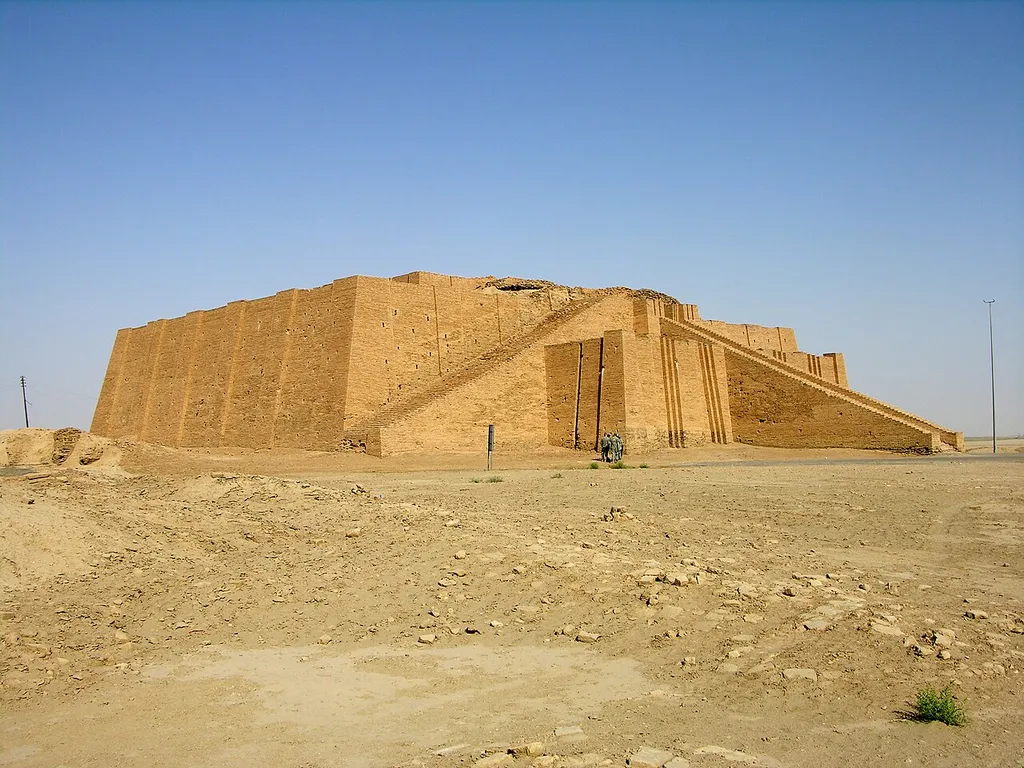
The Great Ziggurat of Ur
Location and Overview
Stand on the flat, sun-bleached plains of Dhi Qar Province in southern Iraq — about 40 kilometres west of Nasiriyah and 340 kilometres south of Baghdad — and you will see it before anything else: a massive, tiered mountain of burnt brick rising against the open sky, proud and defiant after four millennia. This is the Great Ziggurat of Ur, one of the most extraordinary architectural survivals on Earth. Its rectangular base stretches 64 metres in length and 45 metres in width, and the structure once soared over 30 metres high, making it the tallest point in the ancient city by far — a focal point visible for miles across the Mesopotamian plain.
The Ziggurat of Ur is widely regarded as the best-preserved ziggurat in all of Mesopotamia and among the most significant archaeological sites in the world. Its Sumerian name, Etemenniguru, translates as "house whose foundation creates terror" — a fitting name for a monument whose sheer presence still commands awe four thousand years after its construction.
Architecture and Ancient Engineering
The ziggurat was built around 2100 BCE by King Ur-Nammu, founder of the Third Dynasty of Ur, and dedicated to Nanna, the moon god and divine patron of the city. Construction was completed under his successor King Shulgi, whose 48-year reign transformed Ur into the capital of an empire stretching across most of Mesopotamia. Three monumental staircases — two flanking and one central — swept upward to the first terrace, where priests conducted rituals and scanned the heavens.
The structure's core is built from millions of sun-dried mud bricks, clad with baked bricks set in natural bitumen. The ancient architects engineered so-called "weeper holes" through the exterior to allow moisture to evaporate from the core, and carved drains into the terraces to channel away winter rains — feats of ingenuity that would be admirable in any era. The lower level alone required over 720,000 baked bricks, each weighing up to 15 kilograms. In the 6th century BCE, King Nabonidus, the last ruler of the Neo-Babylonian Empire, rebuilt the crumbling structure with seven tiers rather than three. Later, in the 1980s, the lower façade and grand staircase were partially reconstructed — the newer bricks clearly marked, allowing visitors to read the layers of history in the very walls.
A Sacred Crossroads of Three Faiths
The ziggurat was never simply a place of worship in the modern sense. It was the administrative and spiritual heart of an entire civilization — the place where farmers brought their harvest, priests performed celestial observations, and the city's wealth was stored and redistributed. To climb toward Nanna's temple at the summit was to seek both divine favour and earthly sustenance.
But Ur's sacred significance reaches far beyond Sumerian religion. Near the ziggurat lies the House of Abraham — the traditional birthplace of the Prophet Ibrahim (Abraham), father of the three great monotheistic faiths. This makes Ur one of the most profoundly interfaith sites on the planet, drawing Muslim, Christian, and Jewish pilgrims alike. In March 2021, Pope Francis made a historic visit to Ur — his first trip outside the Vatican since the COVID-19 pandemic, and the first ever papal visit to Iraq — hosting an interfaith prayer gathering at this very site that drew global attention and underscored Ur's unique place in the spiritual heritage of humanity.
The Royal Cemetery and City Treasures
Surrounding the ziggurat lie the vast ruins of ancient Ur itself, once one of the world's largest and most prosperous cities. In the 1920s and 1930s, British archaeologist Sir Leonard Woolley led a groundbreaking excavation that unearthed the Royal Cemetery of Ur — a staggering collection of royal tombs containing a golden lyre adorned with a lapis lazuli bull, exquisite gold jewellery, mosaic panels, and finely crafted vessels. These treasures now grace the Iraq Museum in Baghdad, the Penn Museum in Philadelphia, and the British Museum in London.
The ruins also include the Edublamah Temple, which contains one of the world's oldest surviving arches and a hidden cuneiform tablet embedded in the walls — a treasure hunt for curious visitors. Remarkably, archaeologists estimate that at least 80% of the ancient city remains unexcavated beneath the sand, meaning the greatest discoveries of Ur may still lie waiting in silence.
Visiting Ur Today
The Great Ziggurat of Ur is open to visitors every day of the week, from 6 AM to 6 PM. You can walk right up to its ancient walls and run your hand along bricks laid by Sumerian workers four thousand years ago — an almost impossibly intimate encounter with deep history. The adjacent Tourist City of Ur provides modern facilities, cultural centres, a Sumerian Theatre, and dining options, making the visit comfortable and immersive.
The best seasons to visit are spring (March–May) and early autumn (October–November), when temperatures are mild and the desert light turns the brick façade a warm amber gold. Summer heat can be intense, so lightweight clothing, sun protection, and plenty of water are essential. Entry fees apply, and a knowledgeable local guide — some of whom have spent a lifetime beside this site — can unlock layers of detail no guidebook can replicate.
Whether you come as a history lover, an architecture enthusiast, a spiritual pilgrim, or simply a curious traveller, standing before the Great Ziggurat of Ur at sunset — when the shadows lengthen across those ancient steps and the sky burns orange over the Mesopotamian plain — is one of those rare moments that reminds you just how deep the roots of human civilization truly run.
Temple of the Moon God
Built around 2100 BCE and dedicated to Nanna, the Sumerian moon god, the ziggurat was the spiritual epicentre of the ancient city of Ur. At its summit stood a temple where priests performed celestial rituals — a stairway connecting earth to the divine that has endured four thousand years of history.
Ur-Nammu's Masterpiece
King Ur-Nammu engineered a structure of staggering ambition, incorporating moisture-evaporation holes and rain drainage systems that speak to an advanced architectural intelligence. The lower level alone required over 720,000 baked bricks, each set with natural bitumen in a technique that still impresses engineers today.
Abraham's Homeland
Ur is traditionally identified as the birthplace of the Prophet Abraham, making it sacred to Islam, Christianity, and Judaism alike. In 2021, Pope Francis visited Ur for a landmark interfaith prayer gathering — the first papal visit to Iraq in history — drawing the eyes of the world to this ancient cradle of faith.
Royal Cemetery of Ur
Sir Leonard Woolley's excavations in the 1920s revealed a royal cemetery of extraordinary wealth, including a golden lyre, dazzling gold jewellery, and exquisite mosaic panels. These treasures proved the astonishing sophistication of Sumerian civilization, and over 80% of the city still lies unexcavated beneath the desert.
4,000 Years of Endurance
The Great Ziggurat has outlasted empires, invasions, and centuries of desert winds to remain Mesopotamia's finest surviving ziggurat. Its layered walls — original Sumerian bricks below, Neo-Babylonian restorations above — are a physical timeline of three thousand years of continuous reverence and renewal.