

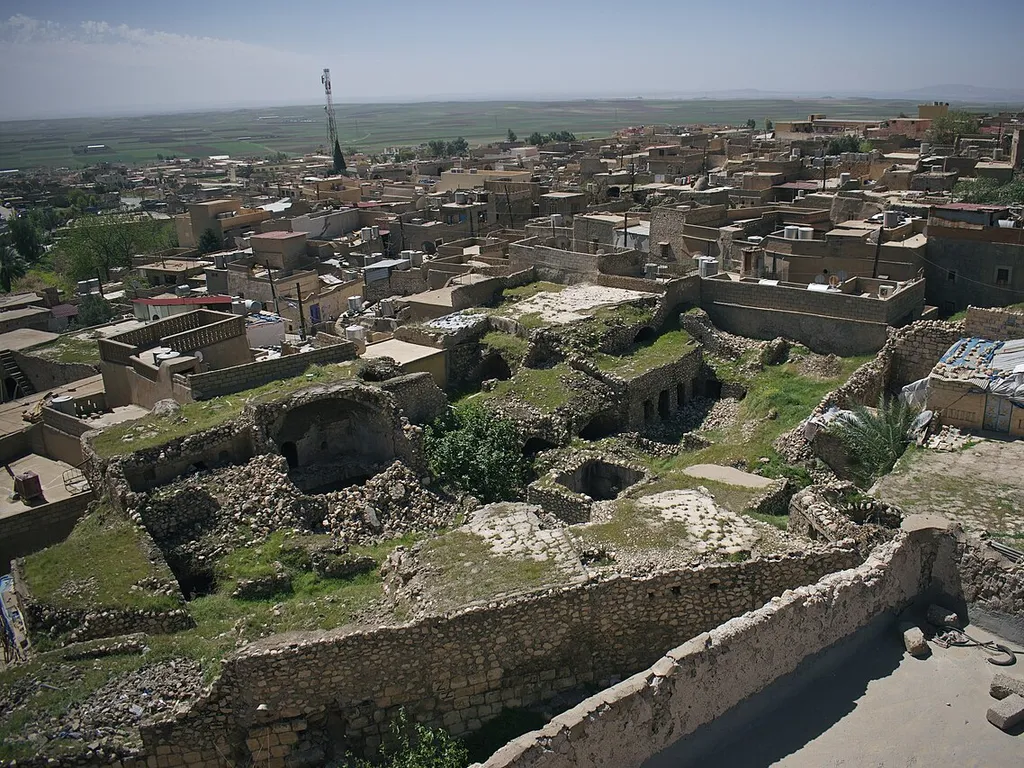
Alqosh: The Eternal Assyrian Gem of the Nineveh Plains
Location & Overview
Alqosh rises proudly from the base of its own mountain in the Tel Kaif district, 45 kilometers north of Mosul in the heart of Iraq's Nineveh Plains. Its name in Syriac combines two ancient roots — Eil and Qosht — meaning "the strong god," as if the town itself was founded on an unshakeable belief in permanence. The community is predominantly Assyrian and belongs largely to the Chaldean Catholic Church, making Alqosh one of the rare places on earth where Neo-Aramaic — the language of ancient Mesopotamia and a close relative of the language spoken by Christ — is still heard as a living mother tongue in everyday life.
The town's origins stretch back before the 8th century BC, with the earliest references linked to the Assyrian empire's era of Sennacherib. During the Iron Age, the Alqosh plain was home to the small regional kingdom of Qumāne before being absorbed into the Assyrian heartland. Today, the town is a quiet marvel of religious coexistence, where Christians, Yazidis, and Muslims have long shared streets, markets, and stories, making Alqosh a living symbol of Iraq's pluralistic soul.
Ancient Roots: A Town Born from History
Walking through Alqosh is like reading a civilization's autobiography. Over its long history, the town has weathered Timur's devastating raid in 1401, the grief of the 1933 Simele Massacre that drove Assyrian refugees to its gates, and the terror of ISIS's advance into the Nineveh Plains in 2014. Yet through each ordeal, Alqosh endured. When ISIS swept the region, the town held firm — protected by its people and Kurdish Peshmerga forces — and its ancient sites were spared, a remarkable fact that underscores both the community's resilience and its deep attachment to their heritage.
Its golden stone alleyways, restored to their original splendor from 2018 onward, reveal layers of architectural memory: ornate wooden window frames, arched doorways, and church towers that have kept watch over the plains for centuries. Strolling through the old quarters feels less like tourism and more like communion with those who came before.
Rabban Hormizd Monastery: A Sanctuary Carved into the Mountain
Two kilometers from town, the Rabban Hormizd Monastery grips a rocky cliff face as naturally as an eagle grips its perch. Founded around 640 AD by the monk Rabban Hormizd and carved directly into the mountainside, it was for centuries the seat of the Patriarchs of the Church of the East and a renowned center of learning and manuscript copying. In the 19th century, it joined the Catholic Church following union with Rome, and today it belongs to the Chaldean Catholic Church.
Reaching the monastery requires climbing over 100 stone steps — a small pilgrimage rewarded at every turn by sweeping panoramas across the Nineveh Plains. Inside, the original cave church preserves carvings cut by human hands fourteen centuries ago, and the dimly lit stone chambers hold an atmosphere of sacred antiquity that no photograph can fully capture. Travelers who have visited describe the experience as profoundly moving — a space where time seems to step aside. If you visit only one site in Alqosh, let it be this mountain sanctuary at dawn.
The Tomb of Prophet Nahum: Where Faiths Converge
Deep within the old town, the Tomb of Prophet Nahum is one of Iraq's most quietly extraordinary sacred sites. Nahum, the Hebrew prophet whose biblical book opens with a vision of Nineveh's fall, is traditionally linked to Alqosh — his very book begins with the phrase "Nahum of Elkosh." For centuries, Iraqi Jews made the pilgrimage to this shrine during Shavuot, and the saying "He who has not made the pilgrimage to Nahum's tomb has not known real pleasure" passed through generations.
When Iraq's Jewish community emigrated after 1948, the last Jewish custodian entrusted the shrine to a local Chaldean Catholic priest — a gesture of profound interfaith trust. When a 2017 survey found the structure at risk of collapse, restoration work began immediately. Today, the restored tomb stands as a testament to shared human memory, welcoming visitors of all faiths, its walls holding centuries of prayers whispered in Hebrew, Aramaic, and Arabic alike.
The Old Village & Alqosh Folklore Museum
In 2018, a remarkable community-led initiative brought together Alqosh's diaspora — scattered across Detroit, Sydney, and San Diego — alongside local churches and prominent figures, raising $120,000 USD to restore the old village quarter to its historical architectural character. The result is a living open-air museum: golden limestone facades, traditional window lattices, and cobblestone paths that transport visitors into the rhythms of Alqosh's past.
The Alqosh Folklore Museum adds a curated layer to this heritage journey, displaying traditional Assyrian costumes, handcrafted tools, historical photographs, and ancient manuscripts. Since 2024, the museum has attracted over 500 international visitors annually and serves as an essential first stop for anyone wishing to understand the depth of this community's identity and continuity across millennia.
Visitor Tips & Getting There
The ideal time to visit Alqosh is spring, from March through May, when wildflowers blanket the mountain slopes and mild temperatures make outdoor exploration a pleasure. The town is approximately one hour from Erbil International Airport and 90 minutes from Duhok, making it a natural stop on a broader northern Iraq itinerary that might also include the Yazidi pilgrimage site of Lalish. Dress modestly when visiting the monastery and church, and plan your monastery climb for morning hours to enjoy cooler conditions and softer light. The nearby Bandawya Resort offers a scenic overnight option surrounded by nature. Alqosh is more than a destination — it is an encounter with one of humanity's oldest living communities, a place that has refused, generation after generation, to let history be extinguished.
Rabban Hormizd Monastery
Climb over 100 ancient stone steps to reach this breathtaking monastery carved into a clifftop around 640 AD. Explore the original cave church with its 14-century-old stone carvings, and soak in panoramic views across the entire Nineveh Plains that stretch endlessly below.
Tomb of Prophet Nahum
A rare and moving site where Jewish, Christian, and Muslim heritage intersects in the heart of Alqosh's old town. For centuries a pilgrimage destination for Iraqi Jews, the restored tomb now welcomes visitors of all faiths — a quiet monument to shared memory and interfaith coexistence across millennia.
The Old Village
Wander through beautifully restored stone alleys that showcase Assyrian architecture in its most authentic form. A community-funded project by Alqosh's global diaspora transformed these historic streets into a living open-air museum, where every golden limestone façade tells a story of belonging and cultural pride.
Alqosh Folklore Museum
A cultural treasure house displaying traditional Assyrian costumes, handcrafted tools, ancient manuscripts, and rare archival photographs. Attracting international visitors from across Europe and beyond, the museum offers an unmatched window into the life, traditions, and enduring spirit of this ancient Assyrian community.
The Mountain & Its Caves
Alqosh's guardian mountain cradles an array of caves with evocative names — the Red Cave, the Cave of Water, the Cave of Satan, the Thundering Cave — each one a chapter in the area's geological and mythological story. Hiking the mountain trails rewards visitors with untouched nature, crisp mountain air, and unparalleled views.