

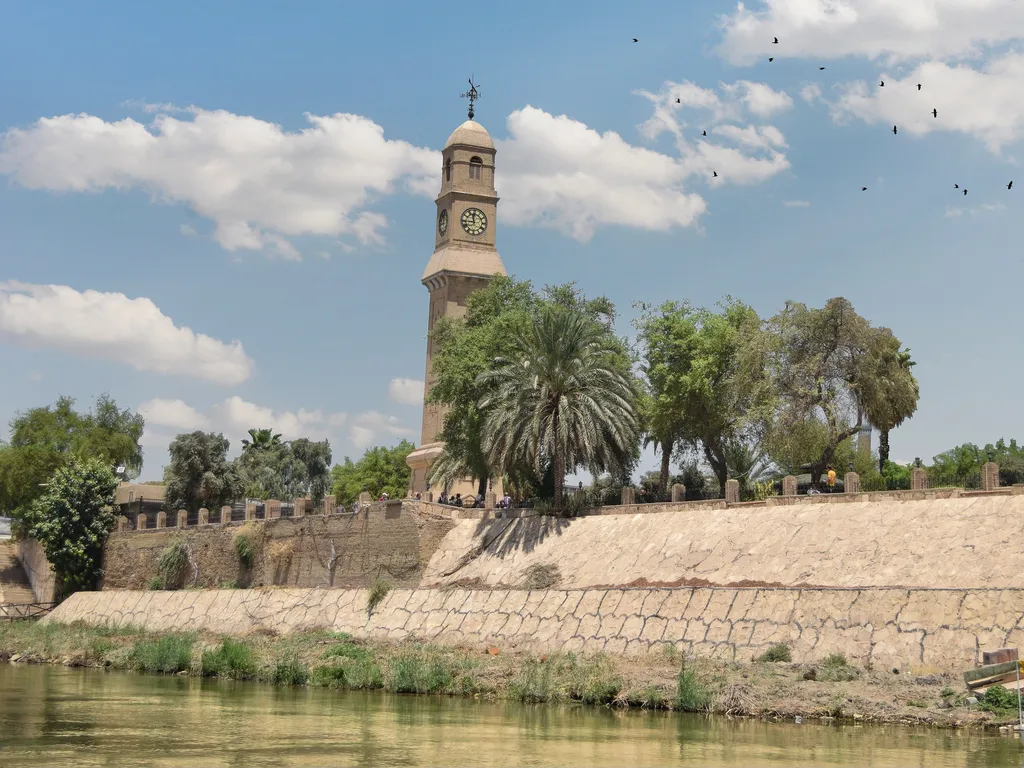
Qushla Clock Tower — Baghdad's Timeless Icon
Location & Overview
On the eastern bank of the Tigris River, in Baghdad's historic al-Rusafa district, the Qushla Clock Tower stands as one of Iraq's most recognizable and beloved landmarks. It anchors the larger Qushla complex — an Ottoman-era compound whose name derives from the Turkish qishlaq, meaning soldiers' quarters. This entire site has been placed on the tentative list of UNESCO World Heritage Sites, a testament to its extraordinary layered significance across three centuries of Iraqi history.
The tower's setting is magnificent: it overlooks the broad sweep of the Tigris, within walking distance of the legendary al-Mutanabi Street book market, in a district that has housed centers of power since the days of the Abbasid Caliphate. To stand before it is to feel the full weight and wonder of Baghdad's story.
Ottoman Origins
The Qushla complex was initiated in 1861 by Ottoman governor Mehmed Namık Pasha, who chose this strategic riverfront site as a military garrison and administrative headquarters. Construction was continued by Taqi al-Din Pasha and finally completed under the reformist governor Midhat Pasha around 1871. At its height, the barracks housed thousands of Ottoman soldiers — and the clock tower was purpose-built to serve them, its powerful bells intended to carry across all of Baghdad, rousing troops for morning drills and regulating the rhythms of military life.
The tower itself is a marvel of civic engineering for its era. Rising over thirty meters, it tapers gracefully as it climbs skyward. Inside, seventy-three steps wind upward past ventilation windows on all sides. At twenty-three meters, a square clock room houses the mechanisms driving four clock faces — each one maintained by hand, by a specialist, every three days. Above the clock room, the great bell chamber crowns the structure, its deep resonant chime still echoing across the rooftops of the Iraqi capital.
A Royal Gift and a Nation's Memory
The story of the clock tower deepened dramatically in 1927, when King Faisal I returned from a state visit to the United Kingdom bearing a remarkable gift: a precision clock crafted by a distinguished British manufacturer, presented by King George V himself. The clock's northern and western faces display Arabic numerals; its eastern and southern faces bear Latin ones — a four-sided symbol of a civilization at the crossroads of East and West. This royal timepiece still ticks inside the tower today, a quiet ambassador between eras.
The Qushla has witnessed pivotal moments in modern Iraqi history beyond the gift of the clock. On March 11, 1917, British forces entered Baghdad and raised the Union Jack above this very tower. And in 1921, in the courtyard of the Qushla itself, King Faisal I was crowned the first king of modern Iraq — an event orchestrated in part by the legendary Gertrude Bell. In stone and bell-toll, this tower remembers everything.
Resilience, Restoration, and Cultural Rebirth
The twentieth century was not always kind to the Qushla. Years of neglect and the tremors of conflict left the complex deteriorating and the clock silent. After a bombing near the adjacent Shabandar Coffeehouse in 2007, Iraqi intellectuals and historians raised urgent calls for the tower's preservation, recognizing it as irreplaceable to the soul of Baghdad. Restoration work began in earnest in 2012, and by 2013 the clock was ticking again — and the Qushla complex had been reborn as something new: a vibrant cultural gathering place in the heart of the city.
Today the Qushla square draws poets, musicians, artists, students, and families. Poetry readings fill the air on weekends; exhibitions animate its courtyards; political debates and calls for social change echo in the same space where Ottoman governors once held council. For young Baghdadis especially, the Qushla has become an oasis — a rare, relatively open public space where ideas can breathe freely.
Visitor Information
The Qushla complex is located in central Baghdad's al-Rusafa district, easily reachable by taxi or private car. It is typically open daily from 9:00 AM to 6:00 PM, and entry is generally free of charge, though some special events may carry a nominal fee. Guided tours can be arranged through the visitor center or local operators. The best times to visit are early morning or late afternoon, when the low sun catches the tower's brickwork and the Tigris shimmers gold. Combine your visit with a stroll along nearby al-Mutanabi Street — particularly on Fridays, when the famous open-air book market transforms the boulevard into a celebration of Iraqi culture and intellect.
Why the Qushla Clock Tower?
There are places in the world that do not merely mark history — they are history, still breathing, still chiming. The Qushla Clock Tower is one of them. From Ottoman garrison to royal gift to symbol of independence to cultural sanctuary, its story is Iraq's story told in stone, iron, and sound. Come to Baghdad, climb its seventy-three steps, listen to its bells roll across the Tigris, and feel the extraordinary continuity of a civilization that has endured for millennia and shows no sign of falling silent.
Ottoman Masterpiece
Founded by Ottoman governor Mehmed Namık Pasha in 1861 and completed by Midhat Pasha, the Qushla Clock Tower is one of Baghdad's finest examples of late Ottoman civic architecture. Its layered construction history mirrors the complex political transitions that shaped modern Iraq.
A King's Gift
In 1927, King George V gifted a magnificent precision clock to Iraq's King Faisal I, which was installed in the tower and remains there to this day. Its four faces display Arabic and Latin numerals — a beautiful symbol of two civilizations meeting on the banks of the Tigris.
Thirty Meters of History
The tower soars over thirty meters above the Tigris, tapering as it rises through seventy-three interior steps to a clock room and bell chamber. Its silhouette is one of Baghdad's most photographed and beloved, visible from the riverbanks and the surrounding historic streets.
Birthplace of Modern Iraq
The courtyard of the Qushla was the stage for King Faisal I's 1921 coronation — the founding moment of the modern Iraqi state. The tower also witnessed British forces raising their flag in 1917, making it an eyewitness to Iraq's most defining historical transitions.
A Living Cultural Hub
Restored and reopened in 2013, the Qushla complex now pulses with poetry readings, art exhibitions, and civic gatherings. Located steps from the famous al-Mutanabi Street book market, it is the perfect gateway to experiencing Baghdad's enduring intellectual and artistic spirit.