

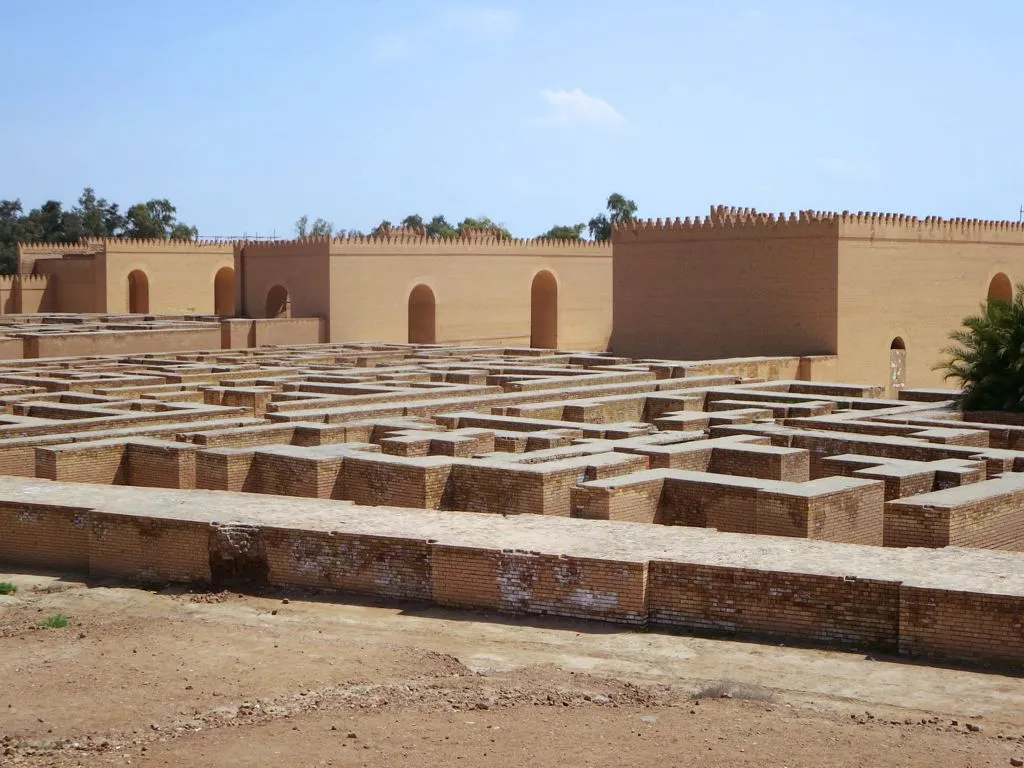
Palace of Nebuchadnezzar in Babylon
Location & Overview
Situated on the western bank of the Euphrates River, roughly 85 kilometres south of Baghdad in the Babel Governorate, ancient Babylon stretches across nearly 850 hectares of fertile Mesopotamian plain. At its very heart stands the Southern Palace of Nebuchadnezzar II — also known by its evocative epithet Bab-Ilim, "Gate of God" — built between 605 and 562 BCE. This colossus of antiquity was one of the largest royal complexes the ancient world had ever seen, and it remains one of Iraq's most profound archaeological treasures. The wider site of Babylon was inscribed as a UNESCO World Heritage Site in 2019, drawing international recognition to what archaeologists estimate is a monument only 15 percent excavated — meaning the greatest chapters of its story are still buried beneath the earth.
For travellers with a passion for history, culture, and the deep roots of human civilization, the Palace of Nebuchadnezzar is nothing short of unmissable. To stand here is to stand at the cradle of the world.
Nebuchadnezzar II — The Builder King
History remembers Nebuchadnezzar II as a formidable military commander who besieged Jerusalem, conquered the Levant, and extended the Neo-Babylonian Empire across the ancient Near East. But those who study him closely know that he was prouder of his buildings than his battles. His royal inscriptions overflow with descriptions of temples, walls, processional avenues, and palaces — a king who measured his legacy in stone, brick, and glazed ceramic.
Nebuchadnezzar himself described his palace in breathtaking terms: "Silver and gold and precious stones, all that can be imagined of costliness and splendor, immense abundance of royal treasure — I stored it within." The Southern Palace covered an extraordinary 43,840 square metres, featuring 250 rooms, five vast courtyards, and a soaring 30-metre entrance arch. The throne room alone — 52 metres long and 17 metres wide, with walls six metres thick — was large enough to swallow entire buildings. Its walls were sheathed in luminous glazed ceramic tiles in deep blues and greens, forming a permanent tapestry of mythological imagery that greeted dignitaries from across the known world.
Architecture & Artistic Wonder
The Southern Palace was not merely a residence — it was a statement of cosmic power. Its main façade overlooked Babylon's great Processional Way, the ceremonial boulevard that swept northward to the legendary Ishtar Gate. Enormous monumental gateways linked each of the five courtyards in sequence, guiding visitors deeper into the palace's labyrinthine heart. The third courtyard, used for state ceremonies, glittered with wall-to-wall glazed ceramics; entering it must have felt like stepping inside a living jewel.
The palace's interior corridors were deliberately designed as a military maze — intruders would meet dead ends while archers ran along the tops of the walls above them. Sections of original lower walls survive to this day, embedded with clay tiles bearing cuneiform inscriptions: some of the earliest writing in human history, sealed in ancient bitumen that has turned the mortar a deep, blackened hue. To touch these walls is to reach across 2,600 years.
The Lion of Babylon & Surrounding Wonders
Adjacent to the palace complex stands one of Iraq's most iconic ancient sculptures: the Lion of Babylon. This seven-tonne black basalt carving, commissioned during the reign of Nebuchadnezzar II, depicts a powerful lion looming over a human figure — a timeless symbol of royal authority and national pride. Excavated in 1876 and restored in 2013, it has become one of the most photographed monuments in the country and a symbol of Iraq's ancient greatness. Nearby, a reconstructed section of the Ishtar Gate — the original of which resides in Berlin's Pergamon Museum — displays the city's breathtaking tradition of animal-relief glazed brickwork in brilliant lapis lazuli blue.
The Temple of Marduk (Esagila) and the great ziggurat Etemenanki — the probable inspiration for the biblical Tower of Babel — also lie within the Babylon archaeological zone, turning a visit to the palace into a full-day journey through the most consequential city of the ancient world.
Layers of History
The site carries layers of history that deepen its narrative. In the 1980s, the Southern Palace was reconstructed atop its original foundations, creating a visually striking — if archaeologically contested — impression of how Nebuchadnezzar's palace may have appeared. Though archaeologists of the era raised concerns about the methods, the reconstruction today allows visitors to walk through towering walls and imagine the palace in its ancient glory. After Babylon's inscription as a UNESCO World Heritage Site in 2019, international and Iraqi conservation teams have been working to protect, document, and carefully restore the site for future generations.
The Babylon Archaeological Museum, located within the site, houses remarkable artefacts discovered during decades of excavation and offers further context for the scale and sophistication of Neo-Babylonian civilization.
Visitor Information & Tips
The site is located near the city of Hillah in Babel Governorate, approximately a two-hour drive south of Baghdad along the main highway. The best times to visit are spring (March–May) and autumn (September–November), when temperatures are pleasant for outdoor exploration. Organised day tours from Baghdad are widely available and are the most convenient option for first-time visitors. Wear light, comfortable clothing and bring a hat and sun protection. Allow at least three to four hours to explore the palace, the Lion of Babylon, the reconstructed Ishtar Gate, and the museum. Guided tours in Arabic and English are available on-site and add immeasurable depth to the experience.
The Palace of Nebuchadnezzar is not simply a ruin — it is an invitation to travel through time to a civilisation that lit the world. Don't let it remain a name in a history book. Come and walk where kings once walked.
The Grand Southern Palace
Nebuchadnezzar II's Southern Palace covered over 43,840 square metres, with 250 rooms, five great courtyards, and a 30-metre entrance arch. The throne room alone stretched 52 metres in length — a space designed to humble the most powerful rulers of the ancient world the moment they entered.
The Lion of Babylon
A seven-tonne black basalt sculpture commissioned by Nebuchadnezzar II and restored in 2013, the Lion of Babylon is one of Iraq's most enduring national symbols. Standing guard near the palace complex, it has watched empires rise and fall for over two and a half millennia.
The Sacred Processional Way
The great ceremonial boulevard that ran from the palace to the Ishtar Gate was paved with stone and flanked by sculpted lions and bulls. Walking it today — even in its partially reconstructed form — is to follow in the footsteps of Babylonian kings on their most sacred processions.
Original Cuneiform Inscriptions
Sections of the original lower palace walls still bear clay tiles inscribed with cuneiform — among the earliest writing ever created by humanity. Sealed in ancient bitumen, these inscriptions connect modern visitors directly to the intellectual life of one of history's greatest civilisations.
UNESCO World Heritage Site
Babylon was inscribed on the UNESCO World Heritage List in 2019, unlocking international support for its conservation. With 85 percent of the site still unexcavated, the Palace of Nebuchadnezzar stands at the frontier of one of archaeology's greatest ongoing discoveries.