

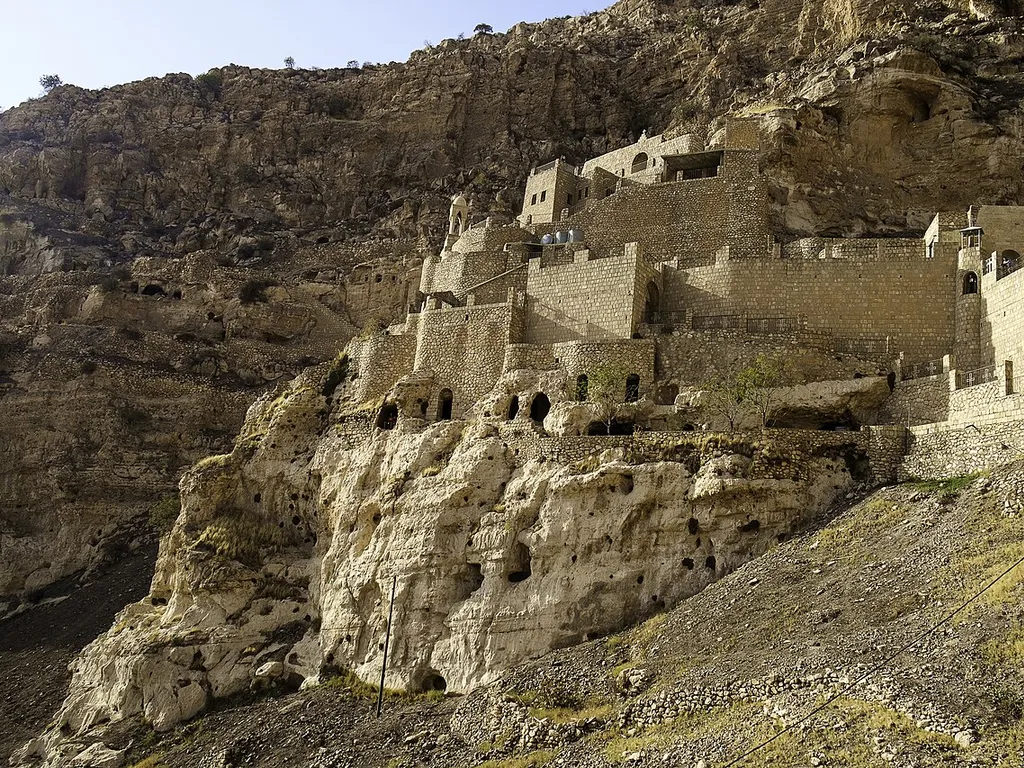
Rabban Hormizd Monastery — The Mountain-Carved Crown of Iraqi Christianity
Location & Overview
Perched on the slopes of Beth Athra Mountain in northern Nineveh Province, the Rabban Hormizd Monastery rises over 815 meters above sea level, just 2 kilometers northeast of the historic Assyrian town of Alqosh and approximately 45 kilometers northeast of Mosul. From this commanding vantage point, the arid sweep of the Nineveh Plain unfolds below, the Tigris River shimmers 10 kilometers to the east, and the rugged mountain ranges that trace the ancient borders of Assyria — and today's frontiers with Turkey and Iran — rise to the north. The monastery feels not merely built upon the mountain, but born of it.
The site's geography was no accident. The mountain offered contemplation and protection in equal measure, a natural amphitheater shielding a community of monks from the turbulent forces of history. Visitors approaching today are struck by how the complex seems to emerge organically from the rock face, as though the cliff itself decided to become a house of prayer.
The Founder: Rabban Hormizd the Persian
The monastery's story begins with one extraordinary man. Rabban Hormizd — "rabban" being the Syriac word for monk or teacher — was born in the late 6th or early 7th century in the Persian province of Beth Lapat (modern-day Khuzestan, Iran) to a wealthy Christian family. At eighteen, he set out on an ambitious spiritual journey toward Egypt, but fate intervened near Mosul, where he encountered three monks of the Church of the East who persuaded him to join the monastery of Rabban Bar Idta instead. He spent nearly forty years there in prayer and asceticism before finally making his way to the mountains above Alqosh.
The Christian inhabitants of Alqosh welcomed the aging monk and asked him to establish a monastery in their hills. Hormizd agreed, and what he founded in the rock face of that mountain would endure for over fourteen centuries. His tomb rests beneath the eastern altar of the monastery's oldest church, where it continues to draw pilgrims and visitors seeking the blessing of this venerated saint.
Fourteen Centuries of Faith and Resilience
Few sacred sites in the world carry as layered a history as Rabban Hormizd. By the end of the 15th century, the monastery had become the patriarchal seat of the Catholicos-Patriarchs of the Assyrian Church of the East, and nine patriarchal tombs — spanning from 1497 to 1804 — still line the corridor leading to the founder's cell. In 1553, a monk from this very monastery, Yohannan Sulaqa, traveled to Rome and was consecrated by Pope Julius III as the first Patriarch of the Chaldean Catholic Church, an event that forever altered the trajectory of Eastern Christianity.
The monastery's history is also one of extraordinary suffering. The Mongols ravaged the region in the 13th century. Nader Shah's army attacked it during the 1743 Ottoman-Persian War. Kurdish raids in the 19th century saw monks tortured and killed, manuscripts burned, and icons defaced. In 1808, the tenacious Chaldean monk Gabriel Dambo revived the long-abandoned monastery, rebuilt it, and established a seminary — only to be murdered by soldiers in 1832. Through earthquake, siege, and plague, Rabban Hormizd endured, rebuilt, and endured again.
Architecture & Sacred Spaces
What makes Rabban Hormizd uniquely mesmerizing is its organic architecture. Unlike conventionally constructed buildings, the monastery rests directly on the bedrock with no traditional foundations — parts are built from roughly hewn sandstone blocks, while other sections are simply cut into the living mountain itself. This seamless blend of construction and geology creates a visual drama that photographs cannot fully capture.
At the heart of the complex stands the Church of Mar Hormizd, believed to date back to the founder's own lifetime in the 7th century — making it among the oldest standing Christian structures in Iraq. Two black marble slabs with Syriac inscriptions near the chapel entrance chronicle the church's turbulent rebuildings, including after a devastating 1666 earthquake. Flanking the main buildings, rows of open rock caves carved into the hillside served as cells for generations of ascetic hermits. Stepping into one of these stark chambers — open to the mountain wind, stripped of all comfort — is to feel the bone-deep chill of a devotional life lived entirely on the edge of human endurance.
What to See & Experience
A paved road now makes the monastery accessible by car, followed by a series of stone steps that ascend to the complex — a short but rewarding climb. Once inside, visitors can explore the Church of Mar Hormizd, the cell of Rabban Hormizd himself, the patriarchal corridor with its ancient tomb inscriptions, and the hermit caves that still pock the surrounding cliffs. The panoramic view from the monastery terrace alone — sweeping across the Nineveh Plain to the shimmering Tigris — justifies the journey entirely.
Active religious services are still held here today, and in keeping with a tradition established by the monastery's founder himself, visitors of all faiths and backgrounds are warmly welcomed. Whether you come as a pilgrim, a history enthusiast, or simply someone searching for stillness in an extraordinary place, Rabban Hormizd offers an experience that long outlasts the visit.
Visitor Tips
Spring (March–May) and autumn (September–November) are ideal for visiting, when temperatures are mild and the mountain slopes take on a refreshing green. Wear comfortable, sturdy footwear suitable for uneven rocky surfaces. The monastery is located near Alqosh in Nineveh Province — Mosul, approximately 45 kilometers south, offers the widest range of accommodation options for visitors arriving from farther afield. Bring sufficient water and allow at least two hours to explore the complex, caves, and surrounding mountain paths at a pace that does justice to this ancient place.
Living Rock Architecture
The monastery is not built against the mountain — it is born from it. Carved directly into the bedrock with no conventional foundations, the complex blends hewn sandstone with the raw cliff face in a marriage of human devotion and geological drama that is utterly unlike anything else in Iraq.
Seat of Eastern Patriarchs
For over two centuries, Rabban Hormizd served as the official residence of the Assyrian Church of the East's patriarchs. Nine patriarchal tombs from 1497 to 1804 still line its corridors, and it was from this monastery that the first Chaldean Catholic Patriarch departed for Rome in 1553.
Hermit Caves of the Ascetics
Rows of open rock-hewn caves pockmark the cliffs surrounding the monastery — the former cells of generations of ascetic monks who chose a life stripped of all comfort. Stepping into these stark chambers, open to the mountain wind, offers a visceral encounter with the tradition of Eastern Christian mysticism.
Panorama of the Nineveh Plain
At over 815 meters elevation, the monastery commands one of the most spectacular views in northern Iraq. The ancient Nineveh Plain stretches endlessly below, the Tigris River glints in the distance, and the mountain ranges of ancient Assyria frame the horizon in every direction.
Tomb of the Holy Founder
Beneath the eastern altar of the monastery's oldest church lies the tomb of Rabban Hormizd himself — a site of continuous veneration for over 1,400 years. Pilgrims from the Chaldean and Assyrian churches travel from across Iraq and the diaspora to pray at this threshold between history and the holy.