

Baghdad — Heart of Islamic Civilization
Location & Overview
Baghdad sits at the geographic heart of Mesopotamia — the cradle of civilization itself — straddling both banks of the Tigris River on a flat, ancient plain that has witnessed the rise and fall of empires for millennia. As Iraq's modern capital with a metropolitan population of over eight million, the city hums with relentless energy: ancient shrines and medieval madrasas rub shoulders with bustling markets, riverside promenades, and a street culture as warm and layered as the history beneath every cobblestone.
Few cities on Earth carry the weight of legacy that Baghdad does. To walk its streets is to trace the footsteps of caliphs and mathematicians, poets and merchants, pilgrims and dreamers. After years of hardship, Baghdad is experiencing a quiet renaissance — and those who visit now are discovering a city that surprises, moves, and utterly captivates.
The Round City: Birth of a Golden Capital
On the 30th of July, 762 CE, the Abbasid Caliph Abu Ja'far al-Mansur commissioned the construction of a new capital he called Madinat al-Salam — the City of Peace. His vision was breathtakingly ambitious: a perfectly circular city, roughly three kilometres in diameter, with the grand palace and mosque at its centre, enclosed within concentric walls that would protect a seat of power unlike any before it. The location was chosen with precision — close to trade routes linking the Mediterranean with Persia, India, and Central Asia, and blessed with rich agricultural land watered by the Tigris and the Euphrates.
By the 10th century, Baghdad had grown into the largest city in the world, with a population exceeding one million — a staggering figure for its time. It was a true metropolis, home to markets, hospitals, libraries, public baths, night watchmen, and debt collectors. Intellectuals from every corner of the known world arrived in search of knowledge, patronage, and prestige. The city that began as a caliph's geometric dream had become the beating heart of human civilization.
The House of Wisdom and the Age of Knowledge
Nothing captures Baghdad's golden legacy more vividly than the Bayt al-Hikma — the House of Wisdom. Founded under Caliph Harun al-Rashid and expanded by his son al-Ma'mun in the early 9th century, it was simultaneously a library, a translation bureau, and a research academy that drew the greatest minds of the age. Scholars worked side by side translating the accumulated wisdom of ancient Greece, Persia, India, and Byzantium into Arabic — and in doing so, preserved and transformed knowledge that would later ignite the European Renaissance.
Here, al-Khwarizmi laid the foundations of algebra. Here, Ibn al-Haytham pioneered optics. Here, physicians wrote medical texts that would be consulted in European universities for centuries. Standing in what remains of old Baghdad, it is not difficult to feel the echo of that extraordinary intellectual ferment. The Al-Mustansiriyya Madrasa — built in 1227 CE by Caliph al-Mustansir and one of the oldest universities in the world — still stands as a monument to that spirit of learning, its graceful brick arches and shaded courtyard transporting visitors directly into the Islamic Golden Age.
Spiritual Heritage: Shrines, Mosques & Living Faith
Baghdad is a city of profound spiritual depth. In the northern Kadhimiya district, the gleaming golden domes of the Al-Kazimiyya Mosque rise above a labyrinth of incense sellers and silver jewellers, marking the shrine of two revered Shia Imams — Musa al-Kadhim and Muhammad al-Jawad. One of the four holiest Shia shrines in Iraq, it draws millions of pilgrims every year and radiates an atmosphere of awe and devotion that is impossible to describe and unforgettable to experience. Non-Muslim visitors are warmly welcomed, provided they dress modestly and approach with respect.
Across the city, mosques of every era testify to the layers of Baghdad's faith life — from Ottoman-era minarets to modest neighbourhood prayer halls where the call to prayer echoes over rooftops at dusk. Baghdad has always been a city of religious plurality, and its historic Christian churches add yet another thread to this extraordinarily rich tapestry.
Must-See Landmarks & Neighbourhoods
No visit to Baghdad is complete without wandering along Al-Mutanabbi Street, the legendary literary heart of the city. Named for the towering 10th-century Arab poet, this historic thoroughfare comes alive every Friday with a sprawling book market: vendors spread classical poetry, political philosophy, religious texts, and cheap paperbacks across the pavement, while the ancient Shabandar Café — over a century old — serves sweet Iraqi tea to scholars, students, and curious travellers alike. It is Baghdad at its most authentically intellectual.
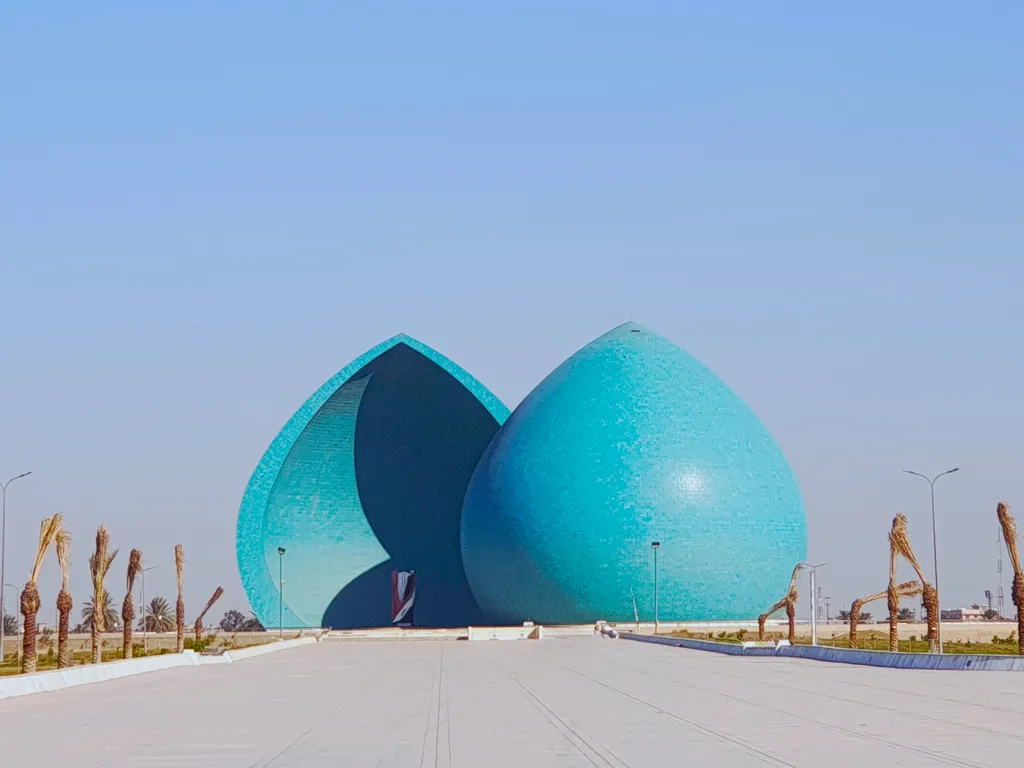
The National Museum of Iraq is a treasure of staggering importance, housing artefacts that span six thousand years of human civilisation — from Sumerian cylinder seals and Babylonian tablets to Byzantine coins and Abbasid ceramics. A visit here is nothing less than a journey through the very origins of writing, agriculture, and urban life. At Tahrir Square, the magnificent Freedom Monument sculpted by Jawad Saleem in 1961 commands attention with its sweeping bronze frieze depicting Iraq's road to independence. And the turquoise-domed Al-Shaheed Monument, designed by Ismail Fatah al-Turk and completed in 1983, reflects with haunting elegance over its circular lake in one of Baghdad's most photogenic settings.
Along the banks of the Tigris, the riverside promenade stretches past parks, garden cafés, and historic mosques, offering a window into the unhurried rhythms of daily Baghdad life — especially beautiful in the golden light of late afternoon.
Flavours, Culture & Visitor Tips
Baghdad rewards visitors who linger at the table. The national dish, masgouf — a whole carp split and slow-grilled over an open fire of date-palm wood on the banks of the Tigris — is an experience as much as a meal. Begin the morning Baghdad-style with kahi (a crispy layered pastry drenched in syrup) served alongside geymar, a rich water-buffalo cream, and a glass of scalding-hot Iraqi tea. The storied Al-Rasheed Street, near Mutanabbi, is ideal for a lunchtime stroll past spice stalls, antique shops, and century-old juice bars.
The ideal time to visit is between October and April, when temperatures are mild and the city's cultural life is in full swing. First-time visitors are strongly encouraged to travel with a knowledgeable local guide, who will not only unlock sites that appear closed to the uninitiated but will also introduce the warmth and hospitality that makes Baghdad a city you will find yourself longing to return to long after you have left.
Al-Mustansiriyya Madrasa
Founded in 1227 CE by Caliph al-Mustansir, the Al-Mustansiriyya Madrasa ranks among the oldest universities ever built, teaching Islamic law, medicine, mathematics, and astronomy under a single roof. Its intricately crafted brick arches and serene central courtyard remain one of the finest surviving examples of Abbasid architecture. Walking through its corridors feels like entering the very classroom of the Islamic Golden Age.
Al-Kazimiyya Shrine
Crowned by brilliant golden domes and soaring minarets, the Al-Kazimiyya Mosque in northern Baghdad enshrines the tombs of two revered Shia Imams and ranks among the holiest sites in the Islamic world. Millions of pilgrims travel from across the globe to visit each year, filling the surrounding streets with the fragrance of incense and an atmosphere of profound spiritual devotion that leaves every visitor — of any faith — deeply moved.
Al-Mutanabbi Street
Named for the legendary 10th-century Arab poet, Al-Mutanabbi Street is the intellectual beating heart of Baghdad. Every Friday, its pavement transforms into a sprawling open-air book market attended by poets, scholars, and book lovers. The legendary Shabandar Café, over a century old, anchors the street with its walls plastered in historic photographs — the perfect place to sip Iraqi tea and soak in the city's enduring love of ideas.
National Museum of Iraq
One of the most significant museums in the Middle East, the National Museum of Iraq holds extraordinary artefacts spanning six millennia — from Sumerian clay tablets and Babylonian sculpture to Abbasid glassware and Islamic manuscripts. Reopened in 2015 following a major international collaboration, it is nothing less than a monument to the origins of human civilisation, an essential stop for every visitor to Baghdad.
The Tigris & Masgouf Experience
The Tigris River has been Baghdad's lifeline since the city's founding in 762 CE, and its banks remain the city's most beloved gathering place. The evening ritual of dining on <em>masgouf</em> — Iraq's iconic Tigris carp, split and slow-grilled over an open fire — while watching the river shimmer under the setting sun is the kind of experience that embeds itself permanently in your memory and draws travellers back again and again.
Al-Shaheed Monument
Designed by sculptor Ismail Fatah al-Turk and completed in 1983, the Al-Shaheed Monument — also called the Martyrs' Memorial — is one of Baghdad's most striking modern landmarks. Its distinctive split turquoise dome rises above a circular lake near the city centre, combining architectural elegance with deep national symbolism. It is one of the most photographed sites in all of Iraq and an essential stop on any Baghdad itinerary.