

Mutanabbi Street — Baghdad's Cultural Soul
Location and Atmosphere
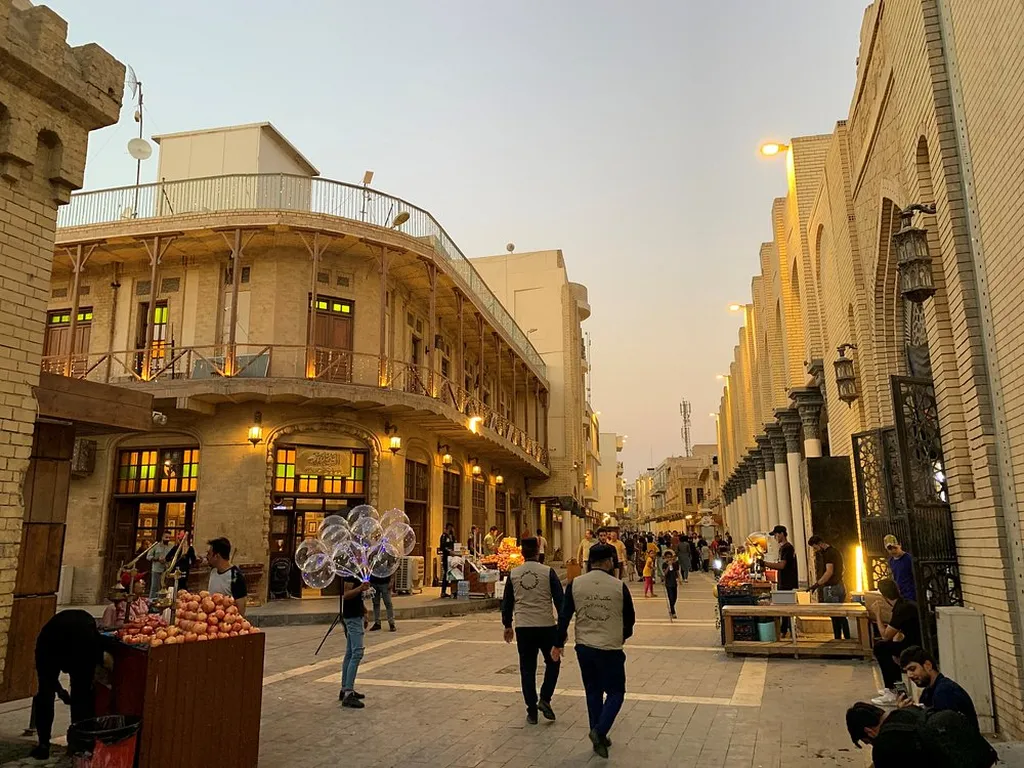
Mutanabbi Street runs for just under a kilometer through the old quarter of Baghdad, hugging the eastern bank of the Tigris River near the historic Al-Rashid Street. It is narrow, car-free, and utterly alive. Fairy lights drape ornate brick façades and wrought-iron balconies overhead; the air carries the mingled scents of old paper, strong tea, and diesel from the city beyond. The street begins with an arch adorned with verses by the great poet al-Mutanabbi and ends with his bronze statue — sculpted by Mohammed Ghani Hikmat — gazing out over the Tigris like a permanent guardian of words.
What strikes every first-time visitor is the sense of timelessness. Students debate beside elderly scholars; a seller arranges rare manuscripts beside a stack of comic books; someone recites poetry to no one in particular. This is not a museum — it is a living, breathing cultural artery that has refused, generation after generation, to go quiet.
A Thousand Years of Bookselling
The origins of Mutanabbi Street as a hub for knowledge trace back to the Abbasid Caliphate, when Baghdad was the intellectual capital of the world. The street hosted Baghdad's very first book traders' market, making it a node in the vast web of scholarship that connected scholars from Andalusia to Central Asia under the Abbasid golden age.
In 1932, King Faisal I formally inaugurated the street under its present name, choosing to honor Abu al-Tayyib al-Mutanabbi — the tenth-century Abbasid poet born in what is now Iraq, widely regarded as one of the greatest Arabic-language poets of all time. The naming was a declaration: modern Iraq grounding its identity in literary heritage. Throughout the twentieth century, the street became a mirror of Iraqi political life. Under varying regimes, the books on its shelves shifted accordingly — Marxist tracts in one era, nationalist literature in another, banned works sold furtively under Saddam's censorship. After 2003, previously forbidden books by dissident thinkers appeared openly in public for the first time in decades, and the old saying that defined Baghdad — Cairo writes, Beirut publishes, Baghdad reads — began to feel alive again.
The 2007 Bombing and the Street's Resilience
On March 5, 2007, a car bomb detonated in the heart of Mutanabbi Street, killing more than thirty people and wounding over a hundred. Bookshops and stalls were gutted; pages swirled through smoke-filled air. It was a deliberate assault on Iraq's intellectual community and cultural memory. Yet within weeks, booksellers were back. Tables reappeared on the pavement; tea was poured; arguments about poetry resumed. The street's response to violence was, simply, to keep reading.
In 2021, a comprehensive restoration project was completed, repaving the street, upgrading its lighting, and refurbishing vendor stalls. The grand reopening on December 25, 2021, was celebrated across Iraq as a cultural milestone — a signal that Baghdad's renaissance was underway.
What to See and Do
Friday mornings are the peak of Mutanabbi Street's week, when the book market transforms every available surface into a literary fair. Hundreds of stalls spill from shops onto pavements, offering classical Arabic poetry, rare manuscripts, philosophy volumes, world literature in translation, vintage magazines, academic journals, and children's books — all at prices to suit both the collector and the casual browser. A beloved local proverb sums up the culture perfectly: "The reader does not steal, and the thief does not read" — so revered is this tradition that sellers have long left their merchandise unattended overnight without fear of theft.
At the far end of the street, the Shabandar Café — established in 1917 — is one of Baghdad's oldest and most storied gathering places. Antique water pipes line its walls alongside photographs tracing Iraq's modern history: wrestling teams, royal courts, the faces of poets and prime ministers. To sit here over a glass of tea is to occupy a seat that has been warmed by a century of political debate, artistic inspiration, and human connection. Nearby, the Ottoman-era Qishla building, with its distinctive 22-meter clock tower originally built to wake soldiers for training, now houses art exhibitions and cultural events — a perfect emblem of Baghdad's ability to reinvent the past for the present.
The Poet Behind the Name
Abu al-Tayyib al-Mutanabbi (915–965 CE) was born in Kufa, in what is now central Iraq, and rose to become the most celebrated poet of the Abbasid age — and arguably of the entire Arabic literary tradition. His verses, marked by extraordinary ambition and piercing wisdom, are still quoted across the Arab world in daily conversation, political speeches, and literary debate. The bronze statue at the street's end distills his famous defiance: a poet who refused to be anything less than monumental. It is a fitting symbol for a street that, like him, has refused to be silenced.
Visitor Tips
The best time to visit is Friday morning, when the market is at its most vibrant and atmospheric. The street is pedestrian-only, making it a relaxed stroll even when crowded. Do not leave without sitting in the Shabandar Café for a glass of tea — the walls alone are worth an hour of slow looking. Mutanabbi Street sits in central Baghdad and is easily reachable from most city districts. As you leave, pause at the al-Mutanabbi statue and watch the Tigris at dusk: the light on the river and the silhouette of the poet above it is a Baghdad moment you will carry with you long after you go home.
Iraq's Oldest Book Market
Mutanabbi Street has served as Baghdad's primary book trading hub since the Abbasid Caliphate — over a thousand years of unbroken literary commerce. It was the first book traders' market in the Iraqi capital and remains its most iconic.
The Legendary Shabandar Café
Founded in 1917, the Shabandar Café has been a gathering place for Iraq's politicians, poets, and intellectuals for over a century. Its walls are lined with photographs chronicling modern Iraqi history, and its tea is poured with the weight of a hundred years of conversation.
The Al-Mutanabbi Statue
The bronze statue of Abu al-Tayyib al-Mutanabbi — sculpted by Mohammed Ghani Hikmat — stands at the street's Tigris-facing end as a monument to Arab literary heritage. More than a landmark, it is Baghdad's declaration of cultural identity to the world.
The Ottoman Qishla
Adjacent to the street stands the Qishla, an Ottoman-era garrison building with a striking 22-meter clock tower. Once built to wake soldiers, it now breathes new life as a cultural space hosting art exhibitions, public events, and creative gatherings.
Baghdad's 2021 Cultural Renaissance
After the devastating 2007 bombing and years of instability, Mutanabbi Street was fully restored and reopened in December 2021. The revitalized street now hosts book fairs, art exhibitions, and poetry festivals — a powerful symbol of Baghdad's unstoppable cultural revival.