

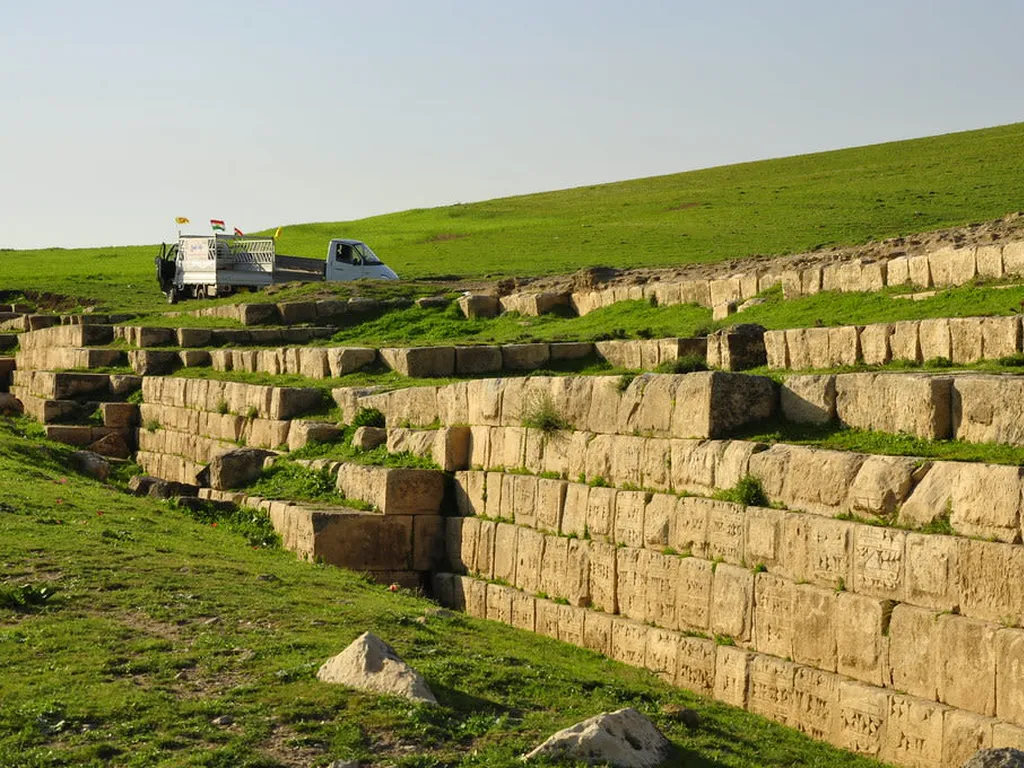
The Assyrian Aqueduct of Jerwan
Location & Setting
Hidden in plain sight among the quiet plains north of Mosul in Iraq's Nineveh Province, the Assyrian Aqueduct of Jerwan is one of history's most remarkable — and least visited — ancient monuments. Located roughly 30 miles northeast of Mosul, near the Erbil-Dohuk road in the Kurdistan Region of Iraq, the site is reached by a dust track that winds through open, sunburnt fields. There is no fanfare here, no crowded tourist trail — just the raw, humbling presence of two-and-a-half millennia of stone.
The surrounding landscape is rural and serene, its silence only deepening the weight of what stands before you: the massive limestone ruins of an aqueduct that once carried life-giving water to one of the ancient world's greatest cities. The contrast between the unassuming terrain and the sheer audacity of the structure makes arrival at Jerwan an experience that stays with you long after you leave.
An Engineering Wonder of the Ancient World
The aqueduct was constructed by King Sennacherib of Assyria (r. 704–681 BCE), one of the most powerful rulers of the ancient Near East. It formed the centrepiece of a vast hydraulic network — the Atrush Canal — designed to channel water from the Khinis Gorge, more than 50 kilometres to the north, all the way to the gardens and palaces of Nineveh, Assyria's magnificent capital. More than two million carefully dressed limestone blocks were used in its construction, some weighing up to 20 tonnes, held together with a waterproof cement that represented a technological breakthrough unknown anywhere else in the ancient world before Roman times.
The structure stretches more than 280 metres in length, stands 9 metres high, and spans 22 metres in width. Its most dramatic feature is a series of five corbelled, pointed arches that soar across the ravine at the centre of the monument, supported by projecting buttresses that divide the façade into fourteen bays. The precision of the stonework and the sophistication of the arch design speak to an engineering culture centuries ahead of its time.
Older Than Rome — The World's First Aqueduct
Many archaeologists and historians consider the Jerwan Aqueduct to be the oldest known aqueduct in the world, predating the famous Roman aqueducts of Europe by more than five centuries. Where Rome would later be celebrated for its hydraulic engineering, it was the Assyrians who first mastered the art of moving water over great distances and across challenging terrain. Standing before the Jerwan Aqueduct is standing at the very origin point of this human skill.
The first systematic scientific excavation of the site was carried out in 1933–1934 by the Oriental Institute of the University of Chicago, led by scholars Thorkild Jacobsen and Seton Lloyd. Their work revealed not only the extraordinary architecture of the monument, but also a trove of cuneiform inscriptions that shed invaluable light on Sennacherib's ambitions and methods. Today, the Jerwan Aqueduct remains an active subject of international archaeological research.
Cuneiform Inscriptions: A King Speaks Across Time
One of the most extraordinary aspects of Jerwan is the abundance of royal inscriptions carved directly into the fabric of the aqueduct. More than 200 inscribed limestone blocks have been identified, bearing royal proclamations in cuneiform script. The most celebrated inscription reads: "Sennacherib, king of the world, king of Assyria. Over a great distance I had a watercourse directed to the environs of Nineveh... Over steep-sided valleys I spanned an aqueduct of white limestone blocks, I made those waters flow over it."
These words, carved into stone nearly 2,700 years ago, remain legible today — a direct, personal message from one of history's most formidable rulers. For history lovers, there are few experiences anywhere in the world quite like reading a king's own words on the very monument he built.
The Hanging Gardens Connection
Recent scholarship has added yet another dimension of fascination to Jerwan. Some historians now propose that the water carried by Sennacherib's canal system — of which the Jerwan Aqueduct was the most spectacular engineering achievement — may have supplied the legendary Hanging Gardens, long counted among the Seven Wonders of the Ancient World. Rather than being located in Babylon as traditionally assumed, these scholars argue the Gardens were in fact in Nineveh, fed by precisely the waters that flowed over the Jerwan Aqueduct. While the debate continues, the possibility alone transforms a visit to this site into an encounter with one of antiquity's greatest mysteries.
Visiting Jerwan
The best time to visit Jerwan is during spring (March to May) or autumn (September to November), when temperatures are mild and the landscape is at its most inviting. The site is accessible from both Mosul and the Dohuk area in the Kurdistan Region. A four-wheel-drive vehicle is recommended for the final stretch of dusty track leading to the ruins. There are no developed tourist facilities on site, which is precisely part of its appeal — this is a destination for the genuinely curious traveller, the archaeology enthusiast, and the adventurer who wants to stand where few others do. Arriving at dawn, when the first light casts long shadows across the ancient limestone arches, is an experience of rare and unforgettable beauty.
World's Oldest Aqueduct
The Jerwan Aqueduct is widely regarded as the oldest known aqueduct on Earth, predating the great Roman waterworks of Europe by over five centuries. Visiting it means standing at the very origins of hydraulic engineering — a privilege granted to very few travellers in the world.
Sennacherib's Grand Vision
Commissioned by the mighty Assyrian king Sennacherib between 703 and 690 BCE, this aqueduct was the crown jewel of a 50-kilometre canal system that fed the gardens and palaces of Nineveh. It was a monument to royal power as much as it was a feat of engineering.
Two Million Limestone Blocks
More than two million dressed limestone blocks — some weighing up to 20 tonnes — were used to build this 280-metre structure, held together with an ancient waterproof cement. Its five soaring corbelled arches spanning the ravine remain among the most impressive stone structures of the ancient Near East.
The Hanging Gardens Link
Compelling research suggests that the waters carried by this aqueduct may have fed the legendary Hanging Gardens — traditionally attributed to Babylon but potentially located in Nineveh. This tantalising theory casts Jerwan in an entirely new and extraordinary light.
Royal Cuneiform Inscriptions
Over 200 limestone blocks at Jerwan bear cuneiform inscriptions in which Sennacherib describes his great waterworks in his own words. These 2,700-year-old royal proclamations, carved into the very stone of the aqueduct, offer an unparalleled direct connection to the ancient Assyrian world.
Gateway to Ancient Nineveh
Jerwan was the lifeline that kept Nineveh — once the largest city in the world — alive and flourishing. Exploring this aqueduct is not just a visit to an archaeological site; it is a journey into the heart of one of humanity's earliest and greatest urban civilisations.