

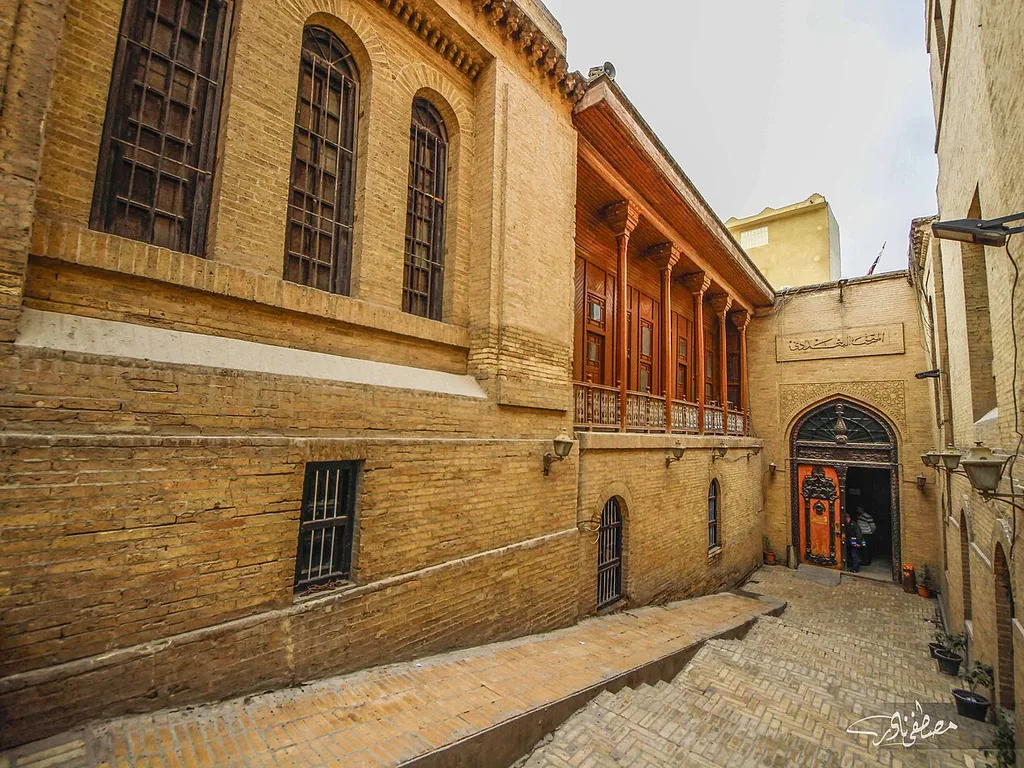
The Baghdadi Museum
Location & Overview
Standing in the heart of Baghdad's historic Rusafa district, the Baghdadi Museum sits beside the slow, silver waters of the Tigris River — just steps from the legendary Al-Mutanabbi Street, where booksellers and poets have gathered for centuries. From the outside, the building's thick Ottoman walls and graceful arches give little away. But step inside, and you are immediately transported to a Baghdad that no longer exists except in memory — and here, in vivid three-dimensional detail, preserved forever.
Unlike conventional museums where artifacts sit behind glass in silence, the Baghdadi Museum immerses you in living scenes. Wax figures haggle in covered bazaars. Musicians coax melodies from traditional instruments. Families gathered around a copper samovar. A bride is carried through the streets in a splash of color and noise. The effect is astonishing: a whole civilization rendered in miniature yet lifelike detail, inviting you to lean in, look closer, and listen — as if the past itself is whispering in your ear.
A Building Born Under the Ottomans
The Baghdadi Museum's home is as remarkable as its contents. The building was constructed in 1869 during the Ottoman administration of Baghdad, originally serving as the printing house of the Baghdad Province — the official press from which the governor's decrees and gazettes were issued. For a century, it was a place of ink and proclamation. Today it is a place of memory and wonder.
When Baghdad's mayor established the museum here in 1970, the choice was inspired: what better vessel for the city's living heritage than one of its oldest surviving structures? The building's architecture — its high-ceilinged rooms, open courtyards, and thick ochre walls — adds a layer of authenticity to every scene within. After suffering damage during the 2003 Iraq War, the museum was painstakingly restored and officially reopened in August 2008, reclaiming its rightful place as one of Baghdad's most beloved cultural landmarks.
Seventy Scenes, One City
The museum's collection encompasses more than 70 fully realized dioramas housing around 385 life-size statues, each scene dressed in period-authentic costumes, tools, household objects, and decorations. Together they form a panorama of Baghdad's social life spanning the late Ottoman period into the mid-twentieth century — a time before the city was transformed by war and modernity, when its neighborhoods thrummed with a particular warmth and character all their own.
Walk from room to room and you encounter a city in full swing. Coppersmiths hammer away at their trays and ewers. Barbers ply their trade beside fragrant herb sellers. A storyteller holds court in a coffeehouse thick with the scent of cardamom. Schoolboys crouch over their lessons in a Quranic school. Women in colorful dishdashas embroider and weave. Each display is a freeze-frame of a vanished world — and yet so lifelike, so full of textured detail, that the world feels anything but gone.
Cultural Traditions on Display
Some of the museum's most affecting scenes are its windows into the intimate rituals of Baghdadi family life. In one room, a mother — lovingly named Oum Ibrahim by local tradition — sits upright amid the cushions of her parlor, reproaching her son for moving out with his new bride and forgetting his maternal duties. It is a domestic moment, tender and scolding at once, that instantly resonates with anyone who has ever known an Iraqi grandmother. The scene is a portrait not just of a woman, but of a whole social philosophy: the irreplaceable centrality of the mother in the home.
Elsewhere, the Zaffa — the traditional procession in which a bride is escorted to her new home by singing, ululating women in festive dress — fills an entire room with color and implied sound. Musicians playing the Iraqi maqam, a form of classical vocal music recognized by UNESCO as an Intangible Cultural Heritage of Humanity, are immortalized mid-performance, their postures capturing the deep concentration and passion of this ancient art form. There are also scenes of circumcision celebrations, Ramadan evening gatherings, afternoon tea rituals, and the lively commerce of the old covered markets — each one a chapter in an unwritten autobiography of Baghdad.
Planning Your Visit
The Baghdadi Museum is located between Al-Shohada Bridge and Al-Risafi Square in the Rusafa district, easily reachable by taxi from anywhere in the city. The entrance fee is extremely affordable — one of the most budget-friendly cultural experiences in Baghdad — and a full tour of the museum takes between one and two hours. For the most comfortable visit, plan your trip in winter or early spring, when the weather is mild; the building can become warm during the long Baghdad summer. The museum is wonderfully family-friendly, with the vivid, colorful dioramas captivating children and adults alike. Before or after your visit, stroll down Al-Mutanabbi Street to browse its open-air booksellers and historic cafés — the perfect complement to an afternoon spent in the company of old Baghdad's ghosts.
Life-Size Dioramas
Over 385 life-size figures populate more than 70 fully dressed scenes, recreating Baghdad's bazaars, coffeehouses, family homes, and festive processions. The detail is extraordinary — every costume, tool, and setting chosen to transport you straight into the city's Ottoman and early modern past.
Ottoman-Era Building
The museum is housed in a rare 1869 Ottoman structure that once served as Baghdad's provincial printing house. Its thick walls, arched galleries, and open courtyards are a landmark in their own right, adding a layer of historic authenticity to every scene inside.
The Zaffa Wedding Scene
One of the museum's most joyful displays recreates the traditional Baghdadi Zaffa: a bride's procession accompanied by ululating women, colorful embroidered gowns, and the rhythms of drums and flutes. It captures the exuberant spirit of Iraqi celebration with warmth and flair.
Iraqi Maqam Musicians
The museum pays homage to the Iraqi maqam, a classical vocal tradition recognized by UNESCO as Intangible Cultural Heritage. Life-size figures of musicians and singers are captured mid-performance, evoking the soulful resonance of an art form that has defined Baghdad's cultural identity for centuries.
Gateway to Mutanabbi Street
The museum sits a short walk from Al-Mutanabbi Street, Baghdad's legendary literary and cultural artery. Combining a museum visit with a stroll among the street's booksellers, poets, and historic cafés makes for an unforgettable afternoon immersed in the soul of the city.