

Samarra — Capital of the Abbasid Caliphate
Location & Overview
Samarra sits on the eastern bank of the Tigris River in Saladin Governorate, roughly 125 kilometres north of Baghdad. Its vast archaeological zone stretches 41.5 kilometres from north to south, making it one of the largest ancient Islamic sites on earth. In 2007, UNESCO inscribed it as a World Heritage Site — one of six in Iraq — recognising its extraordinary legacy of architectural innovation and historical significance. The very name of the city tells you everything: "Surra man ra'a" in Arabic, meaning a joy for all who see it, a phrase coined when Caliph Al-Mu'tasim unveiled his magnificent new capital in 836 CE.
Human settlement here stretches back to the fifth millennium BCE, making Samarra the namesake of an entire prehistoric culture. Yet its golden chapter unfolded during the Abbasid Caliphate, when for over half a century this city on the Tigris was the political, cultural, and artistic heart of the Islamic world — commanding a domain that ranged from North Africa to the steppes of Central Asia.
Birth of an Abbasid Capital
Caliph Al-Mu'tasim founded the modern city of Samarra virtually from scratch as a new administrative base and military stronghold. What followed was one of history's most remarkable episodes of urban creation. Successive caliphs poured resources into the city, raising monumental mosques, gleaming palaces, sweeping gardens, and polo grounds that would have astonished visitors from any corner of the medieval world. Architects, artists, and craftsmen converged here from across the empire, giving rise to entirely new aesthetic traditions that would radiate outward to transform Islamic art for centuries to come.
When the Caliphate returned to Baghdad in 892 CE, Samarra was largely abandoned — and that abandonment, paradoxically, became its greatest gift to posterity. Spared the relentless rebuilding that reshaped other great cities, Samarra preserved its original city plan, its grand proportions, and the intimate texture of its streets and structures. Today it stands as the sole surviving physical testament to the Abbasid Caliphate at the zenith of its power, with a staggering 80% of the site still awaiting excavation.
The Great Mosque & The Malwiya Minaret
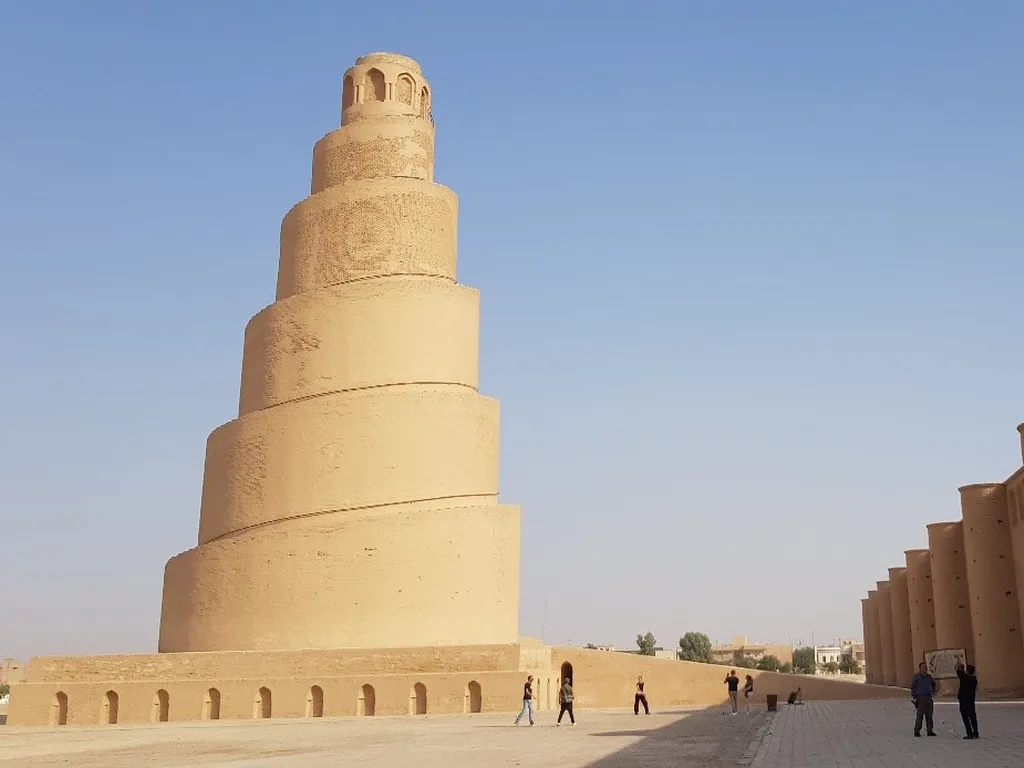
Nothing announces the ambition of Samarra more boldly than the Malwiya Minaret — a 52-metre tower that screws itself into the desert sky in a counter-clockwise spiral of five broad tiers, connected to the Great Mosque by a now-vanished bridge. Built in the ninth century under Caliph Al-Mutawakkil, its circular base and corkscrew ramp were entirely unlike any minaret the Islamic world had ever seen. Many scholars believe the design was inspired by the ancient Mesopotamian ziggurats of the same river valley — a conscious echo of civilisations that came before, reimagined in an Islamic key. The word Malwiya itself means twisted in Arabic, and there is no better description of this instantly recognisable icon, which appears on Iraqi currency and stamps to this day.
The Great Mosque that anchors the minaret measured 264 by 159 metres at its peak — the largest mosque in the world at the time of its construction. Its walls were panelled with dark-blue glass mosaics, its prayer hall featured a mihrab framed as a graceful arch, and its central fountain was reputedly carved from a single stone. The mosque's design directly inspired the Ibn Tulun Mosque in Cairo, and its carved stucco ornament — intricate interlacing of geometric and floral motifs developed in Samarra — spread across the Islamic world from Spain to Persia.
The Golden Dome: Al-Askari Shrine
No visit to Samarra is complete without standing before the Al-Askari Shrine, whose shimmering golden dome defines the city's skyline and draws millions of pilgrims every year. The shrine contains the mausoleums of the tenth and eleventh Imams of Twelver Shia Islam — Ali al-Hadi and Hasan al-Askari — and is considered one of the holiest sites in the Shia Muslim world. The gilded dome, added in its present form in 1905, blazes in the sunlight with an intensity that can be seen for miles across the Tigris plain. It is a place of deep spiritual resonance: visitors arrive from Iran, Lebanon, Pakistan, India, and beyond, to offer prayers at a site that has been a place of devotion since the ninth century.
Palaces, Art & Innovation
Beyond the mosque and the shrine, Samarra rewards the curious explorer with layer upon layer of Abbasid grandeur. The ruins of the Caliphal Palace — Qasr al-Khalifa — and the romantically named Palace of the Lover (Al-Ma'shuq) offer silent testimony to a court culture of extraordinary refinement, surrounded by orchards, hunting parks, and pleasure gardens. Across the immense archaeological site, remnants of residential quarters, bazaars, and public bathhouses paint a picture of a city that was home to hundreds of thousands at its height. The Samarra style of carved stucco — fluid arabesques and geometric interlacing unique to this city — was exported across the Islamic world, and the lustrous ceramics invented here, designed to mimic gold and silver vessels, redefined the decorative arts of the medieval period. Samarra did not merely house an empire; it shaped the visual language of an entire civilisation.
Planning Your Visit
The best seasons to visit Samarra are spring (March–May) and autumn (October–November), when temperatures are mild and outdoor exploration of the open archaeological zones is genuinely pleasant. The city is a two-to-three-hour drive north of Baghdad, making it ideal as a day trip or overnight stay when combined with other sites in central Iraq. Travelling with a knowledgeable local guide is strongly recommended to ensure smooth access to the sites and a richer understanding of what you are seeing. Set aside a full day: the Malwiya Minaret, the Al-Askari Shrine, and the palace ruins each deserve unhurried attention. While you are here, explore Samarra's vibrant market streets and savour the flavours of central Iraqi cuisine — masgouf grilled fish, slow-cooked tashreeb, and hand-stuffed kubba are highlights of any visit.
The Malwiya Spiral Minaret
Rising 52 metres above the Tigris plain in a breathtaking counter-clockwise spiral, the Malwiya Minaret is unlike any other in the Islamic world. Built in the ninth century under Caliph Al-Mutawakkil, its revolutionary design — possibly inspired by ancient Mesopotamian ziggurats — has made it a symbol of Iraq itself, appearing on currency and stamps for generations.
The Great Mosque of Samarra
At its completion, the Great Mosque of Samarra was the largest mosque on earth, measuring 264 by 159 metres. Its dark-blue glass mosaics, carved stucco panels, and monumental proportions set an architectural standard that echoed across the Islamic world from Cairo to Central Asia, directly inspiring the famous Ibn Tulun Mosque in Egypt.
Al-Askari Shrine
The Al-Askari Shrine, with its luminous golden dome, is among the holiest sites in Shia Islam and draws millions of pilgrims from around the globe every year. It houses the mausoleums of the tenth and eleventh Shia Imams, Ali al-Hadi and Hasan al-Askari, making Samarra a city of profound spiritual significance that transcends its archaeological treasures.
Abbasid Palace Ruins
The scattered ruins of Samarra's great Abbasid palaces — including Qasr al-Khalifa and the evocatively named Palace of the Lover — hint at a court life of extraordinary opulence. Once surrounded by sweeping gardens and hunting parks, these monuments offer a rare, tangible glimpse into the world of the medieval Islamic caliphate at the height of its power.
UNESCO World Heritage Site
Inscribed by UNESCO in 2007, the Samarra Archaeological City is one of only six World Heritage Sites in Iraq. With 80% of the site still unexcavated, it remains one of archaeology's great frontiers — a city frozen in time, preserving its original 9th-century plan and awaiting the discoveries that future generations of scholars and explorers will one day uncover.