

Wadi Al Salam — The Valley of Peace in Holy Najaf
A Place Unlike Any Other
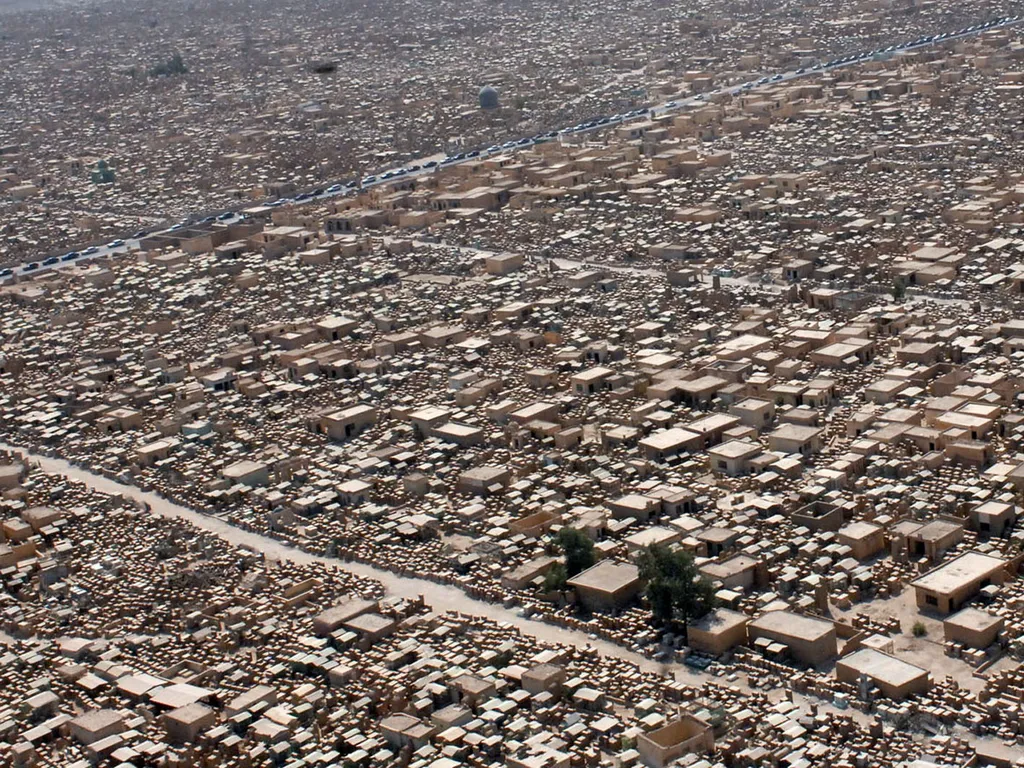
There are places in this world that defy ordinary description, and Wadi Al Salam in Najaf is one of them. Stand at its edge and let your gaze travel outward: white domes catching the sun, inscribed tombstones crowding every lane, slender minarets rising above family mausoleums that stretch as far as the eye can see. This is the Valley of Peace — Wādī al-Salām — the largest cemetery on Earth, covering more than 600 hectares and sheltering between five and six million souls beneath the Iraqi sky.
The name alone speaks volumes. In Shia tradition, Imam Ali ibn Abi Talib — the cousin and son-in-law of the Prophet Muhammad, and the first Imam of Shia Islam — declared this valley to be a part of paradise. Shia belief holds that the souls of all faithful men and women, wherever their bodies are buried in the world, ultimately gather in Wadi Al Salam. It is this conviction, profound and enduring, that has drawn millions of Muslims from Iraq, Iran, Pakistan, and beyond to seek their final rest in this sacred earth.
Deep Roots: From Abraham to the Present Day
The story of Wadi Al Salam begins before Islam itself. Ancient traditions record that the Prophet Abraham passed through this place on his journey from Mesopotamia toward the Levant, and the site was once known as Baniqia — believed to be among the first recorded names for this stretch of land near Kufa. It became an Islamic cemetery of unparalleled significance in the 7th century CE, following the martyrdom of Imam Ali in 661 CE and his burial nearby. From that moment, the faithful came — and never stopped coming.
Over fourteen uninterrupted centuries, Wadi Al Salam has received prophets, kings, sultans, renowned religious scholars, and countless ordinary believers into its earth. The tombs of the prophets Hud and Saleh — figures venerated in both Islamic and biblical traditions — are believed to lie within its grounds, lending the site a sanctity that transcends sectarian lines. Among its distinguished residents is also Grand Ayatollah Muhammad Baqir al-Sadr, one of the most influential Shia thinkers of the 20th century.
A Landscape of Faith: Architecture and Atmosphere
What strikes the visitor first is the extraordinary visual diversity. Simple stone markers stand beside towering family tombs that rise three meters high, their rounded tops once designed to be seen above their neighbors. Wealthy families commissioned domed mausoleums adorned with turquoise and blue tiles, Quranic calligraphy, and carved religious symbols. Underground chambers — entered by stone staircases — hold the remains of entire family lines, generation upon generation sealed in vaulted rooms beneath the desert floor.
Together, these structures form an open-air museum of architectural styles spanning more than a millennium: graves from the Safavid, Ottoman, and modern eras coexist in a single glance, each layer telling its own story of loss, devotion, and the human need to be remembered. At night, the white domes catch the glow of Najaf's lights and the cemetery takes on an otherworldly stillness — vast, silent, and deeply moving.
A Living Site: Ritual, Pilgrimage, and Daily Life
Wadi Al Salam is not a relic frozen in time — it breathes and grows every single day. Approximately 50,000 new burials take place here each year, with custodians, religious authorities, and municipal workers coordinating the continuous cycle of interment, grave maintenance, and visitor guidance. NASA satellite imagery has tracked the cemetery's expansion year by year, confirming what locals have always known: Wadi Al Salam grows with Najaf, inseparable from the city's living pulse.
During the great Shia occasions of Ashura and Arbaeen, the cemetery transforms into a scene of overwhelming spiritual intensity. Families arrive from across Iraq and the wider Shia world to pray at the graves of loved ones, recite Quranic verses, and perform rituals that have been passed down unchanged for generations. Grief, faith, and gratitude mingle in the air — and in the middle of it all, the cemetery hums with a devotion that feels ancient and immediate at once.
UNESCO Recognition and Preservation
Iraq has submitted Wadi Al Salam to UNESCO's Tentative World Heritage List, recognizing it as a site of exceptional universal value. Its unbroken continuity of burial over 1,400 years — unmatched anywhere in the world — combined with the presence of prophets' tombs, the proximity of Imam Ali's shrine, and the richness of its architectural heritage make a compelling case for international recognition. The site is protected under Iraqi law, including the General Endowment Act No. 64 of 1966, ensuring that its sanctity and integrity are formally safeguarded.
Visitor Tips
Visit in the early morning or late afternoon, when the heat softens and golden light plays across the domes and tombstones in a way that is genuinely breathtaking. A local guide is highly recommended — the cemetery's winding lanes and underground crypts can be disorienting, and a knowledgeable guide will lead you to the most significant shrines and explain the layers of history beneath your feet. Dress modestly and respectfully, as this is an active place of worship and mourning. Allow more time than you think you need: Wadi Al Salam has a way of slowing you down, inviting reflection on the deepest questions of human life.
To walk through Wadi Al Salam is to walk through time itself — through fourteen centuries of love, loss, faith, and the unbreakable human desire to rest close to the divine.
World's Largest Cemetery
Spanning more than 600 hectares and holding between five and six million burials, Wadi Al Salam is the largest cemetery on Earth by both area and number of interments. It is, quite literally, a city of the dead — vast, silent, and humbling in its scale.
1,400 Years of Continuous Burial
Since the 7th century CE, burial in Wadi Al Salam has never once paused, making it the only cemetery in the world with over 14 centuries of uninterrupted use. Each generation has added its own layer to this living archive of human memory and faith.
Proximity to Imam Ali's Shrine
The cemetery's profound significance stems from its location beside the holy shrine of Imam Ali ibn Abi Talib. Shia Muslims worldwide believe that resting near the first Imam grants the deceased his intercession on the Day of Judgment — a spiritual honor without equal.
Tombs of the Prophets Hud and Saleh
Wadi Al Salam is believed to contain the tombs of the prophets Hud and Saleh, Quranic figures also recognized in biblical tradition. Their presence elevates the site beyond any single faith community, rooting it in the shared Abrahamic heritage of the region.
14 Centuries of Architectural Diversity
From simple stone markers to towering domed family mausoleums adorned with intricate tilework and calligraphy, Wadi Al Salam is a living museum of Islamic funerary architecture. Each style reflects a different era, culture, and social stratum across fourteen centuries of history.
Ashura and Arbaeen Pilgrimages
During the great Shia occasions of Ashura and Arbaeen, millions of pilgrims and families descend on Wadi Al Salam to pray, mourn, and honor the dead. The cemetery fills with an atmosphere of extraordinary collective devotion — raw, moving, and unlike anything else on earth.