

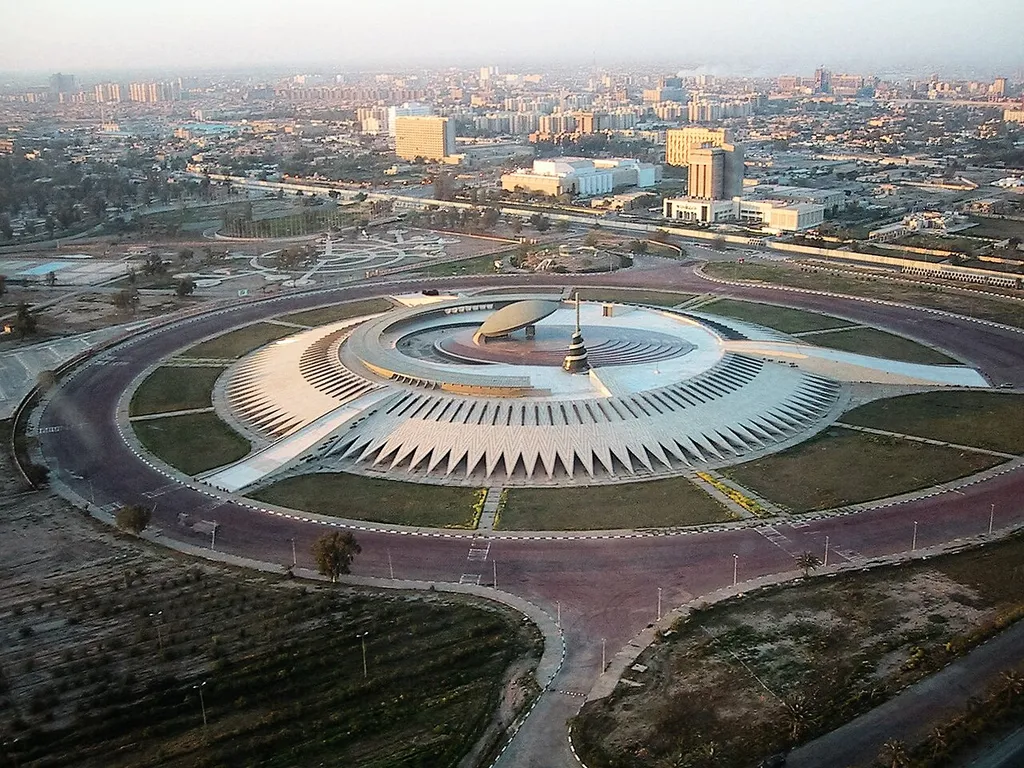
Monument to the Unknown Soldier
Location and Setting
In the heart of Baghdad, where ancient thoroughfares meet modern boulevards, the Monument to the Unknown Soldier stands atop a gently elevated artificial hill near the Grand Celebrations Square and Zawraa Park. The monument occupies a commanding position on the west bank of the Tigris, close to the International Zone, and forms one corner of a remarkable architectural triumvirate alongside the Al-Shaheed Monument and the Victory Arch. Together, these three landmarks constitute one of the most potent memorial landscapes in the Arab world.
The monument's elevated position makes it visible across a wide swath of the capital, lending it a sense of permanence and civic gravity. Whether approached by car along 14th July Street or glimpsed from a rooftop across the river, it registers immediately as something both majestic and poignant — an unmistakable anchor in Baghdad's skyline.
Origins and Historical Context
Commissioned in 1979 and completed in 1982, the monument was dedicated to the Iraqi soldiers lost in the Iran–Iraq War (1980–1988). The original concept was conceived by celebrated Iraqi sculptor Khaled al-Rahal, with the structural and architectural design developed by Italian architect Marcello D'Olivo in close collaboration with Iraqi architect Hisham Munir. The project was part of a sweeping government program to endow Baghdad with monumental public works that projected both national pride and ambition.
It was not Baghdad's first such monument. An earlier Unknown Soldier memorial, designed in 1959 by the distinguished Iraqi architect Rifat Chadirji, once stood in what is now Firdos Square, commemorating the birth of modern republican Iraq. That structure was demolished in the early 1980s. The 1982 monument assumed its legacy and went on to become so emblematic of the city that it appeared on the Iraqi dinar banknote throughout the 1990–2003 series, entering the wallets — and the visual memory — of an entire generation.
An Architectural Marvel: The Falling Shield
The monument's core image is one of profound symbolic weight: a traditional Iraqi warrior's shield (dira'a) dropping from the dying grasp of a fallen soldier. This idea, born in Khaled al-Rahal's sculptural imagination, was translated into a breathtaking spatial composition by Marcello D'Olivo. The artificial hill itself is shaped as a low, truncated cone 250 metres in diameter, circled by elliptical stepped platforms of red granite that draw the eye upward toward the summit.
At the peak, the centrepiece is a cantilevered reinforced concrete dome 42 metres in diameter, inclined at 12 degrees from the vertical. Its outer surface is clad in copper, while the underside features a soffit of alternating steel and copper pyramidal modules that catch and diffuse light in shifting patterns. Surrounding elements include marble-clad girders of triangular cross-section and a striking steel flagpole entirely covered in Murano glass panels displaying Iraq's national colours — a detail that shimmers brilliantly in sunlight and gives the monument an almost ethereal quality at certain hours of the day.
The Underground Museum
Below the dramatic skyward form lies a hidden layer of equal significance. The monument houses an underground museum that gives its soaring exterior a human interior. Here, visitors find documents, photographs, artefacts, and memorials that bring the story of Iraq's military history and its unknown soldiers into intimate focus. The museum transforms an abstract act of commemoration into something deeply personal — a space where statistics dissolve into faces, letters, and the tangible evidence of individual lives.
Descending into the museum from the open air above is itself an experience: a movement from the monumental to the intimate, from the national to the human. Those who visit only the exterior miss the soul of the place. Plan time to explore both levels, and let the contrast between the sweeping architecture above and the quiet galleries below resonate.
The Surrounding Memorial Complex
No visit to the Unknown Soldier Monument is complete without exploring the broader architectural constellation around it. Within walking distance, the Grand Celebrations Square — Iraq's largest national public space — stretches out as a reminder of the sweeping civic vision that animated this entire district. Nearby, the Al-Shaheed Monument (1983), designed by sculptor Ismail Fatah al-Turk, presents its iconic split turquoise dome: two halves of a sphere divided by a spring of water symbolising the blood of the fallen, rated by Art in America as the most beautiful design in the Middle East. And at the entrance to the square, the Victory Arch (1989) — two immense pairs of crossed swords, each sword over 40 metres tall, rising from cast forearms — completes the trilogy with a gesture of defiant endurance.
These three monuments, conceived in the same turbulent decade and clustered within sight of one another, function as an open-air museum of modern Iraqi art and memory. Taken together, they offer an extraordinary afternoon of reflection, visual awe, and historical reckoning that no other city in the region can replicate.
Planning Your Visit
The Monument to the Unknown Soldier lies near the International Zone in central Baghdad. The most practical way to visit is by private taxi or with a trusted local guide, and it is always advisable to check current access conditions in advance. The best season to visit Baghdad is October through March, when the desert heat gives way to mild, pleasant days ideal for exploring outdoor sites at a relaxed pace. Carry Iraqi dinars for transport and any entrance fees, dress modestly out of respect for the site and the city, and — if at all possible — plan your visit to encompass the full memorial complex nearby.
The Monument to the Unknown Soldier is far more than a landmark. It is an act of collective remembrance cast in copper and concrete, a place where a nation has chosen to say: we remember, even those whose names we do not know. To stand before it is to understand something essential about Iraq — its grief, its pride, and its enduring will to honour the sacrifices that shaped it.
The Warrior's Shield
The monument's central image — a traditional Iraqi shield slipping from the grasp of a dying warrior — is one of the most powerful acts of visual symbolism in the Arab world. Conceived by sculptor Khaled al-Rahal and realised by Italian architect Marcello D'Olivo, it condenses the meaning of sacrifice into a single, unforgettable form.
Underground Museum
Beneath the soaring dome lies a contemplative underground museum housing photographs, documents, and artefacts from Iraq's military history. It transforms the monument from a symbol into a story — intimate, human, and deeply moving. Do not leave without descending into this hidden interior.
Architectural Masterpiece
A 42-metre cantilevered dome inclined at 12 degrees, copper-clad exterior, pyramidal steel-and-copper soffit, and a Murano glass flagpole that shimmers in sunlight — the monument is a rare fusion of Italian architectural innovation and Iraqi artistic vision, unlike anything else in the region.
Memorial Triumvirate
The Unknown Soldier Monument anchors a trio of extraordinary memorials alongside the Al-Shaheed Monument and the Victory Arch. Together, they form one of the Arab world's most remarkable open-air memorial landscapes, all within walking distance of each other in central Baghdad.
Icon on the Dinar
For over a decade, the monument appeared on the Iraqi dinar banknote, cementing its place not only in Baghdad's skyline but in the daily life and visual memory of every Iraqi. Few landmarks anywhere carry such a literal imprint on a nation's currency and collective consciousness.