

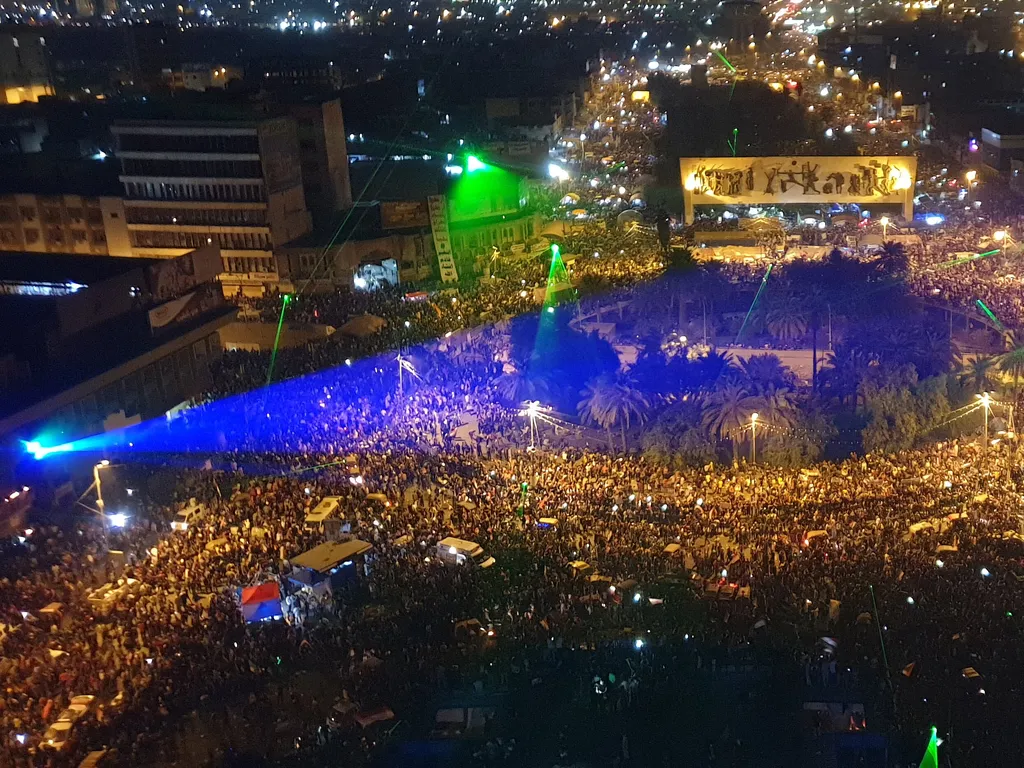
Tahrir Square — The Beating Heart of Baghdad
Location & Overview
Tahrir Square — Arabic for Liberation Square — occupies a commanding position at the heart of Baghdad, on the eastern bank of the Tigris River in the historic Al-Rusafah district. The city's great arteries converge here: the soaring Jumhuriyya (Republic) Bridge links the two banks, Kifah (Struggle) Street stretches toward the popular quarters, and the perpetually busy Al-Sa'doun Street pulses with commerce and life. Far more than a traffic roundabout, Tahrir is Baghdad's true civic center — the place where the city finds its voice, marks its history, and reaffirms its identity with every passing day.
The square is ringed by a rich urban fabric: government buildings shoulder to shoulder with popular markets, storied bookshops, camera stores, and authentic coffeehouses. Mornings bring the hum of a city in motion — newspaper sellers, business commuters, university students — while evenings see Baghdadis linger on the pavements, sipping cardamom-laced tea and exchanging the pleasures of conversation. At every hour, the square is an honest mirror of a city that never truly sleeps.
The Freedom Monument — Iraq's Masterpiece in Bronze
No visit to Tahrir Square is complete without lingering before the Freedom Monument — Nasb al-Hurriyah in Arabic. This extraordinary work was designed by the great Iraqi sculptor Jawad Saleem together with architect Rifat Chadirji, completed in 1961 and standing ever since as the defining icon of modern Iraqi art. Spanning nearly fifty meters across, the monument comprises fourteen bronze relief panels populated by twenty-five symbolic figures — a visual epic that narrates Iraq's full story: from the roots of Sumerian, Babylonian, and Assyrian civilisation, through the glories of the Islamic era, to the July 14 Revolution of 1958 that ended the monarchy and proclaimed the republic.
Saleem conceived the monument to be read right to left, as Arabic is read — an unbroken narrative flowing across history. The fourteen panels are no accident of design: they deliberately echo the date of the revolution, the fourteenth of July, embedding the moment of national transformation into the very structure of the artwork. Amid the 25 figures — soldiers, mothers, political prisoners, farmers, oxen and horses — stand the universal themes of sacrifice, struggle, and renewal. It is a work that moves you before you fully understand it, and stays with you long after you leave.
History & National Identity
Before 1958, the square bore the name Queen Aliya Square, a tribute to the Hashemite monarchy. The revolution changed not only the government but the map: renamed Tahrir — Liberation — the square became the symbolic address of the new Iraq. From that moment on, it became the destination of choice for anyone wishing to speak, celebrate, or demand. It drew hundreds of thousands during the Arab Spring of 2011, and became the epicenter of the October 2019 uprising, when a generation of young Iraqis descended on its pavements demanding an end to corruption and the beginning of genuine reform. Tahrir does not merely preserve memories — it generates them.
Its cultural surroundings are equally rich. Behind the square stretches Al-Umma (Nation) Garden, a green oasis that holds murals by the celebrated painter Faiq Hassan and a monument to motherhood erected in the revolutionary era. Within walking distance lies historic Al-Rasheed Street — once the spine of imperial Baghdad — and the legendary Al-Mutanabbi Street, where booksellers have gathered for centuries and where poets and intellectuals still meet over tea. Everything that defines cultural Baghdad gravitates toward this square.
What to See & Experience
Every visitor begins at the Freedom Monument, studying its intricate panels with deliberate slowness — the faces, the symbols, the horses, and the ancient motifs that compress millennia of human civilisation into bronze. From there, a short walk leads to Al-Umma Garden, where the air is cooler under broad trees and Faiq Hassan's sweeping mural offers a masterclass in Iraqi modernist painting. The nearby Monument to the Mother, erected just after the 1958 revolution, is a quietly powerful tribute to the endurance of Iraqi women.
The surrounding streets reward exploration on foot. Vintage bookshops overflow with second-hand volumes in Arabic, English, and French; camera shops preserve a trace of Baghdad's golden cultural era; and the coffeehouses serve a cup of Iraqi tea — thick, amber, and fragrant — alongside conversations that blend politics, poetry, and everyday life in equal measure. Look around you: in this square, no one is a mere passer-by. Everyone in its orbit contributes something to the meaning of the place.
Visitor Tips
The ideal times to visit Tahrir Square are early morning, when traffic eases and the light falls gently across the Freedom Monument's bronze reliefs, or the hour before sunset, when the square fills with the warm glow of street lamps and evening strollers. Taxis and private cars are the most practical way to reach the square, as central Baghdad's traffic can be formidable. Dress modestly as a mark of respect for the square's popular, public character. After your visit, extend the journey toward Al-Mutanabbi Street for books and culture, or stroll down to Abu Nuwas Street on the banks of the Tigris for a riverside meal of masgouf, Iraq's beloved grilled fish.
Tahrir Square is far more than a tourist stop — it is the coordinates of Baghdad itself. Standing before the Freedom Monument, in the square where a nation has laughed, wept, protested, and celebrated for generations, you will understand something about Iraq that no guidebook can fully convey. Come here and feel it for yourself.
The Iconic Freedom Monument
Designed by sculptor Jawad Saleem and completed in 1961, the Freedom Monument spans nearly fifty meters with fourteen bronze relief panels and twenty-five symbolic figures. Read right to left like Arabic script, it tells the full story of Iraq from ancient Mesopotamia to the birth of the republic — a visual poem cast in bronze.
Baghdad's Geographic & Spiritual Core
Located in the Al-Rusafah district on the eastern bank of the Tigris, Tahrir Square is where Baghdad's great streets converge. From here you can reach Al-Rasheed Street, the historic Jumhuriyya Bridge, and the legendary Al-Mutanabbi bookstreet within minutes, making it the perfect base for exploring the city's historic soul.
Al-Umma Garden & Public Art
Directly behind the square lies Al-Umma (Nation) Garden, a shaded green space housing sweeping murals by the celebrated Iraqi painter Faiq Hassan and a monument honoring Iraqi motherhood. A calm counterpoint to the bustle of the square, it offers a reflective space to absorb the layers of history all around you.
A Witness to Modern History
Tahrir Square has stood at the center of Iraq's most pivotal modern moments — from the jubilation of the 1958 revolution to the courageous protests of October 2019. Walking across its pavement means walking on the very ground where a people wrote its most significant chapters, in full view of the monument they built to remember why it mattered.
Living Culture & Authentic Markets
The streets surrounding the square are lined with legendary bookshops, camera stores, and traditional coffeehouses serving cardamom tea in a distinctly literary atmosphere. As a starting point for exploring Baghdad's cultural and intellectual heritage, Tahrir Square is unrivaled — the city reveals itself most vividly from here.