

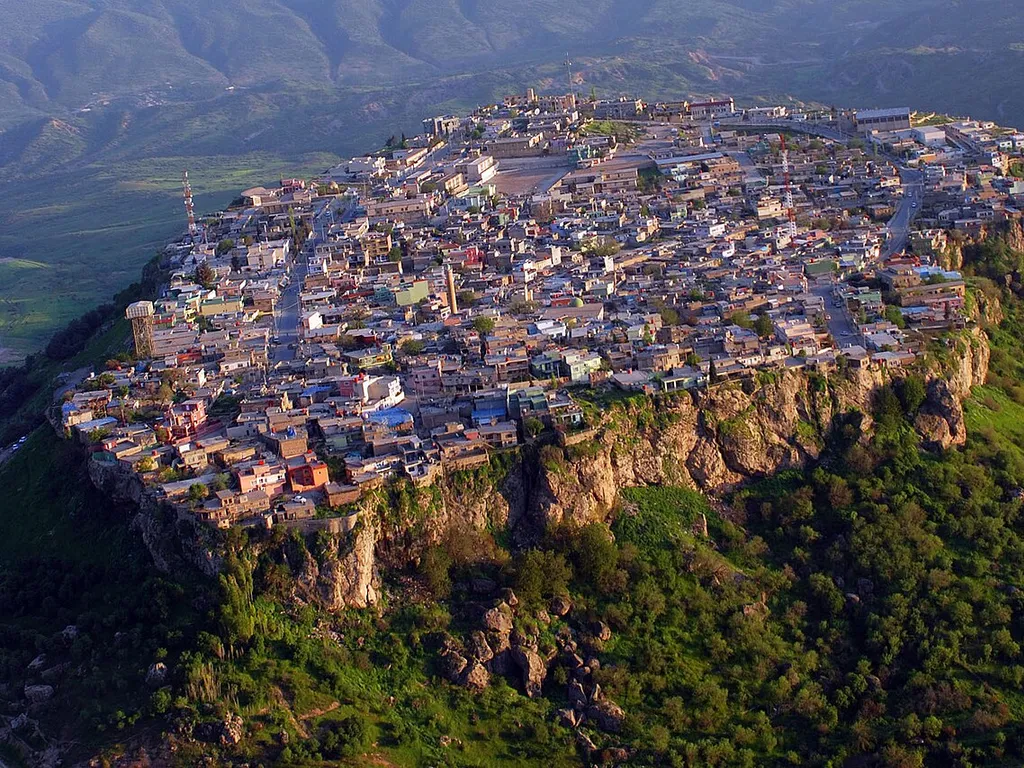
Amadiya (Amedi) — A City in the Clouds
Location & Overview
There are very few places on earth where your first glimpse of a city stops you in your tracks. Amadiya — known in Kurdish as Amedi — is one of them. Rising nearly 1,400 meters above sea level from the valleys of northern Iraqi Kurdistan, the town sits atop a flat-topped mesa of sheer cliffs, barely 15 kilometers from the Turkish border and about 90 kilometers northeast of Duhok city. The plateau itself is just over a kilometer long and barely half a kilometer wide, yet it holds an entire living town of nearly 6,000 people, millennia of layered history, and views that photographers travel oceans to capture.
Iraqis have long treated Amadiya the way Americans treat Niagara Falls — a destination so iconic, so universally beloved, that everyone simply knows it. When summer heat blankets the plains of central and southern Iraq, families from Baghdad, Basra, and beyond make the pilgrimage north to breathe Amadiya's cool mountain air, picnic beside rushing waterfalls, and stare out at a landscape that feels entirely removed from time. The "balcony of Kurdistan," as locals affectionately call it, does not disappoint.
Five Thousand Years of History
Amadiya's story reaches back at least to 3,000 BC and the age of the ancient Assyrians. The earliest written record comes from the 9th century BCE, when Assyrian King Adad-Nirari II referred to the fortified settlement here as Kur Amad — suggesting the site was already a recognized stronghold before the Assyrians even recorded it. Over the following millennia, the plateau changed hands under the Medes, the Achaemenids, the Parthians, the Abbasid Caliphate, and the Ottomans, each civilization leaving its trace in the stone and spirit of the city. Today, thirteen officially registered archaeological sites within the district each open a window onto a different chapter of Mesopotamian history.
Among Amadiya's most extraordinary claims to fame is its connection to the Biblical Magi. Historical evidence points to Amadiya as the home of the three wise priests who traveled to Bethlehem — a tradition that lends the city a profound spiritual significance felt by millions of Christians worldwide, and one that deepens the already rich tapestry of faiths that have called this plateau home.
The Bahdinan Emirate & the Art of Coexistence
Amadiya reached its political and cultural zenith as the capital of the Bahdinan Kurdish Emirate, which ruled the surrounding region from 1376 to 1843. During this golden age, the city flourished as a center of trade and scholarship where Muslims, Christians, and Jews lived side by side in genuine, documented coexistence. Caravans linked Amadiya to Mosul, Sinjar, and beyond; scholars exchanged ideas across faiths; and the bazaar — parts of which still stand — hummed with the commerce of a prosperous crossroads city.
The Great Mosque of Amadiya, founded in 1177 CE during the Abbasid era, anchors the city's spiritual landscape with its distinctive 30-meter minaret, renovated in the 15th century under Sultan Hussein al-Wali. Within the mosque grounds stands a shrine believed to be the tomb of the Prophet Ezekiel, sacred to Muslims, Christians, and Jews alike — a physical embodiment of the city's legacy of shared devotion. Ruins of an ancient synagogue and a church can also still be found in the city, quiet reminders of a community that once prayed to the same sky in different tongues.
What to See & Experience
The journey into Amadiya begins at the Bahdinan Gate (also called the Mosul Gate or Bab Zebar), the city's sole surviving historic entrance portal. You climb a steep staircase carved directly into the rock of the mountain before passing beneath a magnificent carved stone arch nearly 14 meters high, adorned with a relief of the sun encircled by a rope with four knots — a symbol whose meaning historians still debate, but whose power is immediately felt. The gate was recently stabilized and restored through international and local conservation projects, and now welcomes visitors once more with its ancient weight intact.
Inside, the narrow lanes and traditional stone houses lead you toward the citadel, where the panorama that unfolds — 360 degrees of mountain valleys, plunging cliffs, and sky — is among the most spectacular in all of Iraq. Do not miss the old bazaar, where vendors still sell the famous Amadiya tahini and the region's prized mountain honey, both of which travelers come from across the country specifically to buy. Beyond the city walls, the surrounding landscape offers its own rewards: the cascading Sipa Waterfall near Sulav village, the dramatic canyon of Gali Zanta, and seasonal paragliding events that let the boldest visitors see the mesa from above, suspended between mountain and cloud.
Visitor Tips & Practical Information
The best times to visit Amadiya are spring (March to May), when wildflowers blanket the valleys and the air is crisp and clear, and autumn (September to November), when the mountains turn gold and the summer crowds thin. Summer remains cooler than anywhere else in Iraq, making it a popular retreat, while winter occasionally brings snow that transforms the citadel into a scene from a storybook. Entry to all archaeological sites is free of charge, and local cafés serve traditional Kurdish meals within the town. Most visitors base themselves in Dohuk city — about 90 kilometers south — where hotels range from budget to upscale, and take a shared taxi or private car up to the plateau for the day. The Kurdistan Region of Iraq is well-known for its hospitality toward foreign visitors, and Amadiya is among the warmest welcomes you will find anywhere in the country.
The Bahdinan Gate
The Bahdinan Gate — also known as the Mosul Gate — is Amadiya's most iconic monument: a towering carved stone arch nearly 14 meters high, crowned with a relief of the sun and mysterious knotted rope symbols. You reach it by climbing a staircase cut directly into the mountain rock. Recently restored through international conservation efforts, the gate is once again open to visitors and remains one of the most evocative entrances to any ancient city in the Middle East.
Homeland of the Three Magi
Historical evidence connects Amadiya to the three Biblical Magi — the wise priests who traveled to Bethlehem. This extraordinary tradition gives the city a spiritual significance that resonates across faiths and cultures worldwide, drawing pilgrims and history lovers alike to a place where ancient legend and documented history overlap in remarkable ways.
The Great Mosque & Minaret
Founded in 1177 CE during the Abbasid era, Amadiya's Great Mosque is crowned by an elegant 30-meter minaret restored in the 15th century. Within its grounds stands a shrine revered as the tomb of the Prophet Ezekiel — sacred to Muslims, Christians, and Jews — making it one of the most spiritually layered religious sites in all of northern Iraq.
Panoramic Mountain Views
Standing on the edge of Amadiya's clifftop plateau, visitors are treated to one of the most breathtaking panoramas in Iraq: sweeping valleys, jagged mountain ridges, and sky stretching in every direction. Nearby, the Sipa Waterfall, the Gali Zanta canyon, and seasonal paragliding events offer adventure seekers the chance to experience Kurdistan's wild landscape at its most spectacular.
UNESCO Tentative Heritage Site
In 2011, UNESCO accepted Amadiya onto Iraq's Tentative List of World Heritage Sites, acknowledging its outstanding cultural and historical value. The Kurdistan Regional Government followed with a major 2024 infrastructure investment of over six billion Iraqi dinars to develop roads, services, and facilities — signaling a confident future for this ancient city on the world tourism stage.