

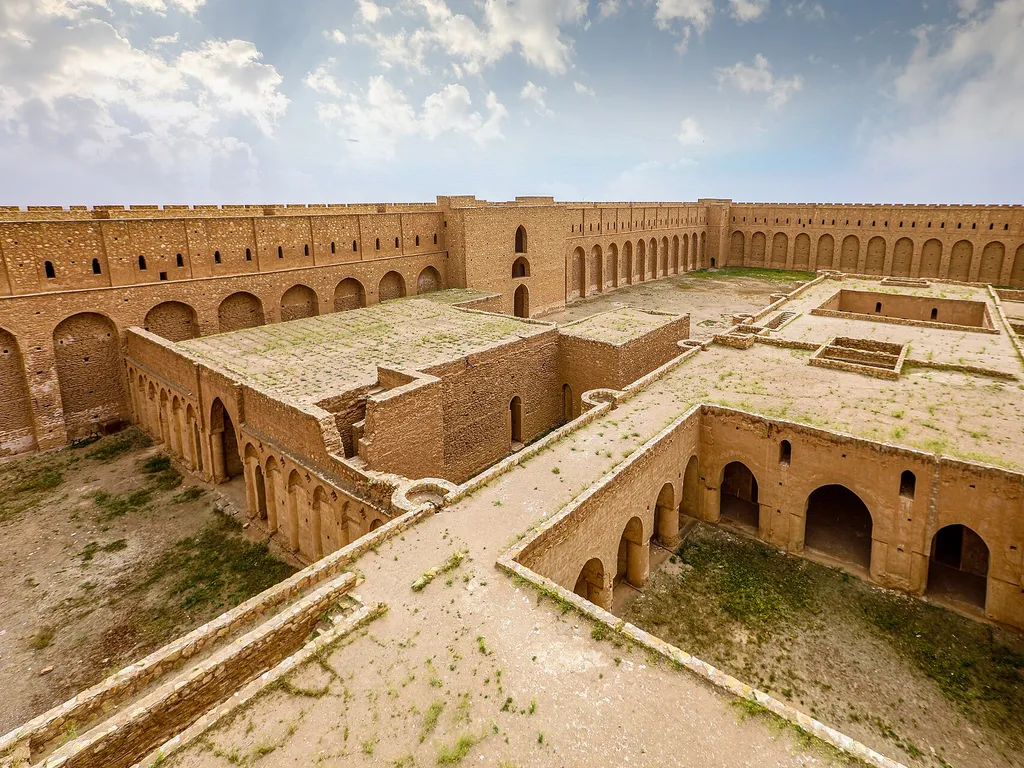
The Fortress of Al-Ukhaidir
Location & Overview
Fifty kilometers southwest of the holy city of Karbala, something impossible rises from the desert floor. Massive stone walls, nearly seventeen meters high, emerge without warning from the flat, sun-scorched landscape — a fortress so immense and so ancient that it seems less like a human construction and more like a geological event. This is the Fortress of Al-Ukhaidir, one of the most remarkable and least-visited architectural treasures in the entire Middle East. Measuring 176 meters in length and 146 meters in width, it dwarfs everything around it, its presence commanding and almost surreal against the silence of the Iraqi desert.
For travelers who make the journey, Al-Ukhaidir delivers something rare: the visceral thrill of standing inside a place where history is not curated or cushioned, but raw, immediate, and overwhelming. There are no crowds here. Only you, the stones, and twelve centuries of uninterrupted time.
A Palace Born of Abbasid Ambition
Al-Ukhaidir was built in 775 AD by Isa ibn Musa, a nephew of Abbasid Caliph As-Saffah and a prince of considerable power within the empire. He chose this remote desert location as a private retreat — a residence away from the political intrigues of the Abbasid capital — yet the design he commissioned was anything but modest. The fortress is simultaneously a luxurious royal palace and a formidable military stronghold, complete with arrow slits, portcullises, and vaulted wall walks built to withstand siege and repel invaders.
This duality reflects the era perfectly. The early Abbasid period was one of great cultural flowering but also sharp political instability, and Isa ibn Musa needed a home that could inspire admiration and inspire caution in equal measure. The result was a monument that has outlasted the dynasty that built it, the empires that followed, and every force — natural and human — that has tested it over the centuries.
Architecture: Where Persia Meets Islam
What makes Al-Ukhaidir architecturally extraordinary is the way it synthesizes multiple traditions into something entirely original. The massive cylindrical corner towers, the barrel-vaulted galleries, and the semi-circular arches all carry clear echoes of Sasanian Persian design — a reminder that the Abbasid world absorbed and transformed the civilizations it inherited. Yet the internal organization of the complex, with its interlocking courtyards, the integrated mosque, the grand audience halls, and the intimate residential quarters, is unmistakably of the Islamic tradition, reflecting a sophisticated sense of hierarchy, privacy, and communal life.
Inside the outer walls, the complex unfolds in layers. A grand throne room anchors the ceremonial heart of the palace. A large iwan — a vaulted open-fronted hall — frames the main reception space. Servants' quarters, storerooms, and residential wings branch off in every direction. The craftsmanship throughout is meticulous: geometric patterns adorn the mihrab of the mosque, archways curve with elegant precision, and the sheer structural logic of the vaulted walkways reveals a level of engineering confidence that astonishes even today.
A Vital Stop on the Trade Routes
Al-Ukhaidir was never truly isolated. It stood on a major commercial artery connecting Iraq to the Arabian Peninsula, Persia, and the Levant, serving as a waystation and refuge for caravans traveling between the great cities of the ancient world. Its thick walls offered protection from desert bandits; its storerooms offered supplies to exhausted travelers; its wells and cisterns offered water in a landscape where water meant survival. For centuries, the fortress hummed with the life of merchants, pilgrims, and soldiers passing through.
This commercial and strategic role added a dimension to Al-Ukhaidir beyond the merely architectural. It was a node in a vast network of power and trade — a visible symbol of Abbasid reach, planted deep in the desert to remind everyone who passed of who controlled the roads.
Rediscovery & Scholarly Recognition
The wider world rediscovered Al-Ukhaidir in the early twentieth century, when pioneering scholar and traveler Gertrude Bell visited the site in 1909 and returned in 1911 for exhaustive photographic and architectural documentation. Her landmark 1914 publication, Palace and Mosque at Ukhaidir, brought the fortress to international attention and established it as a defining example of early Islamic desert architecture. Subsequent Iraqi and international excavations through the twentieth century confirmed its extraordinary historical significance. Today, Al-Ukhaidir sits on the UNESCO World Heritage Tentative List, added in 2000, and holds a place of national pride as the image on Iraq's 5,000-dinar banknote.
Planning Your Visit
The fortress is open daily from 9:00 AM to 6:00 PM. The most comfortable way to reach it is by taxi or private car from Karbala, a journey of roughly ninety minutes. Visit during the cooler months — October through April — or arrive early in the morning to explore before the midday heat sets in. Wear sturdy footwear and light, breathable clothing. Local guides are available and add immense value to the experience, bringing to life the stories embedded in every archway and courtyard. Come prepared to be unhurried: Al-Ukhaidir rewards those who linger, who run their hands along its ancient walls, and who sit quietly in its shaded arcades to let the weight of history settle around them.
Abbasid Architectural Marvel
Built in 775 AD, Al-Ukhaidir is one of the finest surviving examples of early Abbasid architecture anywhere in the world. Its design fuses Sasanian Persian engineering with distinctly Islamic spatial principles, producing a monument unlike any other. To walk its corridors is to step directly into the golden age of an empire.
Towering Walls & Towers
The fortress is encircled by stone walls reaching up to seventeen meters in height, reinforced by massive cylindrical corner towers and punctuated by arrow slits. Walking along the outer ramparts delivers a sweeping panorama of the surrounding desert — a view that soldiers and princes have shared across twelve centuries.
Mosque, Throne Room & Courtyards
Deep inside the complex lies a beautifully preserved mosque with an intricately decorated mihrab, alongside a grand throne room, a monumental iwan, and interconnected residential courtyards. The internal architecture is a masterclass in how the Abbasid world blended ceremony, devotion, and daily life.
Ancient Caravan Waystation
Al-Ukhaidir occupied a key position on historic trade routes linking Iraq with the Arabian Peninsula, Persia, and the Levant. For centuries, merchants, pilgrims, and soldiers rested within its walls. This layered history — military, commercial, and political — makes every stone here a story waiting to be told.
UNESCO-Listed Desert Icon
Added to the UNESCO World Heritage Tentative List in 2000 and featured on Iraq's 5,000-dinar banknote, Al-Ukhaidir is recognized as a site of global cultural significance. Visiting it is not just a travel experience — it is an act of connection with one of humanity's great architectural legacies.