

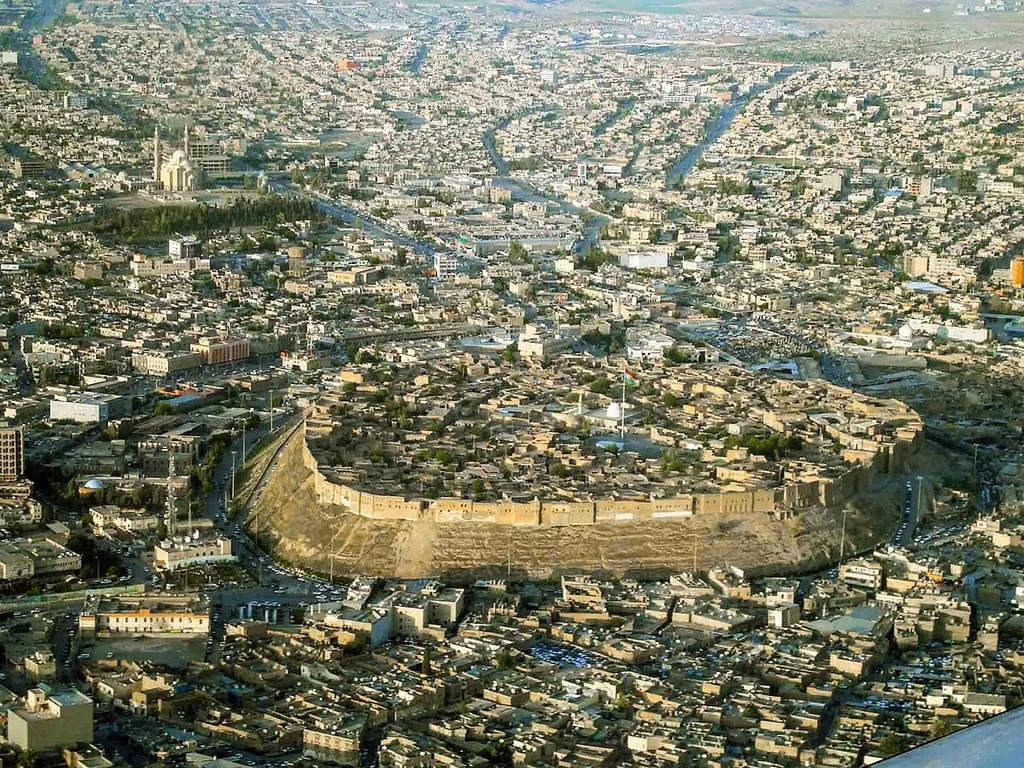
Citadel of Erbil
A Crown Above the City
At the very center of Erbil, the capital of the Kurdistan Region of Iraq, stands one of the most extraordinary human-made features on earth. The Citadel of Erbil — known locally as Qellat, or Qelay Hewlêr in Kurdish — is an enormous ovoid-shaped tell, a mound of accumulated human history, rising a full 26 meters above the modern city that swirls around its base. But this is no ordinary hill. It is, layer upon layer, the physical accumulation of nearly 8,000 years of human settlement: generation after generation who built, lived, rebuilt, and built again upon the same sacred ground.
Covering an area of roughly 102,000 square meters, the Citadel dominates Erbil's skyline with the authority of ancient memory. UNESCO has described it as one of the most visually dramatic and exciting cultural sites not just in the Middle East, but in the entire world. From a distance, its unbroken 19th-century façades give the impression of an impregnable fortress, looming like a colossus above the city below. Up close, it is a labyrinth of history — arched windows, crumbling courtyards, and the whisper of ten thousand years of human stories.
Eight Thousand Years of Continuous History
The Citadel of Erbil is quite possibly the oldest continuously inhabited settlement on Earth. Archaeological evidence places human occupation on the mound as far back as the Chalcolithic period, with pottery sherds resembling the ancient Ubaid and Uruk cultures of Mesopotamia. In April 2019, NASA itself referred to the site as potentially the oldest continuously occupied human settlement on the planet — a staggering claim that speaks to the Citadel's truly unique status in the human story.
Erbil first appears in written history around 2300 BC, mentioned in cuneiform tablets from the ancient Syrian city-state of Ebla under the name Irbilum. Its history draws together the Sumerians, Akkadians, Assyrians, Babylonians, Persians, Greeks, Romans, Sassanids, Arabs, Mongols, Ottomans, and the Kurdish people who call it home today. No city on earth has been shaped by more civilizations across a longer continuous span of time.
The Assyrian Legacy and Ancient Arbela
The Citadel's most glorious ancient chapter came during the era of the Neo-Assyrian Empire, when the city was known as Arbela — a great religious and political center that housed a celebrated temple to Ishtar, the goddess of love, war, and fertility. Ishtar's temple in Arbela was so revered that it was consulted as an oracle by Assyrian kings before major campaigns.
In 331 BC, the plain surrounding Erbil witnessed one of history's most consequential battles — the Battle of Gaugamela — where Alexander the Great defeated the Persian King Darius III, reshaping the ancient world entirely. The city endured Mongol conquest in 1258, an Ottoman siege in the 16th century, and the turmoil of modern Iraqi history, yet its mound never ceased to be occupied, never lost its role as the living heart of the city.
A Tapestry of Faiths and Civilizations
Throughout the centuries, Erbil served as a remarkable meeting point of cultures and faiths. During the Sassanid and Abbasid periods, the city became an important center of Nestorian Christianity, hosting ecclesiastical councils and sustaining vibrant Christian communities for centuries. Beneath and alongside these layers, the Citadel also preserves a 13th-century mosque that still stands within its walls, and an 18th-century hammam — the oldest bathhouse on the mound — which speaks to the rhythms of daily life across the generations.
The late Ottoman phase left perhaps the most visible architectural legacy: a continuous, sweeping wall of tall façades arranged in a distinctive fan-shaped pattern that gives the Citadel its iconic silhouette. These 19th-century buildings, though empty today, are being carefully restored to their former grandeur as part of an ongoing international effort to breathe new life into the ancient mound.
What to See Inside the Citadel
Stepping through the Citadel's grand gateway today is a journey through layered time. The Kurdish Textile Museum, opened in 2004 in a beautifully restored traditional mansion in the Citadel's southeastern quarter, offers an absorbing window into the rich traditions of Kurdish weaving and textile arts across the centuries. Its collection of rare carpets, embroideries, and traditional garments is a must for lovers of cultural heritage.
The UNESCO Visitor and Interpretation Center is a state-of-the-art museum experience that makes the Citadel's vast history accessible and alive. Interactive tools allow visitors to take a virtual walk through time, type their names in cuneiform, explore traditional Kurdish architecture through large-format projections, and listen to samples of traditional Kurdish music. A curated multimedia film gives an overview of the Citadel's revitalization journey. Beyond the museums, wandering the Citadel's atmospheric lanes — past traditional courtyard houses, carved wooden doorways, and views that stretch across the entire modern city — is an experience in itself that no guidebook can fully capture.
UNESCO Recognition and Ongoing Restoration
In 2007, the Kurdistan Regional Government established the High Commission for Erbil Citadel Revitalization (HCECR), relocating the Citadel's remaining residents and launching a major international restoration program backed by over $13 million in public funding. On June 21, 2014, the Citadel was officially inscribed on UNESCO's World Heritage List — a landmark recognition of its outstanding universal value. International teams from across the world continue to collaborate with local archaeologists and conservation specialists to preserve, restore, and gradually reveal the mound's extraordinary buried secrets.
Planning Your Visit
The Citadel sits at the heart of Erbil and is easily reached from any hotel or from Erbil International Airport, which offers direct flights from several Arab and European cities. The best times to visit are spring (March to May) and autumn (September to November), when temperatures are comfortable and the city is at its most welcoming. Erbil's summers are hot and dry; winters are mild and crisp. The Citadel is open throughout the week, with free or nominal-fee access depending on the area and specific museums. Combine your visit with a stroll through Erbil's lively traditional bazaars at the Citadel's base for a complete immersion in the city's living heritage.
Oldest Inhabited Settlement
With evidence of continuous human occupation stretching back nearly 8,000 years, the Citadel of Erbil is widely regarded as possibly the oldest continuously inhabited settlement on earth. In 2019, NASA described it in those very terms — a distinction that places Erbil in an entirely singular category among the world's ancient cities.
UNESCO World Heritage Site
Inscribed on UNESCO's World Heritage List on June 21, 2014, the Citadel was recognized for its outstanding universal value as a rare surviving example of a multi-layered tell that continues to dominate its urban landscape visually and symbolically. This inscription marked a defining moment for heritage tourism in Iraq and the wider region.
The Great Tell
Rising 26 meters above the surrounding city and spanning over 102,000 square meters, the Citadel's mound contains dozens of meters of buried archaeological layers representing every major civilization of Mesopotamia. This physical accumulation of human history is unlike anything else on the planet — a mountain built entirely by human hands and human lives.
Kurdish Textile Museum
Opened in 2004 in a beautifully restored traditional mansion, this museum showcases the richness of Kurdish weaving traditions across the centuries. Its rare collection of carpets, garments, and embroideries offers an intimate window into the cultural identity of the Kurdish people — an essential stop for travelers drawn to living heritage and artisan traditions.
Ottoman Façades
The Citadel's outer wall is defined by a sweeping, unbroken row of tall 19th-century Ottoman-era buildings arranged in a distinctive fan-like pattern unique to Erbil. This monumental façade — golden-hued sandstone rising against an open sky — creates the unmistakable visual impression of an ancient fortress standing guard over the modern world below.