

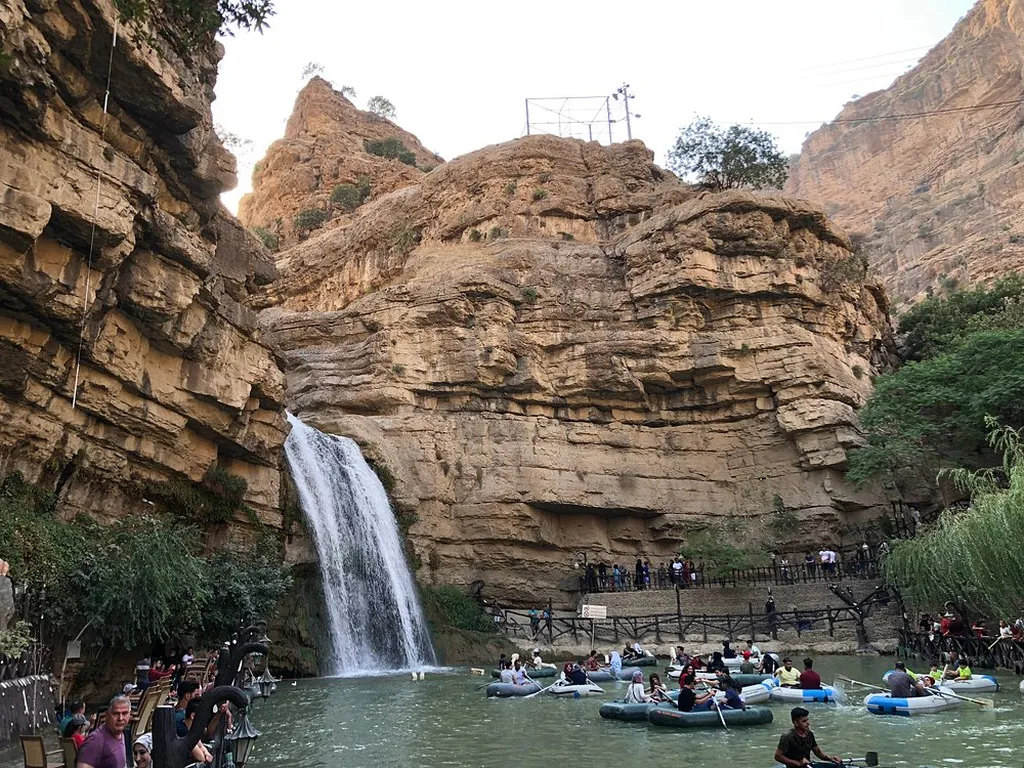
Geli Ali Bag Waterfall
Where the Mountains Part for Water
Deep in the heart of Iraqi Kurdistan, where the Zagros Mountains rise in dramatic tiers of limestone and sky, a cascade plunges from ancient rock with the force of three rivers combined. Geli Ali Bag — the highest waterfall in Iraq and the entire Kurdistan Region — tumbles approximately 12 meters into a shimmering pool below, filling the surrounding gorge with the thunder of rushing water and a cool, perpetual mist that has drawn travelers for generations. Located about 130 kilometers northeast of Erbil, along the legendary Hamilton Road between the towns of Rawanduz and Soran, this is a place where nature speaks louder than words.
The waterfall sits at the confluence of three rivers — the Rawanduz, Sidakan, and Khalifan — in the shadow of Mount Korek, which soars to 2,076 meters above sea level. The surrounding gorge, carved into sweeping curves of dolomite, marlstone, and limestone, has been compared by visitors to the American Grand Canyon in its scale and drama. In spring, fueled by melting snow from the highest peaks, the falls roar with particular force; in summer, they offer blessed relief from the scorching heat of Iraq's southern plains. Over half a million visitors make the journey here each year — a testament to the enduring pull of this mountain marvel.
A Name Born from History
Every great landscape carries a story, and Geli Ali Bag carries one of remarkable poignancy. The waterfall is named after Mîr Elî Beg, a Yazidi prince who was executed in this very valley in 1833 by Prince Muhammad of Rawanduz — the powerful ruler of the Soran Emirate — for refusing to renounce his Yazidi faith and convert to Islam. In the shadow of these ancient cliffs, an act of unwavering defiance became legend, and the waterfall that witnessed it carries his name to this day.
That story resonates with particular power in a region whose people have endured so much for their identity and belief. For Kurdish Iraqis, Geli Ali Bag is more than a waterfall — it is a symbol of heritage, resilience, and the indestructible bond between the land and its people. So iconic is the site that it was featured on Iraq's 5-dinar banknote issued between 1978 and 1990, ensuring that even those who had never visited Kurdistan could recognize its silhouette. Many Iraqis describe their first real visit to the falls as a moment of childhood wonder finally made real.
Ancient Geology, Timeless Beauty
The story of Geli Ali Bag begins long before any human memory. According to leading geologists from Soran University, the rock formations at the waterfall date back approximately 25 million years to the Miocene epoch — shaped by the tectonic collision of the Arabian and Iranian plates along the Zagros Mountain curve. The diverse rock composition — dolomite, marlstone, and limestone — gives the gorge its characteristic layered appearance, with cliffs of varying hues catching the light differently at each hour of the day. Mount Korek itself, which forms the dramatic backdrop to the falls, is even older, with formations tracing back to the Jurassic era approximately 165 million years ago. Standing at the edge of the pool and looking up at those ancient walls, you are not merely seeing a waterfall — you are reading 25 million years of the Earth's autobiography.
The Hamilton Road: Engineering Through the Mountains
The journey to Geli Ali Bag is an experience in its own right. The route from Erbil winds through Shaqlawa, Harir, and Soran before joining the famous Hamilton Road — a remarkable feat of civil engineering commissioned by the British administration in 1928. Named after its chief engineer, Archibald Hamilton, the road was carved through sheer mountain gorges to create a strategic route toward the Iranian border. Hamilton later wrote about the experience in his book Road Through Kurdistan, describing both the immense technical challenges and the extraordinary beauty of the landscape he worked within. Driving this road today, with its hairpin bends and sweeping canyon views, remains an adventure that rivals the destination itself — a living monument to human ambition set against one of the most spectacular natural corridors in the Middle East.
What to See and Do
At Geli Ali Bag, the cold, crystalline water that pools at the base of the falls invites visitors to wade in barefoot and feel the mountain chill on their skin — a rite of passage that generations of Kurdish families have shared, children squealing and elders smiling in the shallows. During spring and summer, small boats are available for hire, offering a unique vantage point from the water itself. Shaded picnic areas line the riverbanks, while cliffside paths lead to panoramic viewpoints above the gorge. The surrounding terrain is laced with hiking trails that wind past ancient ruins, natural cave formations, and forested slopes, rewarding those who venture further with views of extraordinary grandeur.
Local vendors near the entrance sell traditional Kurdish sweets and handcrafted souvenirs, and riverside restaurants serve grilled meats and freshwater fish with the falls as backdrop. The experience need not end at the waterfall itself: nearby attractions — including the Bekhal Waterfall and the Korek Mountain cable car, which ascends to a resort village at over 2,000 meters — make Geli Ali Bag the centerpiece of a full day, or even a weekend, in one of Iraq's most breathtaking natural corridors.
When to Visit and How to Get There
The best time to visit Geli Ali Bag is between April and October. Spring sees the waterfall at its most powerful, swollen with snowmelt and surrounded by wildflowers. Summer draws crowds seeking relief from the heat, while autumn wraps the surrounding hills in warm amber and russet tones. By car from Erbil, the journey takes approximately 1.5 to 2 hours. Shared taxis from Erbil to Soran are an affordable option at around 3,000 IQD, and from Soran a local taxi to the waterfall costs roughly 10,000–15,000 IQD. Entry to the site is generally free. Come with comfortable shoes, an open heart, and the willingness to let the sound of falling water slow the pace of the world around you.
Iraq's Highest Waterfall
Standing approximately 12 meters tall, Geli Ali Bag is the highest waterfall in Iraq and the Kurdistan Region. Fed by the convergence of three rivers in the shadow of Mount Korek, it produces a cascade of remarkable power — and draws over half a million visitors to its misty pool every year.
The Yazidi Prince
The waterfall is named after Mîr Elî Beg, a Yazidi prince executed here in 1833 for refusing to abandon his faith. His defiance in the face of death became legend, and his name lives on in the very landscape that witnessed his final stand — a powerful reminder of Kurdistan's layered human history.
Printed on Banknotes
Geli Ali Bag was featured on Iraq's 5-dinar banknote between 1978 and 1990, making it one of the most recognizable natural landmarks in the country. For generations of Iraqis, the waterfall existed first as a dream glimpsed on currency — and later as a destination finally reached in person.
The Hamilton Road
The drive to the falls follows the historic Hamilton Road, carved through mountain gorges in 1928 by British engineer Archibald Hamilton. The road — documented in Hamilton's own book, <em>Road Through Kurdistan</em> — is a scenic adventure of hairpin bends and canyon panoramas that rivals any destination in the region.
Gateway to the Zagros
Geli Ali Bag sits within a 25-million-year-old gorge of dolomite and limestone, surrounded by hiking trails, natural caves, and sweeping mountain vistas. Nearby Bekhal Waterfall and the Korek Mountain cable car make it the anchor of an unforgettable journey into the wildest and most beautiful corner of Iraq.