

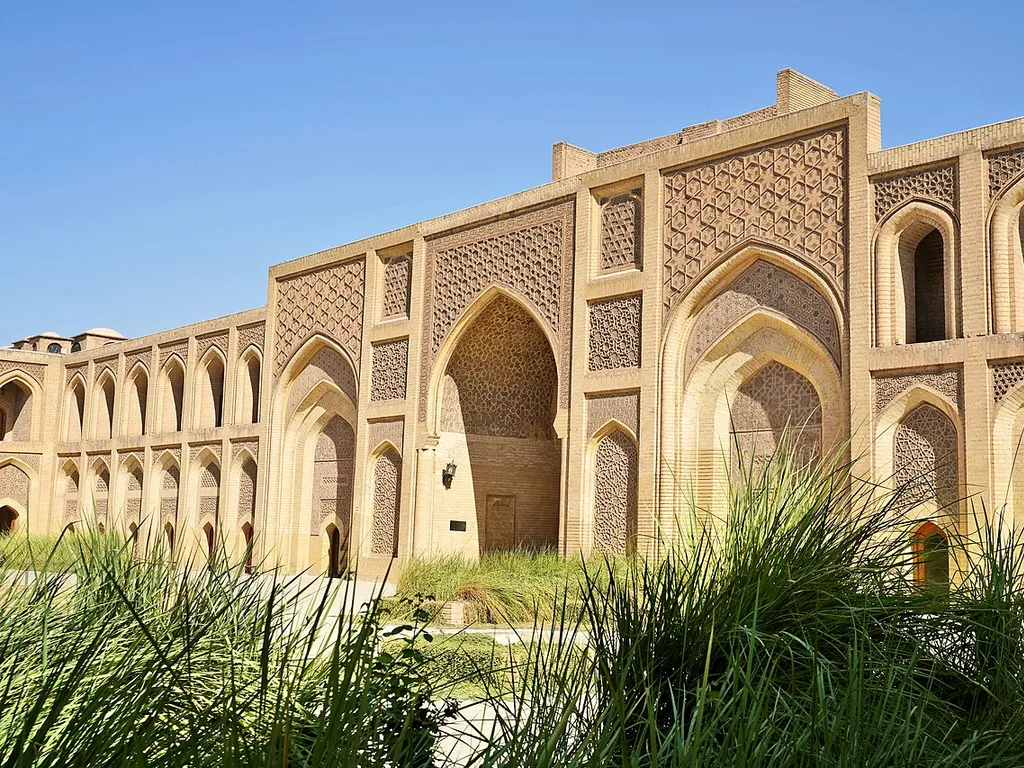
Al-Mustansiriya School
Location & Overview
Al-Mustansiriya School stands on the eastern bank of the Tigris River in central Baghdad, just downstream from the Shuhada Bridge. Constructed entirely of golden-ochre brick, its long riverside facade has watched centuries of history unfold — from the peak of Abbasid glory to Mongol fire, Ottoman commerce, and modern restoration. Today it remains one of the only surviving authentic landmarks of medieval Baghdad and a living testament to Iraq's enduring intellectual spirit.
The madrasa is officially listed as part of a tentative UNESCO World Heritage Site, recognised for its outstanding universal significance as a monument to Islamic education, science, and architectural achievement. Visiting it feels less like touring a ruin and more like stepping through a portal to the very heart of the Islamic Golden Age.
The Birth of a Universal University
In 1227 CE, the thirty-seventh Abbasid Caliph al-Mustansir Billah commissioned this extraordinary complex, and after six years of meticulous construction it was formally inaugurated on April 6, 1233 CE, in a grand ceremony attended by the Caliph himself. Its total construction cost was reported at 700,000 dinars — an astonishing sum that speaks to how deeply the Abbasids valued the pursuit of knowledge.
What makes Al-Mustansiriya revolutionary in educational history is its universal character. It was the first institution ever to teach Islamic jurisprudence according to all four Sunni schools of thought — Hanafi, Maliki, Shafi'i, and Hanbali — under one roof. Each of the four great iwans in its central courtyard was devoted to one school, transforming the building itself into a physical declaration that knowledge belongs to all.
A Cathedral of Learning
The curriculum at Al-Mustansiriya far exceeded religious study. Students immersed themselves in theology, Arabic grammar, literature, medicine, mathematics, astronomy, philosophy, and Islamic law. Entry was competitive, and those who gained a place were rewarded handsomely: the madrasa provided free lodging, food, clothing, and a monthly stipend for the duration of their studies — which could stretch to a full decade. Graduates emerged qualified for the highest offices in the state, serving as judges, diplomats, viziers, and professors.
Students journeyed from across the Islamic world to study here — from Andalusia and Egypt in the west to the Levant, Isfahan, and Khorasan in the east. The library alone was one of the wonders of the age: the Caliph donated 80,000 volumes at opening, and the collection eventually swelled to an estimated 400,000 manuscripts and books, drawing scholars from every corner of civilisation.
Architectural Splendour
The building is a masterclass in classical Abbasid architecture. Rectangular in plan, it surrounds an open central courtyard with four monumental iwans — deep vaulted halls — facing each other on two axes. Two stories of pointed arched arcades line the courtyard on all sides, leading to student cells, lecture halls, and service rooms. The entrance facade along the Tigris is framed with intricate carved brickwork: geometric star patterns, arabesque terracotta reliefs, concentric mouldings, and calligraphic inscriptions in flowing Arabic script.
Among its more astonishing innovations, a water-powered mechanical clock was completed in the entrance hall in 1235 CE — one of the earliest automatic timepieces in history, capable of announcing the hours of prayer and the time of day and night. It is a reminder that this was not merely a religious school but a living hub of scientific inquiry.
Survival Through the Ages
Al-Mustansiriya's history is a saga of destruction and rebirth. In 1258 CE, Hulagu Khan's Mongol armies sacked Baghdad in one of history's most devastating acts of cultural vandalism: students were massacred, books were hurled into the Tigris, and the madrasa was severely damaged. It survived, only to be struck again by Timur (Tamerlane) in 1392 and again in 1400. In the centuries that followed, the complex served as a caravanserai for traders, a military depot, and finally an Ottoman customs office in 1865 — noble walls reduced to bureaucratic duty.
Restoration began in earnest in 1945, when the Iraqi Directorate of Antiquities cleared the encroaching market stalls and began rebuilding. Today, the surrounding commercial district has been largely removed to return the site to its original footprint. The United Nations has explicitly praised the madrasa as a testament to Iraq's resilience, calling it proof that culture and knowledge will always outlast barbarism.
Visitor Tips
Al-Mustansiriya is easily accessible from central Baghdad and is open to visitors during set hours. The early morning is the ideal time to visit: the low golden light catches the carved brickwork at a dramatic angle and the riverside is at its most serene. A knowledgeable local guide will greatly enrich your visit — the calligraphic inscriptions running along the portals and iwans tell stories that take time to decode.
The madrasa sits close to the lively souqs of old Baghdad and the banks of the Tigris, making it an ideal anchor for a full-day walk through the ancient city. Whether you are a history enthusiast, an architecture lover, or simply a traveller hungry for meaning, Al-Mustansiriya does not disappoint. It is not just a monument — it is the place where the Islamic world once gathered to think, and where Iraq continues to remember who it is.
World's First Universal University
Al-Mustansiriya was the first institution in history to teach Islamic law according to all four Sunni schools of thought under a single roof. This groundbreaking model of inclusive higher education drew students from every corner of the Islamic world, pioneering a vision of knowledge as a universal inheritance.
Abbasid Architectural Masterpiece
The building is one of the rarest surviving examples of Abbasid Baghdad's architecture. Its four monumental iwans, carved geometric brickwork, arabesque terracotta reliefs, and soaring pointed arches represent the Islamic architectural tradition at its most refined and ambitious — a building that is itself a work of art.
Library of 400,000 Manuscripts
The madrasa housed one of the greatest libraries in the ancient world, with a collection that grew to an estimated 400,000 volumes covering every field of human knowledge. Despite catastrophic losses during the Mongol invasion, the library's memory endures as a symbol of Baghdad's role as the world's intellectual capital.
Medieval Mechanical Clock
In 1235 CE, one of the earliest water-powered automatic clocks in history was installed in the madrasa's entrance hall. It announced the hours of prayer and marked time both day and night — a stunning testament to the scientific genius that flourished within these walls.
Symbol of Iraq's Resilience
Surviving Mongol sieges, Ottoman conversion, and modern conflict, Al-Mustansiriya stands today as a powerful symbol of Iraq's unbreakable spirit. Praised by the United Nations and nominated for UNESCO World Heritage status, it proves that culture and learning always outlast those who seek to destroy them.