

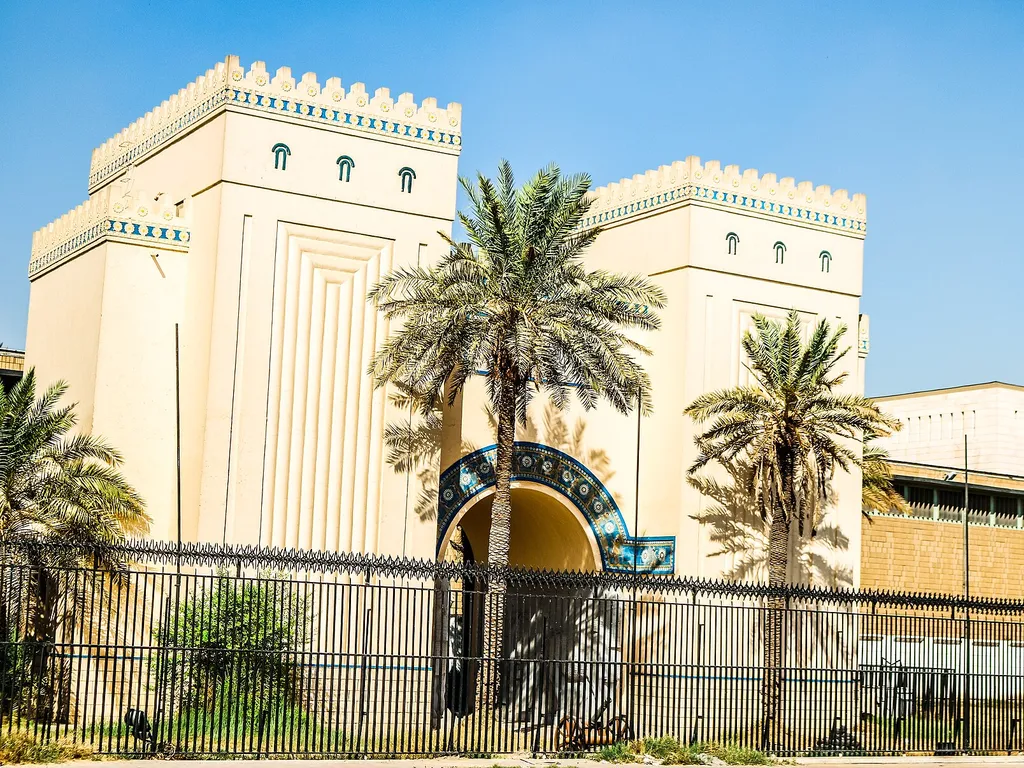
The Iraqi Museum
Guardian of Human Civilization
Standing on the west bank of the eternal Tigris in the heart of Baghdad, the Iraqi Museum is not merely a building — it is a time machine. Step through its doors and you are transported across more than ten thousand years of human civilization: from the very first scratches of cuneiform writing pressed into clay, to the soaring geometric beauty of Abbasid Islamic art. No other museum on Earth tells the story of Mesopotamia — the cradle of civilization — with such staggering depth and intimacy. This is where humanity first wrote its name.
Spanning 45,000 square meters and housing artifacts across 28 galleries and vaults, the Iraqi Museum is home to treasures from the Sumerian, Akkadian, Babylonian, Assyrian, Chaldean, Persian, and Abbasid civilizations. Every stone, every clay tablet, every gilded ornament whispers its own chapter of a story that belongs not just to Iraq, but to all of humankind.
From Humble Beginnings: The Museum's History
The museum's origins trace back to a single room. In 1922, the extraordinary British orientalist and political officer Gertrude Bell began storing Iraqi antiquities in a Baghdad government building, driven by her conviction that the people of Iraq deserved custodianship of their own heritage. She personally lobbied for Iraq's first antiquities law and selected many of the earliest acquisitions herself. In 1926, the Baghdad Archaeological Museum was formally established, with Bell as its first director — a role she held until her death that same year.
Over the following decades, the collection grew alongside Iraq's archaeological ambitions, fueled by landmark excavations at Ur, Uruk, Nineveh, and Nimrud. In 1966, the museum relocated to its current grand premises in Baghdad's Al-Ṣāliḥiyyah neighborhood. Though the devastating looting of 2003 — during which over 15,000 artifacts were stolen — inflicted wounds that are still being healed, the museum's resilient staff and international partners rallied to restore and reopen it. On February 28, 2015, the Iraqi Museum opened its doors once more, defiant and alive, as a symbol of Iraq's unbreakable cultural identity.
Treasures Beyond Measure: The Collection
The museum's galleries read like a greatest-hits album of human achievement. The crown jewel is undoubtedly the Nimrud Gold Collection — an extraordinary cache of golden jewelry, vessels, and figurines encrusted with precious stones, unearthed from the royal tombs of Assyrian queens and dating to the 9th century BCE. Considered among the finest examples of ancient goldsmithing in the world, these pieces dazzle with their intricacy and elegance.
Equally mesmerizing are the cuneiform tablets from ancient Uruk, dating between 3500 and 3000 BCE — some of the oldest written documents in human history. Standing before them, you are face to face with the moment humanity invented writing. The Assyrian galleries overwhelm with their monumental stone reliefs and towering winged bull statues — lamassu — that once guarded the gates of imperial palaces, their serene human faces radiating an ancient, authoritative calm. The Islamic galleries chart the golden age of the Abbasid Caliphate, when Baghdad was the intellectual capital of the world. And throughout, the museum traces the unbroken thread of daily life in Mesopotamia: pottery, jewelry, weapons, mathematics, and medicine across the ages.
A Story of Resilience
No visit to the Iraqi Museum is complete without reflecting on the extraordinary story of its survival. The 2003 looting — described by Iraqi officials as "the crime of the century against the heritage of all mankind" — saw thousands of priceless artifacts vanish. Yet what followed was equally remarkable: an international mobilization involving Italy, the United States, Japan, UNESCO, and dozens of institutions helped restore the museum's galleries, repatriate stolen pieces, and train a new generation of Iraqi conservators. Artifacts that had been smuggled across borders were recovered at checkpoints and returned by remorseful individuals.
Today, the Iraqi Museum stands as one of the most powerful symbols of cultural resilience anywhere in the world. Every object on display carries a double meaning — it is both an artifact of an ancient civilization and a testament to a modern nation's determination to preserve its soul. Visiting this museum is an act of solidarity with that story.
Planning Your Visit
The museum is located in the Al-Ṣāliḥiyyah district of Al-Karkh, easily reachable by taxi or private car from central Baghdad. Admission for foreign visitors is approximately 25,000 Iraqi dinars. Allow at least two hours for a thorough visit; three or more if you wish to linger over the details. The museum is open Tuesday through Sunday, and the cooler months of autumn and spring offer the most comfortable visiting conditions. It is advisable to confirm current opening hours in advance. Don't leave Baghdad without stepping inside — this is one of the great museums of the world.
The Nimrud Gold
An extraordinary collection of golden jewelry, vessels, and gemstone-encrusted ornaments recovered from the royal tombs of Assyrian queens, dating to the 9th century BCE. Considered among the finest ancient goldsmithing in the world, the Nimrud Gold collection is breathtaking in its artistry and its survival against all odds.
Cuneiform Tablets of Uruk
Dating between 3500 and 3000 BCE, these clay tablets from ancient Uruk are among the oldest written documents ever found. Standing before them, you witness the precise moment humanity first committed language to material form — an invention that changed the course of civilization forever.
Assyrian Monumental Sculptures
Towering winged bulls with human faces — the legendary lamassu — and intricately carved stone reliefs depicting royal hunts and military conquests fill the Assyrian galleries. These imposing works, once guardians of palace gates, radiate a power and presence that has not dimmed in three thousand years.
Abbasid Islamic Art
A dedicated gallery celebrates the Abbasid Caliphate's golden age, when Baghdad was the world's foremost center of science, philosophy, and artistic brilliance. The ceramics, metalwork, and decorative arts on display reveal a civilization of extraordinary sophistication and creative energy.
28 Galleries, 10,000 Years
From prehistoric stone tools to Babylonian mathematical tablets to exquisite Islamic manuscripts, the museum's 28 galleries trace an unbroken arc of human ingenuity and expression. No other institution offers quite this sweep of time — each room is a civilization unto itself, waiting to be discovered.