

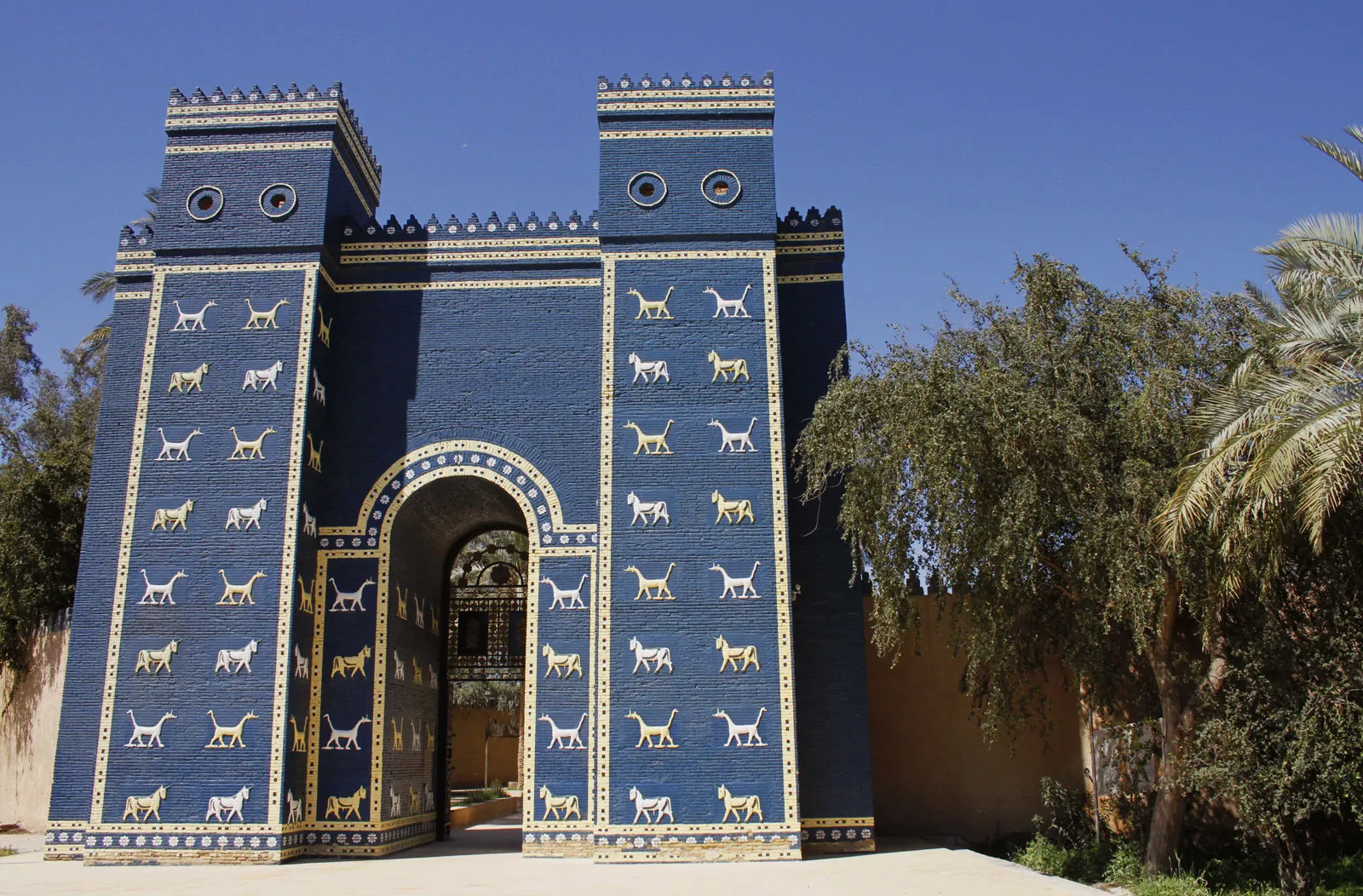
The Ishtar Gate — Babylon's Eternal Gateway
A Gateway That Opens onto History
Eighty-five kilometres south of Baghdad, in the fertile plains of Babil Governorate, rests one of the ancient world's most magnificent creations: the Ishtar Gate. It served as the main ceremonial entrance to the inner city of Babylon — the eighth gate in its formidable outer walls — and was constructed on the orders of King Nebuchadnezzar II around 575 BCE. Today, the site lies within the boundaries of modern Hillah and forms the centrepiece of the Babylon Archaeological Site, inscribed on the UNESCO World Heritage List in 2019.
Close your eyes and picture what a traveller of antiquity would have seen approaching the city: a gate rising over twelve metres into the sky, blazing in a thousand shades of royal blue, as though fashioned from lapis lazuli itself — the most coveted gemstone of the ancient world. This was no mere entrance. It was a thunderous proclamation of Babylonian civilisation at its absolute zenith.
Nebuchadnezzar's Masterpiece
Nebuchadnezzar II ruled Babylon from 604 to 562 BCE, and at the height of his power he was determined to make his capital the greatest city the world had ever seen. The Ishtar Gate was the crown jewel of his sweeping architectural programme, which also included the restoration of the great Temple of Marduk and the construction of the legendary Hanging Gardens — one of the Seven Wonders of the Ancient World. He dedicated the gate to the goddess Ishtar, deity of fertility, love, and war, a divine guardian whose power was meant to shield the city from any who dared oppose it.
In its original form, the gate was a double structure: a smaller frontal gate and a larger, more imposing rear section. Its foundations plunged fourteen metres underground to ensure permanence, and its roof and doors were fashioned from cedar wood and bronze. Buried within its very foundations, Nebuchadnezzar placed a dedication plaque inscribed in his own name, describing the gate's grandeur and consecrating it to the gods — a royal voice preserved in clay for more than two and a half millennia.
Sacred Art and Divine Symbolism
What elevates the Ishtar Gate from monument to masterpiece is the profound union of artistry and religious meaning embedded in every brick. Its facades are adorned with alternating rows of three sacred animals: the serpentine mušḫuššu dragon, the wild aurochs bull, and the lion. These were not decorative choices — each creature embodied a supreme Babylonian deity. The dragon represented Marduk, the supreme god of Babylon; the bull embodied Adad, god of storms and weather; the lion stood for Ishtar herself.
Each animal was sculpted in moulded and glazed brick, rendered in shades of gold, brown, and cream against a backdrop of brilliant blue. Scholars estimate there were 575 dragons and bulls arranged across thirteen rows on the gate alone, while 120 glazed lions lined the Processional Way beyond. The craftsmen responsible — known in Babylonian as ummânū, or "experts" — were regarded not merely as skilled artisans but as ritual specialists capable of imbuing clay and glaze with genuine divine power.
The Sacred Processional Way
The Ishtar Gate cannot be understood in isolation from the Processional Way, the great ceremonial boulevard that ran from the gate deep into the heart of the city for over half a mile. Paved with limestone and baked brick, its towering walls were lined with more than 120 glazed brick lions striding forward, eternal sentinels watching over all who passed.
Every year, ancient Babylon celebrated Akitu — the New Year festival, the most important religious event in the Babylonian calendar. In a spectacular procession, priests, musicians, and worshippers carried the statue of Marduk down the Processional Way, through the Ishtar Gate, and to his great temple at the city's sacred centre. In those luminous moments, the gate was not merely architecture — it was the threshold between the mortal world and the divine, a portal through which the gods themselves were believed to move.
A National Symbol and the Debate Over Heritage
German archaeologist Robert Koldewey excavated the gate between 1902 and 1914, meticulously numbering each fragment and shipping the glazed brickwork to Berlin, where it was reassembled at the Pergamon Museum by 1930. The reconstruction — 14 metres high and 30 metres wide — draws millions of visitors to Berlin each year. The original glazed brickwork remains in Germany to this day, despite repeated calls from the Iraqi government for its repatriation, most notably in 2002 and 2009.
At the Babylon site in Iraq, visitors can still see the earliest construction phase — the unglazed relief-brick foundations that formed the very first iteration of the gate, still standing in their original location. The Ishtar Gate has become a powerful symbol of national identity for modern Iraq, appearing on the facades of Iraqi embassies from Beijing to Amman, and its contested history makes it one of the world's most compelling examples in the ongoing global conversation about the repatriation of cultural heritage.
Visiting Babylon Today
The ancient city of Babylon is an easy day trip from Baghdad — approximately one hour by road heading south. The site received nearly 50,000 visitors in 2024, with foreign tourism steadily growing, and infrastructure improvements continue to make access easier for international travellers. At the site, you can walk through the reconstructed Ishtar Gate, stand on the ancient Processional Way, gaze upon the famous 2,600-year-old Lion of Babylon carved from black basalt, and explore the ruins of Nebuchadnezzar's great palace.
The best times to visit are spring (March–May) and autumn (October–November), when temperatures are mild and the ruins glow golden in softer light. Bring your passport for registration at the entrance, wear comfortable walking shoes, and carry water and sunscreen. Guided tours depart regularly from Baghdad, and the World Monuments Fund's ongoing Future of Babylon Project — which includes conservation work on the Ishtar Gate's north retaining wall — ensures the site continues to be protected for generations to come. To walk through Babylon is to walk through the very origin of human civilisation.
Lapis Lazuli Blue
Thousands of bricks fired and glazed in deep royal blue were chosen to evoke the prized lapis lazuli stone, making the gate shimmer like a jewel against the Mesopotamian sky. This ancient Babylonian glazing technique was so advanced that it still fascinates architects and materials scientists today.
Sacred Animal Reliefs
The gate's dragons, bulls, and lions were not mere decoration — each embodied one of Babylon's supreme deities: Marduk, Adad, and Ishtar. An estimated 575 animals once adorned its thirteen rows, a staggering sculptural achievement that has never been surpassed in the ancient Near East.
The Processional Way
Stretching over half a mile from the gate into the city, the Processional Way was lined with 120 glazed lion reliefs and served as the stage for Babylon's greatest religious festivals. Walking its path today still carries the weight of three thousand years of ceremony and reverence.
Nebuchadnezzar's Own Words
A dedication plaque buried in the gate's foundations — written in the king's own voice — describes the gate's construction and consecrates it to the gods. It is one of the most intimate royal inscriptions to survive from the ancient world, a direct line to one of history's most powerful rulers.
Iraq's National Icon
The Ishtar Gate graces the facades of Iraqi embassies across the globe and lies at the heart of an ongoing international debate about cultural repatriation. Its story is both deeply ancient and urgently modern — a reminder that the heritage of Mesopotamia belongs to all of humanity.