

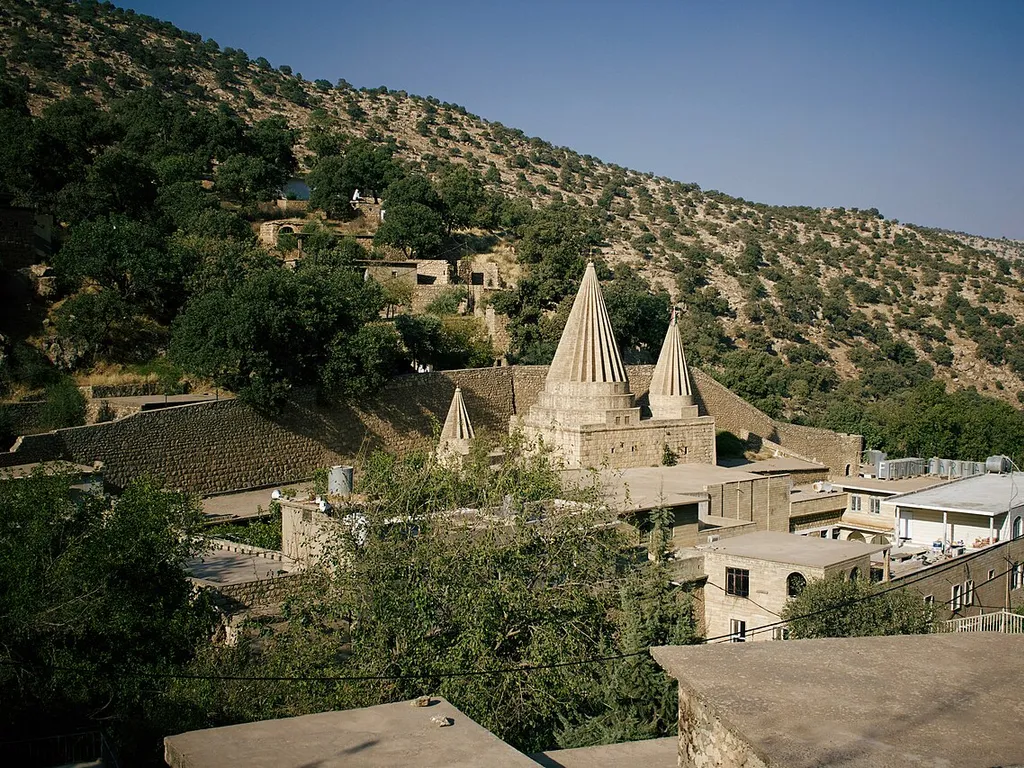
Lalish — The Sacred Heart of the Yazidi World
Location & Setting
Hidden within a mountain valley in the Nineveh Plains of northern Iraq, Lalish sits approximately 60 kilometres northwest of Mosul and 40 kilometres from the city of Duhok. Three mountains embrace it on all sides — Hizrat to the west, Misat to the south, and Arafat to the north — as if the landscape itself conspired to shelter this sacred ground from the outside world. Perched at 861 metres above sea level, the valley enjoys a cool breeze and lush greenery that stands in beautiful contrast to the sun-scorched plains below.
The approach to Lalish is part of the experience itself: a winding mountain road flanked by ancient mulberry and oak trees, until the valley suddenly opens to reveal a cluster of white, finger-like conical spires piercing the sky. In that first moment, before a single word is spoken, you understand you have arrived somewhere extraordinary.
Ancient Origins & History
The valley of Lalish is believed to have served as a sacred site since the earliest Mesopotamian civilisations, with scholars noting the presence of pre-Christian symbols carved into its stone walls. The site's central significance in its current form, however, crystallised in the 12th century, when Sheikh Adi ibn Musafir — a Sufi mystic born in Lebanon's Beqaa Valley — chose this remote valley for a life of contemplation and spiritual teaching. Local Kurds, practitioners of ancient syncretic traditions, gathered around him, and from this union the Yazidi faith as it is known today emerged. Sheikh Adi died in 1162 CE and was buried at Lalish; his tomb has been the beating heart of Yazidi devotion ever since.
The valley has known great suffering. In 1892, Ottoman-backed forces seized Lalish and converted the temple into a Quranic school, only for Yazidi fighters to reclaim it by force in 1904. Then in August 2014, as ISIS unleashed genocide upon the Yazidi community of Sinjar, thousands of refugees fled to Lalish — a place of refuge as much as prayer. This living memory of endurance is inseparable from the valley's identity, and it is part of why visitors today are welcomed with such open, generous warmth.
Architecture of Light
Lalish is architecturally unlike any other religious site in Iraq. Its sharply ribbed conical domes — tapering spires divided into precise vertical flutes from apex to base — have no parallel in any other temple or mausoleum in the country. Each dome is designed to catch and reflect sunlight, embodying the Yazidi belief in the divine power of the sun. For this reason, Yazidis call Lalish "Mekka Rakka" — the Home of the Sun.
The temple complex spreads across a series of shrines, courtyards, stone passageways, and ancient trees. The most prominent structure is the Shrine of Sheikh Adi, crowned by three conical domes and housing the saint's sarcophagus draped in green velvet and ringed with knotted, coloured scarves — each knot a prayer tied by a pilgrim. Outside the shrine's entrance, carved into the stone, is one of Lalish's most iconic symbols: the Black Serpent, which Yazidi legend says saved Noah's Ark by sealing a leak with its own body. Throughout the complex, visitors will also find ancient carvings of the solar eye, the open ring, and other symbols whose full meaning has been carried for generations in the oral tradition of the Yazidi people.
Living Faith & Pilgrimage
To the Yazidis, Lalish holds the same sacred weight as Mecca to Muslims or Jerusalem to Christians and Jews — it is their spiritual homeland, the axis around which their entire religious universe turns. Every Yazidi is expected to undertake a six-day pilgrimage to Lalish at least once in their lifetime. Yazidi children are baptised in the waters of Lalish's two sacred springs, even when families must travel from Europe or the Americas to do so. Sacred soil from the valley, mixed with spring water, is formed into clay balls that play a role in the community's most important rituals: marriage ceremonies, funeral rites, and daily devotion.
The most spectacular time to visit is during the annual Autumn festival of Cejna Cemaiyye, when thousands of pilgrims descend on the valley for days of prayer, music, and dancing. Each evening throughout the year, resident priests carry oil lamps through the complex in a torchlight procession, their ancient hymns rising with the incense smoke into the mountain air — a ritual that has continued unbroken for centuries.
Visitor Information & Tips
Lalish welcomes visitors of all backgrounds and faiths, and the resident community takes quiet pride in sharing the beauty of their traditions with the world. A few customs must be respected: shoes must be removed at the valley entrance, as the entire site is walked barefoot (or in socks, which is permitted). Thresholds of doorways must never be stepped on — Yazidi belief holds that an angel stands on each threshold. Dress modestly: long trousers for men; covered legs, shoulders, and a headscarf for women.
The ideal seasons to visit are spring and early autumn, when the mountains are green and the temperature is mild. Lalish is best reached by private vehicle or taxi from Duhok (approximately 40 km) or from Erbil (approximately 120 km). There is no public transport to the valley. Nearby, the ancient Chaldean Christian monastery of Alqosh makes for a rewarding combined day trip, adding yet another layer to northern Iraq's remarkable tapestry of faith and heritage.
Lalish is not merely a destination — it is a conversation across millennia. Come barefoot, come quietly, and let the valley speak.
Shrine of Sheikh Adi
The tomb of Sheikh Adi ibn Musafir (died 1162 CE), founder of the Yazidi faith, is the holiest site in the entire Yazidi world. Three white conical domes crown the shrine, and inside, the saint's sarcophagus is draped in green velvet and encircled with knotted, coloured scarves — each knot a prayer placed by a pilgrim's hands.
The Conical Domes
Nowhere else in Iraq does architecture like this exist. The sharply ribbed, finger-like spires of Lalish are specifically designed to channel sunlight, representing the divine radiance at the core of Yazidi belief. Ancient symbols carved into the surrounding stone walls — some dating to pre-Christian millennia — make every façade a page of living scripture.
The Black Serpent
Carved beside the entrance to Sheikh Adi's shrine, the Black Serpent is one of Yazidism's most powerful emblems. According to Yazidi tradition, when Noah's Ark began to take on water, a black serpent plugged the leak with its own body, saving humanity. The symbol encapsulates the Yazidi view that divine mystery cannot be reduced to simple categories of good and evil.
The Sacred Springs
Beneath the temple complex flow two springs of water considered among the most sacred in the Yazidi faith. Yazidi children are baptised in these waters, and soil from Lalish mixed with spring water forms the sacred clay balls used in marriage and funeral rituals across the global Yazidi community. Access to the springs is reserved for Yazidi worshippers.
Nightly Torchlight Procession
Every evening without fail, resident priests at Lalish light oil lamps and carry them through the temple complex in a ceremonial procession, chanting ancient hymns as incense smoke curls between the stone arches and old mulberry trees. This unbroken daily ritual is a mesmerising reminder that Lalish is not a relic — it is a living, breathing sacred community.