

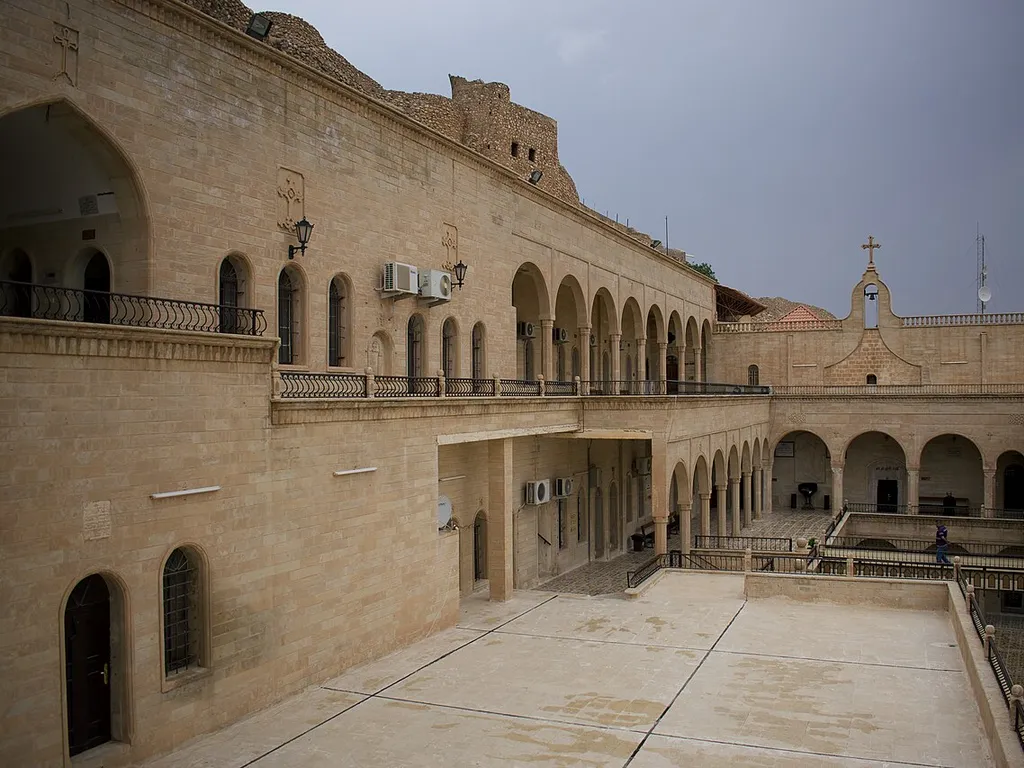
Mor Mattai Monastery — A Fortress of Faith on Mount Alfaf
Location and Overview
Perched at roughly 820 meters above sea level on Mount Alfaf — also known as Mount Maqlub — in the Nineveh Governorate of northern Iraq, Mor Mattai Monastery commands one of the most breathtaking vantage points in all of Mesopotamia. Located approximately 20 kilometers northeast of Mosul, this ancient stronghold seems to grow organically from the mountain itself, its honey-colored stone walls suspended between earth and sky. From its ramparts, the legendary plains of Nineveh stretch away to the horizon in every direction, golden and seemingly infinite beneath the vast Iraqi sky.
Recognized as one of the oldest Christian monasteries in existence anywhere in the world, Mor Mattai holds the distinction of being the oldest Syriac Orthodox monastery on earth. Its three-story complex encompasses around 100 rooms, two historic churches — one dedicated to Saint Mattai and the other to the Virgin Mary — ancient cisterns, cave hermitages carved into the mountainside, and a library housing centuries-old Syriac manuscripts.
The Story of Its Founding
In the year 363 AD, as the Roman Emperor Julian the Apostate unleashed a campaign of persecution against Christians across his empire, a devout hermit named Mor Mattai fled his home city of Amid — modern-day Diyarbakır in southeastern Turkey — together with 25 fellow monks. Seeking refuge in the rugged mountains near Nineveh, he made his home on Mount Alfaf, where he quickly became revered for his piety and his reported gift of healing.
Syriac tradition tells a story of miracles and conversion: Mor Mattai is said to have healed Sarah, the daughter of Sennacherib — a governor of the Nimrud region appointed by the Persian King Shapur — of a grave illness, and in doing so brought both Sarah and her brother Behnam to Christian faith. Though Sennacherib initially reacted to their conversion with rage, tradition holds that he repented and, at Mor Mattai's request, built a church and monastery on Mount Alfaf to honor the memory of his children. The monks who had followed Mor Mattai settled in huts and caves around the mountain, forming one of the earliest monastic communities in the entire Christian East.
Spiritual and Scholarly Legacy
At the height of its influence, Mor Mattai reportedly sheltered as many as 7,000 monks within its precincts and the surrounding mountain caves — earning Mount Alfaf the epithet "the mountain of thousands." The monastery became the pre-eminent Syriac Orthodox center in northern Iraq, serving as a seat for bishops and metropolitans and hosting three major church synods that shaped the organization of the Eastern church for centuries.
Its scholarly output was equally remarkable. The monastery's library assembled a vast collection of Syriac Christian manuscripts, including illuminated gospel books, theological treatises, and liturgical texts. Though a catastrophic fire in 480 AD and successive raids over the centuries destroyed much of this archive, the library still holds 224 manuscripts today, the oldest being a New Testament copy dating to 1222 AD. Mor Mattai has produced three Patriarchs of Antioch, seven Maphrians (the highest ecclesiastical title in the Eastern church below the patriarch), and more than sixty metropolitans — an unparalleled contribution to the leadership of Syriac Christianity.
Centuries of Resilience
The monastery's history is inseparable from the story of survival against extraordinary odds. Kurdish forces attacked it repeatedly during the 12th through 16th centuries; Mongol armies under Hulagu — grandson of Genghis Khan — swept through the Mosul region in 1262; fire, earthquake, and neglect all took their toll in turn. Each time, the monastery was rebuilt, its monks returning like the mountain spring after a dry season, stubbornly persistent in their devotion.
The most dramatic test came in 2014, when the Islamic State seized Mosul and swept across the Nineveh plains, coming within a few kilometers of the monastery's walls. Remarkably, Mor Mattai survived completely intact while much of the region's Christian heritage was being systematically destroyed. The reasons for its preservation remain a mystery — and for the monks who stayed at their posts throughout the crisis, something very close to a miracle. By 2017, pilgrims and visitors were returning once more, and the monastery's ancient bells were ringing again across the mountain.
What to See and Experience
A visit to Mor Mattai is an immersive journey through time. Explore the two ancient churches with their richly carved stone interiors and lingering incense. Wander the House of Saints, where the relics of Mor Mattai himself and successive bishops are venerated. Descend into the cave hermitages and cisterns that have barely changed since the first monks carved them from the living rock. Browse the manuscript library, where parchment pages nearly 800 years old still hold their ink with quiet dignity.
The monastery is best reached from Mosul or the nearby Christian towns of Bakhdida (Qaraqosh) via a recently paved road that winds up the mountainside. Arrive in the early morning for the best light on the stone facades, the quietest corridors, and the chance to hear the monks chanting the ancient Syriac liturgy. Dress modestly out of respect for an active place of worship, and allow yourself time simply to sit and absorb the panorama of Nineveh spread below — a view that monks have contemplated in prayer for sixteen hundred years.
An Invitation to Visit
Mor Mattai is not a ruin or a museum piece. It is a living monastery where robed monks continue to pray, chant, and tend their mountain home with the same unhurried devotion as their predecessors in late antiquity. To visit is to step across one of history's most remarkable thresholds — to stand at the intersection of the ancient world and the present moment, and to feel, in the silence between the bells, just how deep the roots of human faith can reach into stone and time.
World's Oldest Syriac Monastery
Founded in 363 AD, Mor Mattai holds the extraordinary distinction of being the oldest Syriac Orthodox monastery still in active use anywhere on earth. Sixteen centuries of continuous monastic life have made it an irreplaceable pillar of Eastern Christianity and a living archive of Mesopotamian spiritual heritage.
Panoramic Views Over Nineveh
At 820 meters above sea level, the monastery's ramparts offer an unbroken panorama of the ancient plains of Nineveh stretching to the horizon. The same sweeping view that has inspired monastic contemplation for centuries rewards modern visitors with one of the most visually dramatic and historically resonant landscapes in all of Iraq.
Syriac Manuscript Library
Once home to thousands of precious Syriac manuscripts, the monastery's library still holds 224 documents including a New Testament copy dating to 1222 AD. These fragile pages are living evidence of Mor Mattai's centuries-long role as a center of scholarship, calligraphy, and Christian learning in the heart of Mesopotamia.
The Legend of Mattai and Behnam
The monastery's founding legend — a healing, a royal conversion, and a father's repentance — connects it spiritually to the nearby Mar Behnam Monastery in Nimrud, weaving the entire Nineveh plain into a tapestry of sacred narrative. Together these sites form a unique pilgrimage circuit through the earliest chapters of Syriac Christianity.
Survival Against ISIS
When ISIS seized Mosul in 2014 and ravaged the Christian heritage of the Nineveh plains just kilometers away, Mor Mattai Monastery emerged completely unscathed. The monastery's unexplained survival has since become a defining part of its story — a symbol of perseverance, of faith outlasting violence, and of an ancient institution's refusal to disappear.