

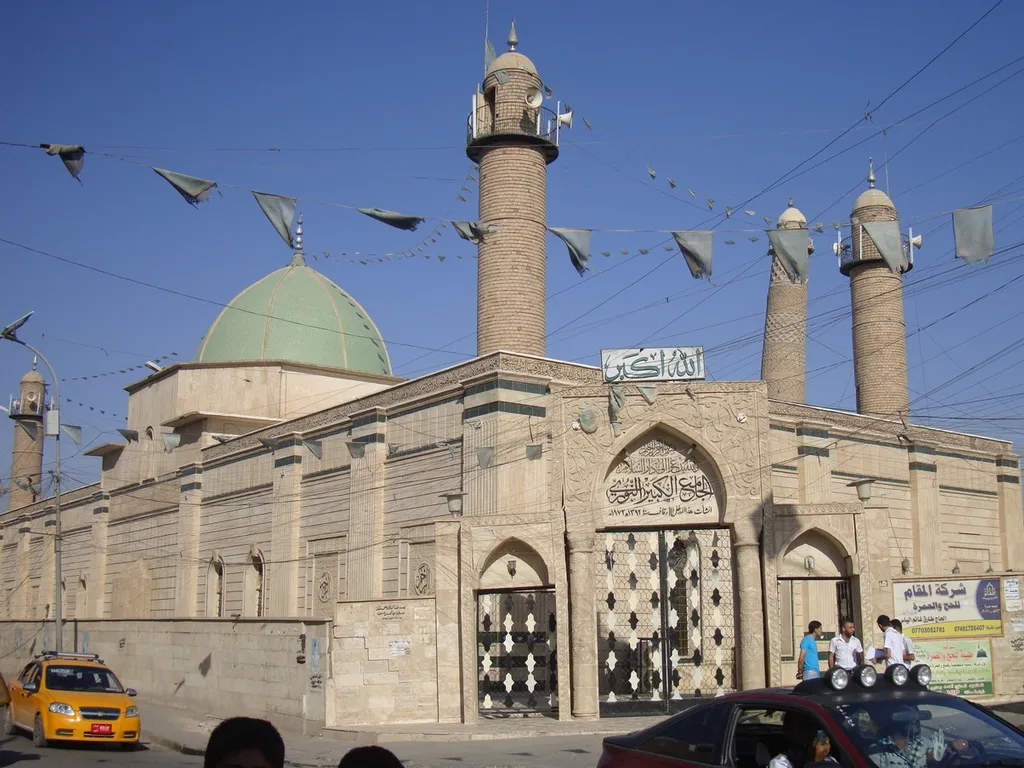
Great Mosque of al-Nuri
The Heart of the Old City
Nestled in the labyrinthine alleys of Mosul's ancient Old City, on the western bank of the Tigris River in Iraq's Nineveh Governorate, the Great Mosque of al-Nuri stands as the city's most beloved landmark. For nearly nine centuries, its graceful silhouette has anchored the Mosul skyline, drawing worshippers and wanderers alike into its sacred courtyard. Known in Arabic as Jāmiʿ an-Nūrī al-Kabīr, the mosque sits at the geographic and spiritual core of Mosul — Iraq's second-largest city and one of the oldest continuously inhabited places on earth. The winding streets around it are still lined with Ottoman-era stonework, traditional craft workshops, and the hum of a city slowly, triumphantly reclaiming its past.
Today, fully restored and officially reopened on 1 September 2025, the mosque invites travelers from around the world to witness one of the most remarkable stories of heritage revival in the modern era — a story of destruction, defiance, and extraordinary human determination.
Born in the Age of Nur ad-Din
The mosque's story begins in 1172–1173 CE, when Nur ad-Din Mahmud ibn Zangi, the formidable Zengid atabeg who ruled from Mosul to Aleppo, commissioned its construction near the end of his reign. Named al-Nuri in his honor, the complex originally featured a prayer hall, a madrasa, and a soaring minaret — three pillars of Islamic civic life woven into a single architectural vision. According to the medieval historian Ibn al-Athir, Nur ad-Din personally inspected the site, climbed a neighboring rooftop to survey the land, and insisted that every shop and home needed for the project be purchased fairly, with no coercion.
The prayer hall was supported by 40 elegant octagonal columns of Moslawi marble, crowned by alabaster arches that bathed the interior in filtered, serene light. A mihrab transferred from the even older Umayyad Mosque of Mosul — dating to 956 CE — was placed within the qibla wall, linking the new mosque to a still deeper vein of Islamic heritage. Through Timurid, Ottoman, and modern Iraqi periods, renovations followed one another, each era leaving its mark while preserving the spirit of Nur ad-Din's original vision.
Al-Hadba: The Hunchback of Mosul
No feature of the mosque is more iconic than its minaret, al-Hadba — Arabic for "the hunchback." Rising 45 meters into the Mosul sky, it was built in 1172 CE and adorned with seven tiers of ornamental brickwork in intricate geometric and floral patterns, a hallmark of Zengid-era Islamic artistry. Over the centuries, the minaret developed a pronounced lean — nearly three meters off vertical — that gave it an endearing, almost human quality. Moslawis came to treasure this tilt as an expression of their city's own resilient, unbowed character, earning Mosul the proud nickname: "the hunchback city."
The cause of the lean has long been debated: some attribute it to prevailing desert winds, while local officials have pointed to the differential thermal expansion of sun-facing bricks across the seasons. Whatever the reason, al-Hadba became inseparable from Mosul's soul. For centuries, the call to prayer rang out from its tilted heights, greeting every dawn over the silver ribbon of the Tigris below.
Destruction, Defiance, and Rebirth
In June 2014, when ISIS militants swept into Mosul, the mosque became the stage for one of the most disturbing scenes in modern history: from its pulpit, ISIS leader Abu Bakr al-Baghdadi declared a so-called caliphate. Yet even in those darkest days, the people of Mosul formed human chains around the mosque to protect it from desecration — an act of extraordinary collective courage. Three years later, as Iraqi forces advanced to liberate the city, ISIS detonated explosives inside the mosque, bringing down both the prayer hall and the beloved al-Hadba minaret in a calculated act of cultural erasure. The world watched in disbelief as nearly 850 years of living history collapsed into rubble.
The response was equally historic in its scope. In 2018, UNESCO, the United Arab Emirates, and the Government of Iraq signed a landmark agreement to restore the Great Mosque and its minaret as the flagship project of the Revive the Spirit of Mosul initiative. Over USD 115 million was mobilized globally. Engineers removed 115 explosive devices from the site before a single brick could be laid. Archaeologists sifted through rubble to recover original materials — more than 45,000 original bricks from al-Hadba were painstakingly catalogued and reintegrated into the reconstruction. An Egyptian architectural team, selected from among 123 international entries, led the rebuilding effort in close collaboration with local experts and the University of Mosul.
On 13 November 2024, an Iraqi flag was raised atop the newly completed minaret, marking the end of the construction phase. On 1 September 2025, Iraqi Prime Minister Mohammed Shia al-Sudani presided over the official reopening ceremony alongside UNESCO and UAE dignitaries — a celebration that moved an entire nation to tears of pride.
Wonders Beneath the Surface
The reconstruction brought surprises that even history had forgotten. During excavations beneath the prayer hall in August 2021, archaeologists uncovered four stone-and-plaster rooms dating to the 12th century — almost certainly the original ablution chambers of Nur ad-Din's mosque. These rooms had never appeared in any historical record, lying buried and untouched for 800 years. Today, they are preserved beneath a glass-panel floor in the prayer hall, allowing visitors to peer directly into the medieval foundations of the mosque — a breathtaking encounter between the living present and the deep, unbroken past.
Visiting the Great Mosque of al-Nuri
The Great Mosque of al-Nuri is open to visitors and worshippers in Mosul's Old City, easily reached from the city center via the main arteries leading to the historic western bank of the Tigris. The surrounding area is rich with additional wonders: the reconstructed Al-Tahera Church and Al-Saa'a Convent are just steps away, together telling the full story of Mosul's long tradition of interfaith coexistence. The best time to visit is during the cooler months of October through March, when Mosul's afternoons are mild and the old city's stone-paved streets are most welcoming. Respectful dress is required; non-Muslim visitors are warmly welcomed outside of prayer times. Whether you come for spiritual reflection, architectural wonder, or the sheer power of a story of survival — the Great Mosque of al-Nuri will leave you transformed.
The Al-Hadba Minaret
Built in 1172 CE and rising 45 meters with seven tiers of ornate geometric brickwork, al-Hadba's distinctive lean earned Mosul its beloved nickname: "the hunchback city." Painstakingly rebuilt using over 45,000 original catalogued bricks, it once again dominates the Mosul skyline, crowned by a gleaming copper crescent.
Nur ad-Din's Legacy
Commissioned by the great Zengid ruler Nur ad-Din Zangi, the mosque blends Zengid patronage with Seljuk architectural traditions in a design of enduring elegance. Its marble prayer hall, supported by 40 octagonal Moslawi columns, still contains a mihrab transferred from Mosul's even older Umayyad Mosque — dating back to 956 CE.
A 12th-Century Discovery
During reconstruction excavations in 2021, archaeologists discovered four stone-and-plaster rooms buried beneath the prayer hall — Nur ad-Din's original ablution chambers, hidden for 800 years and unrecorded in any historical source. Visible today through a glass floor panel, they offer an unparalleled window into medieval Islamic life.
A Symbol of Resilience
When ISIS attempted to use the mosque as a symbol of its caliphate in 2014, Moslawis formed human chains to protect it. Three years later, militants destroyed it on their retreat. Iraqi Prime Minister al-Abadi called the act a "declaration of defeat" — and the mosque's eventual rebirth proved him right, becoming a global symbol of cultural resilience.
UNESCO's Revive Mosul Initiative
Backed by USD 50.4 million from the UAE and overseen by UNESCO, the mosque's reconstruction stands as a landmark model for post-war heritage recovery. Over 115 explosive devices were removed before work began, and the project mobilized more than USD 115 million in total — rebuilding not just walls, but an entire city's sense of identity and hope.