

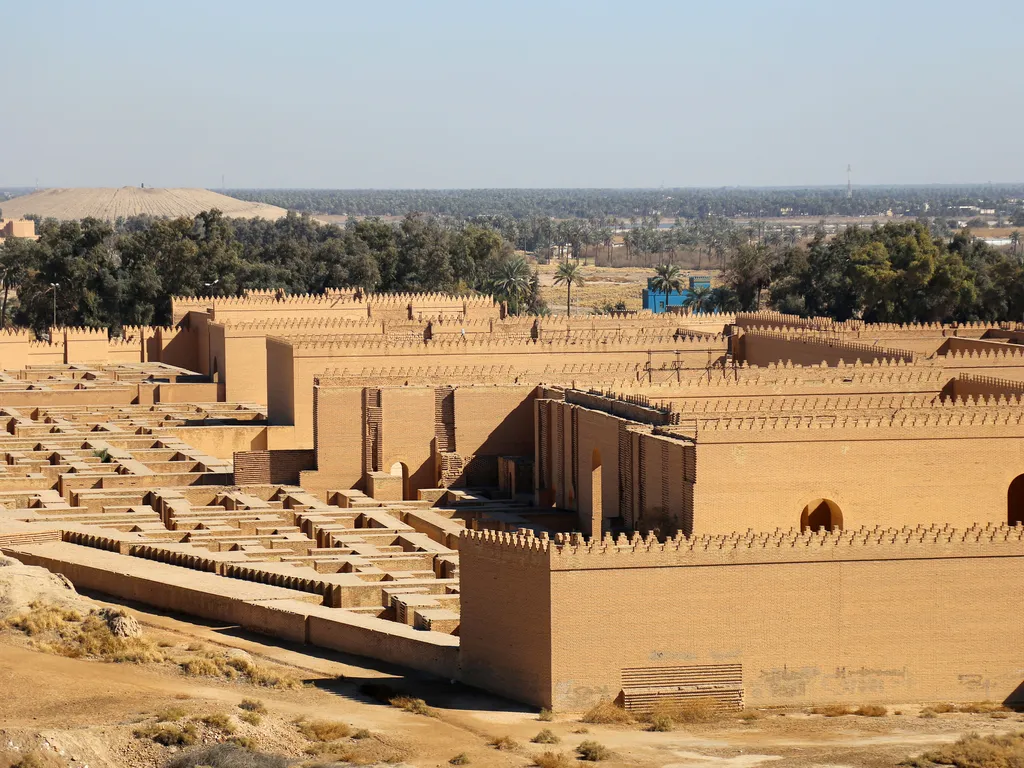
The Hanging Gardens of Babylon
Location & Overview
Near the modern city of Hillah in Babil Governorate, crumbling mounds of ancient mudbrick rise from Iraq's flat, sun-baked plains — the remains of one of the most legendary cities ever built. Babylon, whose name means "Gate of the Gods," was once the largest city on Earth and the dazzling capital of the Neo-Babylonian Empire between the seventh and fifth centuries BC. And it was here, rising improbably above the desert plain, that the Hanging Gardens were said to have bloomed — a paradise so magnificent it earned eternal fame as one of the Seven Wonders of the Ancient World.
The archaeological site of Babylon lies 85 kilometres south of Baghdad, on the banks of the timeless Euphrates River. In 2019, after more than three decades of Iraqi lobbying efforts, UNESCO inscribed Babylon as a World Heritage Site, cementing its status as a treasure belonging not just to Iraq, but to all of humanity.
A King's Gift to His Queen
Legend holds that King Nebuchadnezzar II — who ruled from 605 to 562 BC and built Babylon into the mightiest empire of its age — constructed the gardens as a lavish gift for his wife, Queen Amytis of Media. Far from her native land of green hills and cool valleys, the queen grew homesick in the flat, arid heat of Mesopotamia. And so the king commanded that a mountain be built from stone and brick, cascading with every tree, flowering vine, and fragrant shrub he could gather from across the known world.
Ancient sources describe the gardens as a breathtaking series of ascending terraced platforms, each dense with lush vegetation, rising like a great green mountain above the city's rooftops. Water was lifted from the Euphrates through an ingenious irrigation system — perhaps using a device resembling the Archimedes' screw, centuries before Archimedes himself — to keep the plants perpetually green and alive. Greek historian Diodorus Siculus recorded that the gardens stretched some 400 feet wide by 400 feet long and soared nearly 80 feet into the sky.
An Engineering Marvel Lost to Time
The Hanging Gardens hold a unique and tantalising distinction: they are the only one of the Seven Wonders of the Ancient World whose existence and precise location remain unconfirmed. Despite thorough excavation of the Babylon site, no definitive physical evidence of the gardens has been uncovered — a mystery that has captivated archaeologists, historians, and dreamers for centuries. Some scholars, such as Oxford researcher Stephanie Dalley, have proposed that the gardens may have actually stood 300 miles north in Nineveh, constructed by the Assyrian king Sennacherib, whose inscriptions describe elaborate water-raising devices and a "wonder for all peoples."
Whether the gardens bloomed in Babylon or Nineveh — or whether they were an elaboration of real wonders witnessed by Alexander the Great's astonished soldiers — the legend endures as humanity's most romantic engineering fantasy. To stand on this ancient soil and imagine cascading green terraces shimmering above the desert is an experience no history book can replicate.
Babylon Today: Walking Through History
Visiting ancient Babylon is a journey into the very foundations of civilisation. It is estimated that over 82 percent of the site remains unexcavated, meaning the tells and mounds beneath your feet still hold secrets waiting to be uncovered. The site receives a growing number of visitors each year — including an increasing wave of international travellers drawn by the site's UNESCO status and Iraq's expanding tourism profile. In 2024, nearly 50,000 visitors made the pilgrimage to Babylon, including over 5,000 from abroad.
What you see today is a fascinating layering of ancient ruin, ambitious reconstruction, and living history. Saddam Hussein's controversial "Revival of Babylon Project" in the 1980s rebuilt sections of the city walls and palace over original archaeological foundations — his personal ambition to cast himself as a modern Nebuchadnezzar. His towering summer palace looms on a hill above the site, an incongruous monument to a more recent chapter of Iraq's turbulent story.
What to See at Babylon
Plan at least one to two hours to explore the site, though history enthusiasts will want longer. The journey begins with the iconic Ishtar Gate reconstruction — a soaring monument of glazed blue tiles adorned with the dragon of Marduk and the bull of Adad, the original of which was removed to the Pergamon Museum in Berlin and remains there despite Iraq's requests for its return. Beyond the gate, the foundations of Nebuchadnezzar's Southern Palace spread across a vast area, where you can trace the outlines of throne rooms and ceremonial halls that once awed ambassadors from across the ancient world.
The Lion of Babylon — a 2,600-year-old black basalt sculpture of a lion standing over a prostrate human figure — is one of Iraq's most powerful symbols and a must-see on any visit. A small on-site museum holds artefacts and interpretive displays, while the site also marks the traditional location of the Tower of Babel, the legendary ziggurat that inspired one of history's most enduring biblical stories.
Visitor Tips
The site is located approximately 3 kilometres from the city of Hillah, about 90 minutes by car from Baghdad. Bring your passport, as it is required for entry. The entrance fee is 25,000 Iraqi dinars. The best times to visit are spring (March to May) and autumn (October to November), when temperatures are pleasant. Wear comfortable walking shoes and bring ample water. Avoid walking over active excavation areas to help preserve this irreplaceable heritage. A knowledgeable local guide is warmly recommended — Babylon rewards those who listen to its stories as much as those who simply walk its paths.
One of the Seven Wonders
The Hanging Gardens of Babylon hold a singular place in history as the only one of the Seven Wonders of the Ancient World whose exact location remains unconfirmed. This enduring mystery transforms a visit to Babylon into something extraordinary — a journey where history and legend intertwine in ways no other archaeological site on Earth can match.
A King's Love Story
Nebuchadnezzar II, one of antiquity's most powerful rulers, is said to have built these extraordinary gardens as a tribute to his homesick queen, Amytis of Media, who longed for the green mountains of her homeland. This deeply human story transforms Babylon from a ruin into a monument to love — proof that the grandest gestures in history are driven by the heart.
UNESCO World Heritage Site
Inscribed on the UNESCO World Heritage List in 2019 after Iraq lobbied for the recognition since 1983, Babylon is officially among the most important cultural sites on Earth. This designation has brought renewed conservation efforts and a surge of global interest in one of Mesopotamia's most magnificent legacies.
The Legendary Ishtar Gate
Visitors are welcomed by a stunning reconstruction of the Ishtar Gate, its deep blue glazed tiles shimmering with dragons and bulls dedicated to the gods of ancient Babylon. The original gate was transported to Berlin's Pergamon Museum over a century ago — making every visit to this site a quiet act of reclaiming an Iraqi heritage that belongs to the world.
The Lion of Babylon
Carved from black basalt over 2,600 years ago and one of Iraq's most iconic national symbols, the Lion of Babylon stands proudly on the ancient site as it has for millennia. A silent sentinel through the rise and fall of empires, the lion is both a profound historical artefact and a striking focal point for any visit to this extraordinary place.