

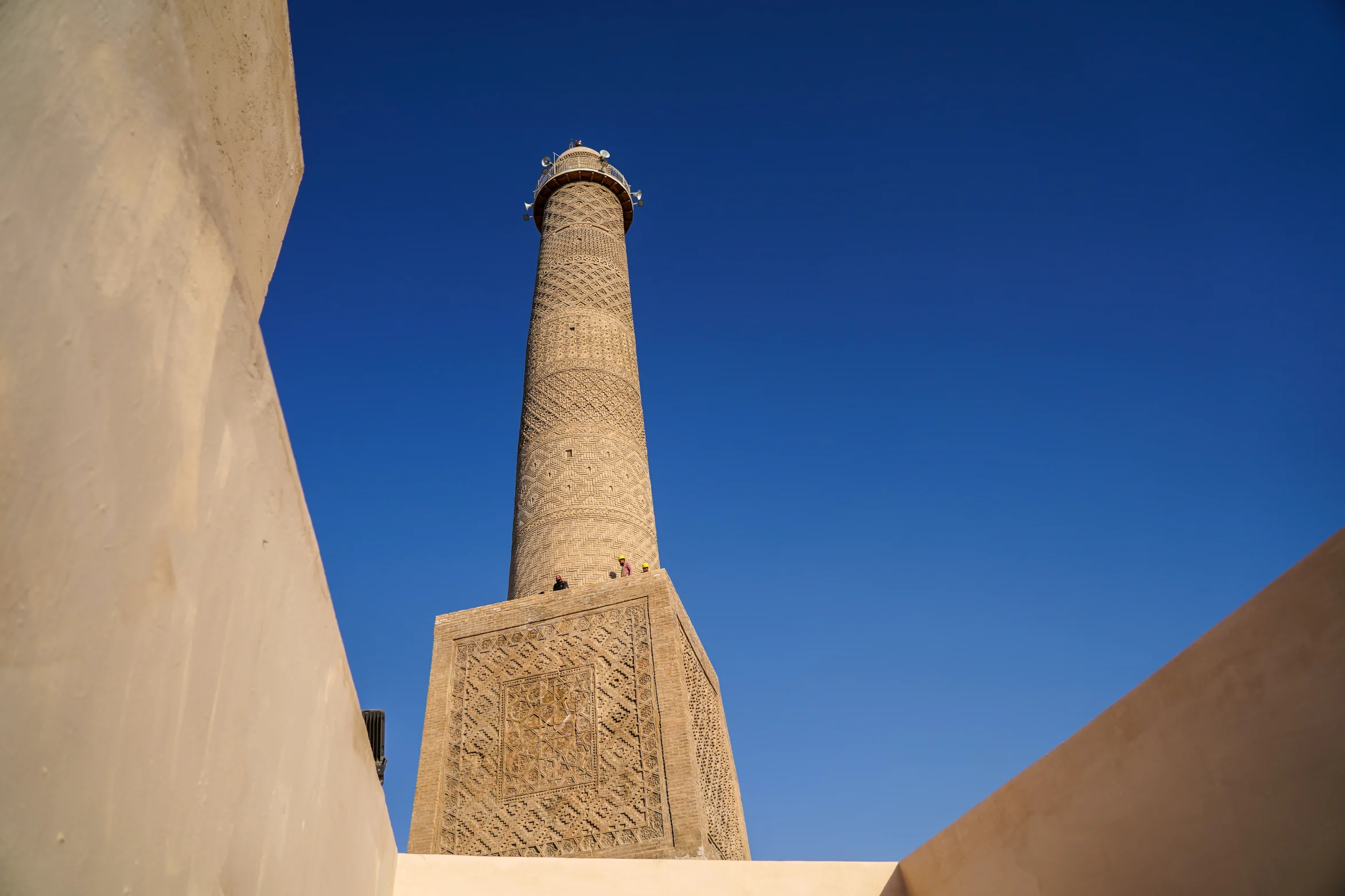
Al Hadbaa Minaret
Overview: The Minaret That Named a City
Towering over the ancient alleyways of Mosul's Old City, Al Hadbaa — the hunchback in Arabic — is one of the most emotionally resonant monuments in all of Iraq. Part of the Great Mosque of al-Nuri complex in the heart of Nineveh Governorate, this 45-metre minaret leans with a grace that has defied both gravity and time. Its distinctive tilt, the product of centuries of natural settling, became so beloved that it gave the city of Mosul its eternal nickname: al-Hadbaa. The minaret's silhouette is printed on Iraq's 10,000-dinar banknote, and its name is synonymous with the city itself. For travellers seeking to connect with Iraq's layered past — and its determined future — this is a destination that commands the soul.
Located in the western part of Mosul within the Old City's Hayy al-Nabijarjis neighbourhood, Al Hadbaa stands at the heart of a historic complex that once included a mosque, a madrassa, and centuries of uninterrupted prayer. It is about 400 kilometres north of Baghdad and 90 minutes by road from Erbil.
A Monument Born in the Seljuk Age
Al Hadbaa was built in 1172 CE on the orders of Nur al-Din Mahmud Zengi, the Seljuk Atabeg celebrated across the Islamic world for his campaigns against the Crusaders. Rising 45 metres into the Mosul sky, its cylindrical shaft was adorned with seven bands of intricately carved brickwork in complex geometric patterns — a masterpiece of Seljuk Islamic architecture that drew on traditions rooted in neighbouring Iran and Central Asia, yet evolved into something uniquely Mesopotamian.
Five times a day, a muezzin would ascend the minaret's internal double-helicoidal staircase and sing the call to prayer from its lofty balcony, a ritual that echoed across the city for nearly a millennium. The Great Mosque of al-Nuri, named after its patron Nur al-Din, stood alongside the minaret as the spiritual heart of Mosul, a sanctuary of worship that endured crusades, invasions, and empires. The minaret was the last surviving original element of the medieval complex, having outlasted centuries of renovation and rebuilding around it.
The Lean That Made It Legend
By the time the great Moroccan explorer Ibn Battuta visited Mosul in the 14th century, the minaret had already begun its famous lean. Rather than unsettle the people of Mosul, the tilt became a source of deep local pride. Locals began calling it al-Hadbaa — the hunchback — an affectionate nickname that stuck for centuries and eventually became synonymous with the city itself.
The lean, which extends the tower approximately 1.6 metres horizontally from its base, gave Al Hadbaa a poetic, almost human quality: it seemed to bow protectively over the city, watching over the generations who had prayed, lived, and dreamed beneath it. The 19th-century traveller Grattan Geary captured it beautifully, writing that the minaret's posture resembled a man bowing. So iconic did it become that its image was pressed onto Iraq's 10,000-dinar banknote, cementing its place not merely as a local landmark but as a national emblem.
Destroyed, Then Reborn
On 21 June 2017, the world watched in horror as Islamic State militants detonated explosives at the base of Al Hadbaa as Iraqi forces moved to liberate Mosul. The destruction of this 850-year-old landmark was a calculated act of cultural erasure. Yet even in that devastating moment, residents of Mosul formed a human chain around the ruins in a defiant act of love — refusing to let the minaret simply disappear into memory.
The recovery that followed is nothing short of extraordinary. UNESCO mobilised $115 million under its Revive the Spirit of Mosul initiative, with major contributions from the United Arab Emirates and the European Union. Active reconstruction began in February 2022, with engineers and local artisans employing traditional brick masonry — a technique that had not been used for centuries — to rebuild the minaret exactly as it once stood, including its iconic lean. Original fragments salvaged from the rubble were reused wherever possible, and the reconstructed shaft extends to the same 1.6-metre horizontal offset as the original. The project required cutting-edge structural engineering combined with centuries-old craftsmanship, and represented an unprecedented feat of post-conflict heritage restoration.
In February 2025, UNESCO Director-General Audrey Azoulay stood at the foot of the restored Al Hadbaa and declared: "This is like history coming back — like the identity of this city coming back." The Great Mosque of al-Nuri officially reopened for worship in September 2025, completing one of the most remarkable chapters in modern heritage recovery.
Visiting Al Hadbaa Today
Al Hadbaa stands in Mosul's Old City in Nineveh Governorate, northern Iraq. The best time to visit is between October and April, when the weather is mild and the city is most alive. The Old City itself is a place of living history — narrow bazaars, Ottoman-era houses, and the sound of a city joyfully rediscovering itself. Visitors can walk through the restored mosque complex, examine the extraordinary craftsmanship of the reconstruction up close, and explore nearby sites including the al-Tahira and al-Sa'aa churches, also restored by UNESCO as part of the same initiative.
Mosul is accessible by road from Erbil (approximately 90 minutes) and from Baghdad (approximately 5–6 hours). As tourism infrastructure continues to develop across the city, this is a profound moment to witness Mosul's renaissance firsthand — and to stand beneath the lean of Al Hadbaa, which bows once more over its ancient city, resilient and irreplaceable.
The Legendary Lean
Al Hadbaa's famous tilt sets it apart from every other minaret in the Islamic world. Beginning in the 14th century, the tower shifted approximately 1.6 metres horizontally from its base — an organic, centuries-long lean that locals came to cherish as part of the minaret's identity. It inspired the city's enduring nickname, gave Mosul its soul, and made Al Hadbaa instantly recognisable to every Iraqi, whether they had visited or not.
Seljuk Masterpiece
Built in 1172 CE by the Seljuk Atabeg Nur al-Din Zengi, Al Hadbaa is a jewel of medieval Islamic architecture. Its 45-metre cylindrical shaft rises from a square base and is encircled by seven bands of carved geometric brickwork of extraordinary intricacy. The minaret's internal double-helicoidal staircase, which once carried the muezzin to his daily call to prayer, stands as a feat of engineering that was ahead of its time.
Icon of a Nation
Few architectural landmarks in the world have the distinction of appearing on a nation's currency — Al Hadbaa is one of them. Its silhouette has graced Iraq's 10,000-dinar banknote since 2003, a recognition of its unmatched cultural and symbolic importance. The minaret gave Mosul its Arabic nickname, al-Hadbaa, and its image evokes Iraqi identity as powerfully as any flag or anthem.
Reborn from Ruins
Destroyed by ISIS in June 2017 after 850 years of standing, Al Hadbaa was rebuilt in one of the most complex heritage restoration projects ever undertaken. UNESCO led the effort with $115 million in international funding, using traditional brick masonry and salvaged original fragments to reconstruct the minaret — lean and all — to its exact original form. Completed in February 2025, it is a monument to what determined human hands can achieve.
Gateway to Mosul's Old City
Visiting Al Hadbaa means stepping into the labyrinth of one of Iraq's oldest and most storied cities. The surrounding Old City offers Ottoman-era architecture, traditional bazaars, and nearby restored sites including the al-Tahira and al-Sa'aa churches. Mosul's multi-faith, multi-cultural heritage is on vivid display here — making Al Hadbaa not just a minaret, but a gateway to one of the world's most compelling urban histories.